
Conway's Game of Life is not much of a game. You set up a grid, apply four rules, and watch. Nobody plays a turn after the start. The lesson is about intuition, and about how often it fails when simple rules pile up over many steps.
What the Grid Demands
John H. Conway's Game of Life is a two-dimensional cellular automaton. It reached a wide audience in October 1970, when Martin Gardner described it in his Scientific American column. MathWorld's entry on the Game of Life covers the history and the pattern catalog.
A cellular automaton is a discrete, abstract computing system. Its cells update in parallel at fixed time steps. Each cell looks only at its local neighborhood, never at the whole grid. In Life, every cell is either alive or dead. The game was first played by hand with counters. Computers later made it far easier to explore patterns, and a hand-run generation of a large pattern is slow enough that you start to see why.
The Four Rules
A cell's next state depends on its own state and its eight surrounding neighbors. That ring of eight is called the Moore neighborhood. There is no central authority, only the neighbor count.
- A live cell with fewer than two live neighbors dies (underpopulation).
- A live cell with more than three live neighbors dies (overpopulation).
- A live cell with two or three live neighbors stays alive.
- A dead cell with exactly three live neighbors becomes alive.
Every other cell keeps its state. The person running the game chooses only the starting pattern. After that, the rules do all the work, and a wide variety of patterns can arise from that one choice.
Try this on paper. Mark three live cells in a horizontal row. The middle cell has two live neighbors, so it survives. Each end cell has only one, so both die. The cells directly above and below the middle each have exactly three live neighbors, so both are born. After one generation you have a vertical row of three. Apply the rules again and it flips back to horizontal. That is the blinker, and it takes about two minutes to confirm by hand.
Still Lifes, Oscillators and Gliders
Some patterns settle. A still life does not change from one generation to the next. It has period 1. The block is the simplest case: four cells in a square, each with exactly three live neighbors. Oscillators, like the blinker, cycle through a set of configurations. Other patterns travel, and a glider is the best known. Its individual cells change, yet the shape keeps moving across the grid.
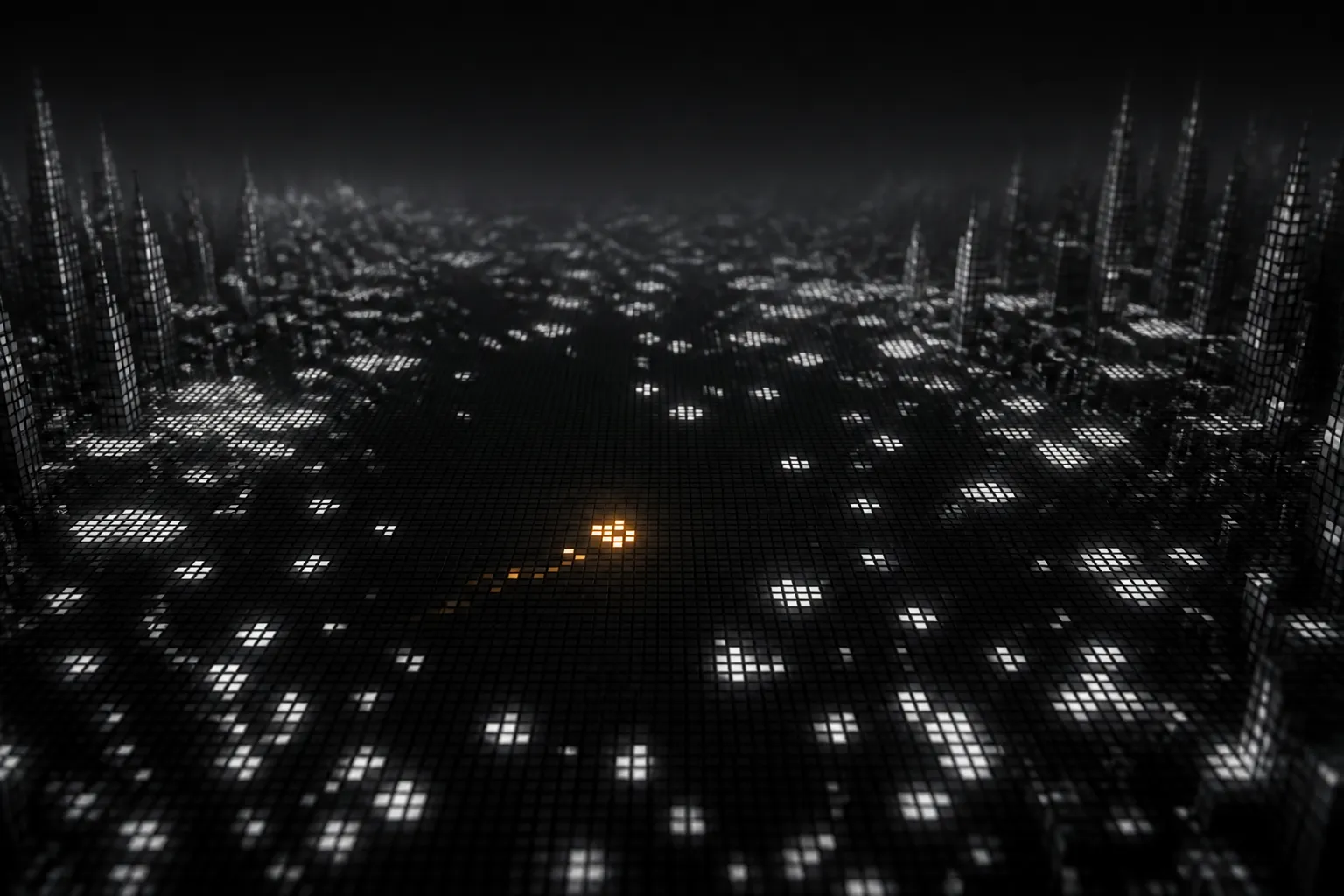

These patterns are not programmed in. They fall out of the rules. That raises a question researchers still discuss. Are such emergent patterns real features of the system? One view says yes, because a glider can be tracked and predicted as a thing in its own right. The other view says they are only the rules working themselves out, and that nothing exists beyond the cell states. The sources here only preview that debate, so it is better to hold the question open than to claim an answer.
What a Grid Can Compute
Life is possibly the most popular cellular automaton, and it is studied for its computational abilities. With suitable rules, cellular automata can emulate a universal Turing machine. Given Turing's thesis, that means they can compute anything computable. A grid of trivial cells, with no gears and no wires, can in principle do the work of a general computer. Simple local rules on simple cells can yield complex behavior, which is why researchers in both cognitive and natural sciences study them.
Where Intuition Failed Conway
Conway himself guessed wrong. He believed no pattern could produce an infinite number of cells. He offered a $50 prize for a counterexample before the end of 1970. Patterns known as guns and puffer trains later showed that growth without limit is possible from a finite start. The sources do not say who found the first one or exactly when.
The practical lesson is to test instead of guessing. Two questions help whenever someone makes a claim about a pattern.
- Which initial pattern is being tested, and how many generations has it been run? Ten steps tell you little about ten thousand.
- Is it a still life, an oscillator, or something that grows? Each answer predicts very different long-run behavior.
Conway had good reasons for his guess, and it still lost. Run the pattern, count the generations, and write down what you see before you trust a hunch. Start with the blinker above, then try a pattern you cannot predict. The gap between your guess and the result is the point.
Sources
Siobhan O'Reilly investigates the friction between urban decay and digital expansion for Deeperpectives. She spent a decade reporting from transit hubs and temporary settlements across the rust belt. Her work prioritizes the raw data of lived experience over polished corporate narratives.