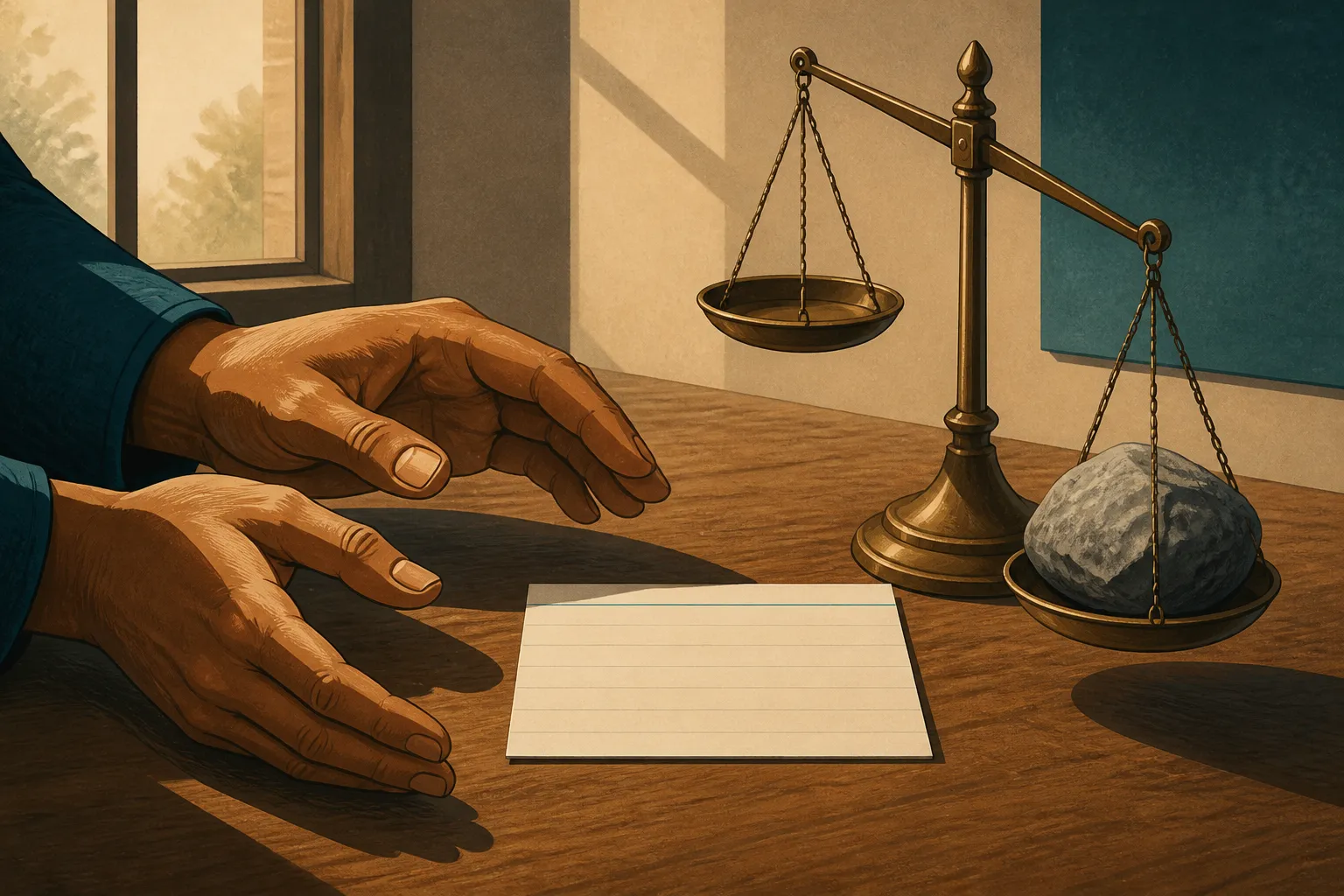
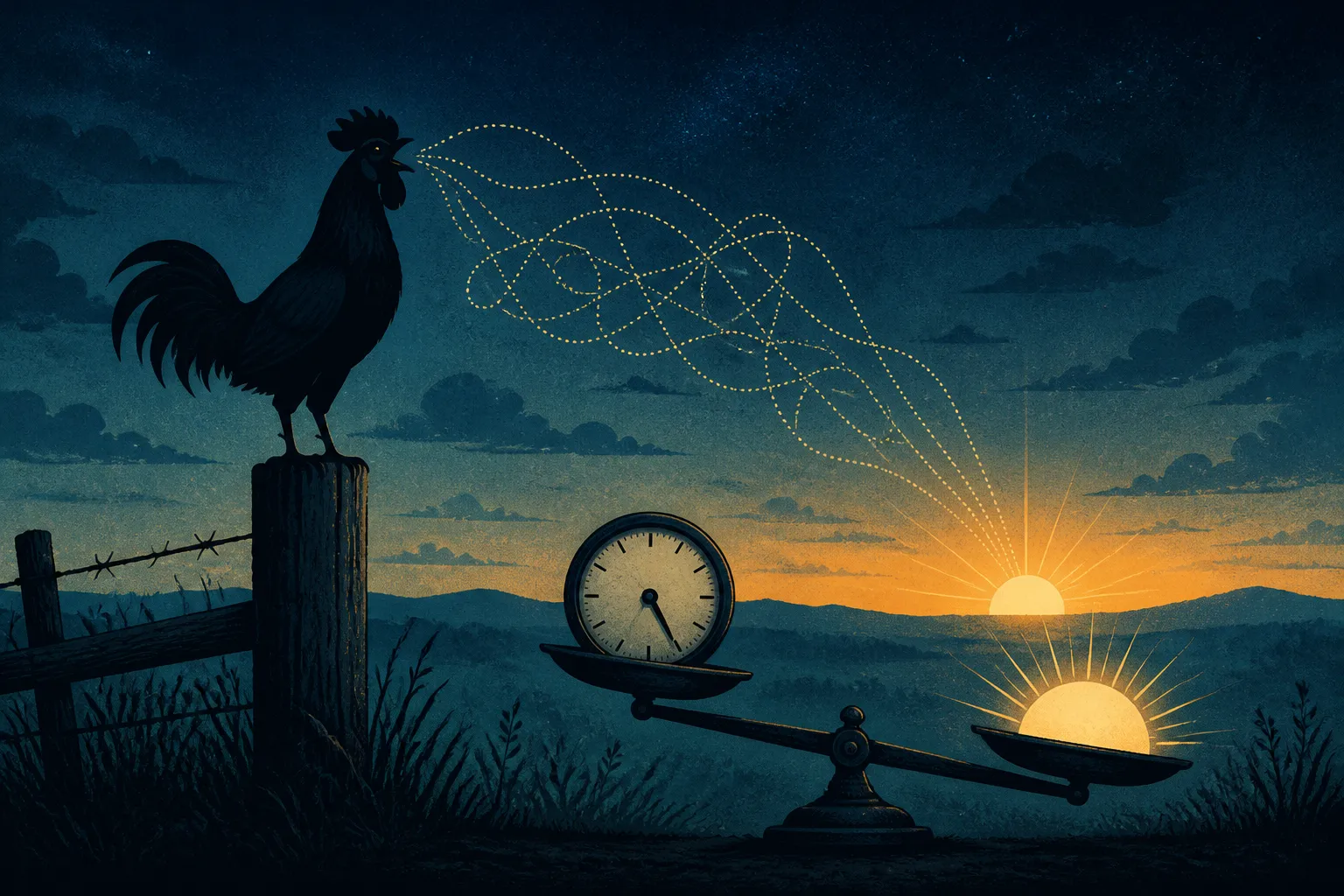
A rooster crows in the dark. Some minutes later the sun comes up. Anyone who watched this every morning for a year could be forgiven for giving the bird some credit. The old Latin name for that mistake is post hoc, ergo propter hoc. It is worth a slow look, because the error is small, tidy and very easy to commit.
What the Latin Means and Where the Fallacy Begins
The phrase translates roughly as "after this, therefore because of this." The Legal Information Institute's Wex entry describes it as the fallacy of assuming one thing caused another merely because it came first. It draws a causal conclusion from a temporal fact.
The temporal fact is not worthless. Causes do tend to come before their effects. A match is struck, then the flame appears. So order in time is a fair clue. The fallacy starts at the moment the clue is promoted to proof. The inquiry stops one step early.
The Classic Examples, From Roosters to Muppets
The standard illustration is the rooster. The crow comes before sunrise, so the bird is assumed to summon the sun. The American Bankruptcy Institute uses it and calls the pattern questionable causation: since event Y followed event X, Y must have been caused by X. Silence the rooster and the sun would still rise. That is the quickest way to see the flaw.
The Wex entry offers a plainer case. A dog barks just before the power goes out, and the bark gets the blame for the outage. The ABI piece adds Ernie of Sesame Street, who concludes that the banana in his ear keeps alligators away. There are no alligators in the room, which he takes as proof. In each story the order is real. The cause is unsupported.

Why Sequence Alone Proves Nothing
A sequence tells you only that one thing came before another. It does not say whether the first thing pushed the second. The shape of the argument is the weak point: X happens, Y follows, so X caused Y. Nothing in it checks whether X could plausibly produce Y. Nothing in it asks whether the pattern holds up on a second look.
Many events line up in time with no link at all. Some are linked, but only because a third factor sits behind both. That is a common cause, and it is a separate idea from the fallacy itself. The sources do not discuss it, but it is a standard reason a pattern can mislead. A related error, called cum hoc, ergo propter hoc, treats two things happening together as proof that one caused the other. Post hoc leans on order. Cum hoc leans on coincidence in time.
Testing a Suspected Cause
The two main sources do not lay out a testing method, so what follows is general practice in careful reasoning, not their advice. Five checks cover most cases.
- Look for a mechanism. Ask how X could physically produce Y.
- Look for a common cause that could produce both events.
- Check whether Y happens without X.
- Check whether Y fails to happen when X is removed.
- Look for repeated observations, not one striking case.
Here is a worked example. Suppose you wash your car on 10 Saturdays and it rains the next day on 7 of them. That feels like a curse. Now check how often it rains on Sundays when you did not wash the car. If it rained on 7 of 10 of those Sundays too, the washing adds nothing. The rain was likely just the season. If it rained on only 1 of 10, the pattern is stranger and deserves a closer look, though even then a mechanism would still be missing.
The dog and the power outage work the same way. Count the nights the dog barked and the lights stayed on. Count the outages that came with a silent dog. One tidy pairing proves little. A long record of both kinds of night proves much more.
The Fallacy in Legal Writing
The error also appears in legal commentary. The ABI article points to Huss v. Gayden, 571 F.3d 442 (5th Cir. 2009). That case cites the Eleventh Circuit's explanation and avoidance of the reasoning in McClain v. Metabolife International, Inc., 401 F.3d 1233, 1243 (11th Cir. 2005).
The source text stops before it describes what either court held, so the details of how they applied the idea are not covered here. The citations still show something useful. Courts and commentators treat this reasoning as a named, recognizable fault, not a parlor quibble. Anyone who needs the actual holdings should read the full opinions.
A Habit Worth Keeping
The next time a neat pairing catches your eye, slow down. Order is a clue. It is where an investigation starts, not where it ends. The rooster gets credit every morning, and the sun never notices.
Sources
Marcus Adeyemi-Holt is a house writer for Deeperpectives, where he examines how ordinary routines reveal larger patterns in work, memory, and place. He draws on years of reporting on municipal records and oral histories to trace the quiet forces that shape everyday life.