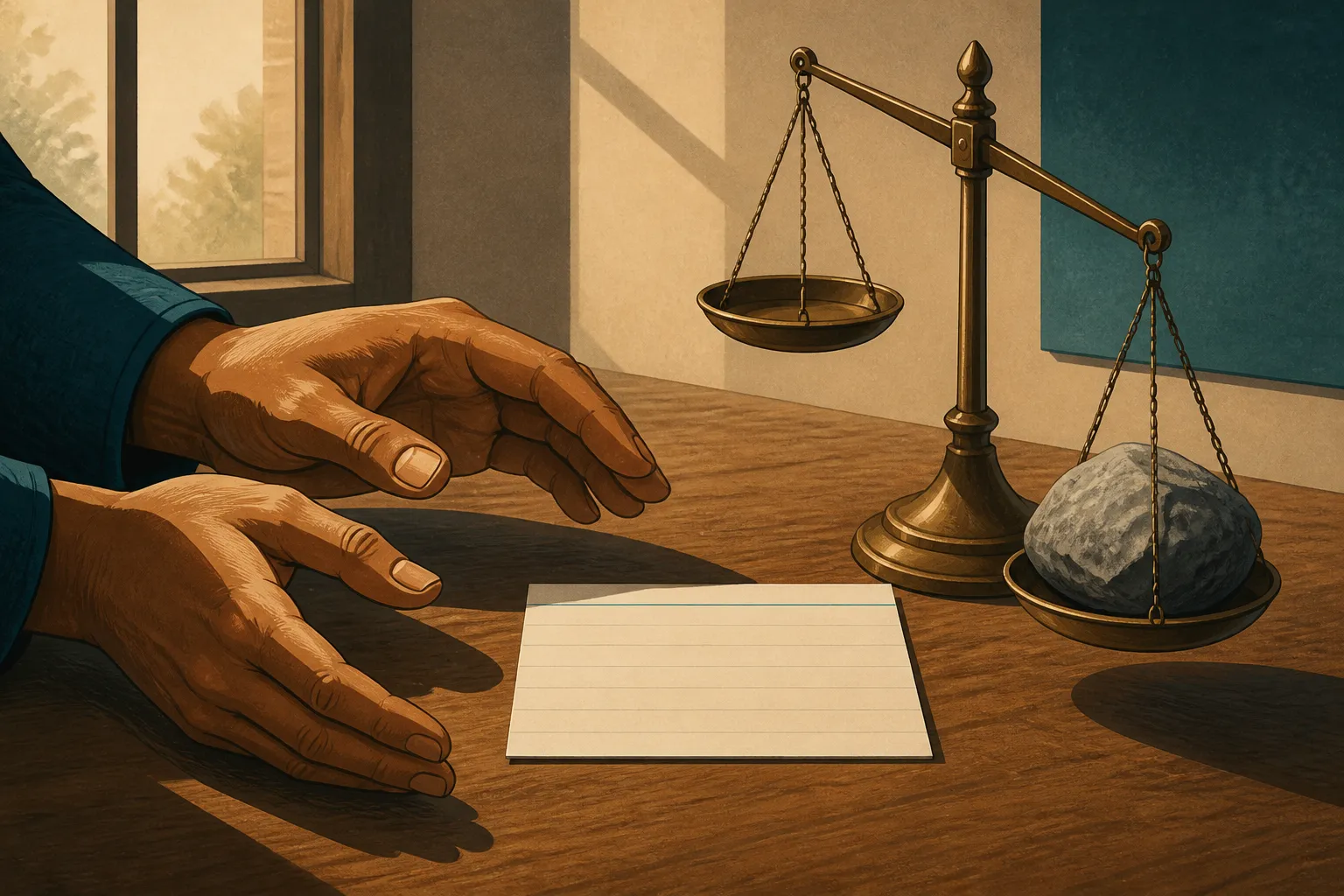
Write the question on an index card: Could an all-powerful being make a stone so heavy that it could not lift it? The sentence gives the hand two jobs, making and lifting, then asks whether any power can complete both. Say yes, and the being seems unable to lift what it made. Say no, and it seems unable to make the stone. The card keeps both answers in view, like a small record with a contradiction filed under its name.

The puzzle in its simplest form
The paradox does not need a real stone, a scale, or a theory of gravity. Its pressure comes from the wording. It appears to offer two options, each with a cost: either the being lacks the power to lift a certain object, or it lacks the power to create one. If omnipotence means having every power, both answers look like evidence against it.
That appearance is the point. Omnipotence paradoxes are meant to test whether the idea of unlimited power can be stated coherently. If the definition contains a contradiction, then the problem may be with the idea itself, rather than with any particular account of a god. Defenders of omnipotence dispute that conclusion, but they have to explain what the question gets wrong.
It helps to keep the scope narrow. The stone puzzle is not a test of whether a particular religious tradition is true. It asks what follows from a description: an agent can do everything. The word everything sounds complete, yet the stone question makes two demands collide inside it. Before deciding which demand wins, we have to ask what “can do everything” is supposed to cover.
Define the power before testing it
In traditional Western theism, God is commonly understood as omnipotent because maximal greatness includes maximal power. That familiar starting point does not, by itself, settle what maximal power permits. One account treats omnipotence as the ability to perform any task. On a literal version, the list might include tasks such as making 2 + 2 equal 4 or bringing about one’s own death. Those examples reveal how quickly “any task” can include descriptions that may not make sense as possible tasks at all.
A different approach defines omnipotence in terms of possible states of affairs: an omnipotent being can bring about any state of affairs that is possible. That small qualification, possible, does substantial work. It asks us to distinguish a genuine task from a string of words that sounds like one. The Stanford Encyclopedia of Philosophy’s discussion of omnipotence lays out the importance of these competing definitions.
The answer to the stone question depends on which definition is in play. If power means completing every description that can be phrased as a task, the paradox presses hard. If power concerns possible states of affairs, the next question is whether a stone that its maker cannot lift is possible in the relevant sense. The definition is not a footnote to the puzzle. It is the floor the puzzle stands on.
Where the proposed answers draw a line
One common reply says omnipotence does not include the ability to break the laws of logic. On this view, a being’s inability to create a logically impossible object is no more a failure of power than an inability to make a square circle. The claim is not that a physical law blocks the being. It is that the requested object never becomes a coherent object for power to act upon.
Aquinas gives a related account: omnipotence concerns all things that are absolutely possible. Something is absolutely impossible when its description makes its predicate incompatible with its subject. A man who is a donkey is his example of a description that defeats itself. Applied to the stone, this response asks whether “a stone that an omnipotent being cannot lift” is similarly self-defeating. If it is, not making it is not a missing ability.
Other replies challenge the question’s form. One calls it sophistry, a verbal trap that produces no meaningful task. Another points to a hidden assumption: the question moves from creating the stone to lifting it, as if the stone has already been created and stands there awaiting a test. Rejecting that assumption may help, but it does not automatically explain why the proposed object is impossible.
A further possibility is that the snag belongs to human language. Perhaps our sentence combines ideas in a way that cannot describe what a limitless being is like. This shifts attention from the being to the description. It also leaves a difficult question on the table: how can we tell the difference between a genuine limit in the world and a limit in the words we use to describe it?
The objection inside the escape
Each answer draws a boundary, and critics can ask whether that boundary has already conceded too much. If logic is something an omnipotent being cannot exceed, then the being seems bound by a rule. A defender may reply that logic is not an outside force restraining power; it marks what counts as a coherent possibility in the first place. The disagreement is less about the stone’s weight than about whether logical impossibility belongs on a list of things anyone could do.
The “no” answer makes this point directly. Saying that God cannot create an unliftable stone need not mean that God faces a physical obstacle. It can mean that no such stone belongs to the set of possible stones. The being is not limited by the laws of physics, but the description may still fail to name a possible object. That is a careful distinction, not a final agreement. Someone who defines power as the ability to perform any stated task may ask why the definition should exclude this one.
Calling the puzzle meaningless also needs more than a label. If the question is only a trick, the answer should show where its wording stops referring to a possible task. Otherwise “sophistry” risks functioning as a door closed before the inquiry has reached the room. The opposing concern is equally serious: treating every grammatically formed request as a real task makes power answerable to contradictions as if they were objects.
Both sides start with the same sentence and disagree about what its terms allow. That is why the debate persists. One side sees logical consistency as part of what power can mean. Another worries that this gives logic the final say over a being described as unlimited. Neither concern disappears simply by repeating the word “omnipotent.”
Carry the question to neighboring cases
The stone is one file in a larger cabinet of puzzles. Could an omnipotent agent overturn logical or mathematical truths? Could it alter the past? Could two omnipotent agents coexist if each could prevent the other from acting? These questions change the object, but preserve the same test: does a phrase describe a possible state of affairs, or does it combine claims that cannot all hold together?
When weighing an answer, three checks keep the discussion grounded:
- Which definition of omnipotence is being used? Does it mean any task whatsoever, or any possible state of affairs?
- What role does logic play? Is it a limit on what the being can do, or a way to identify what a task could be?
- Does the answer address the objection? An appeal to theology alone may leave the logical structure of the question untouched.
These checks do not produce a verdict by themselves. They show where a proposed answer places its weight. The overview of the paradox and the discussion of the stone question present several familiar moves, though no single resolution commands agreement.
Return to the index card. The sentence has not become easier, but its parts are easier to see: a definition of power, an assumption about possibility, and a judgment about whether logic binds the task. The stone may be imaginary; the distinctions it exposes are not. What can a power do, and what can a description coherently ask it to do? The question remains useful because those are not always the same thing.
Sources
An exceptional writer at Deeperpectives, she covers public memory, family archives, and the histories held in ordinary objects. Before joining the desk, she cataloged oral histories for a neighborhood museum, where she learned to treat a small detail as a door, not a conclusion.