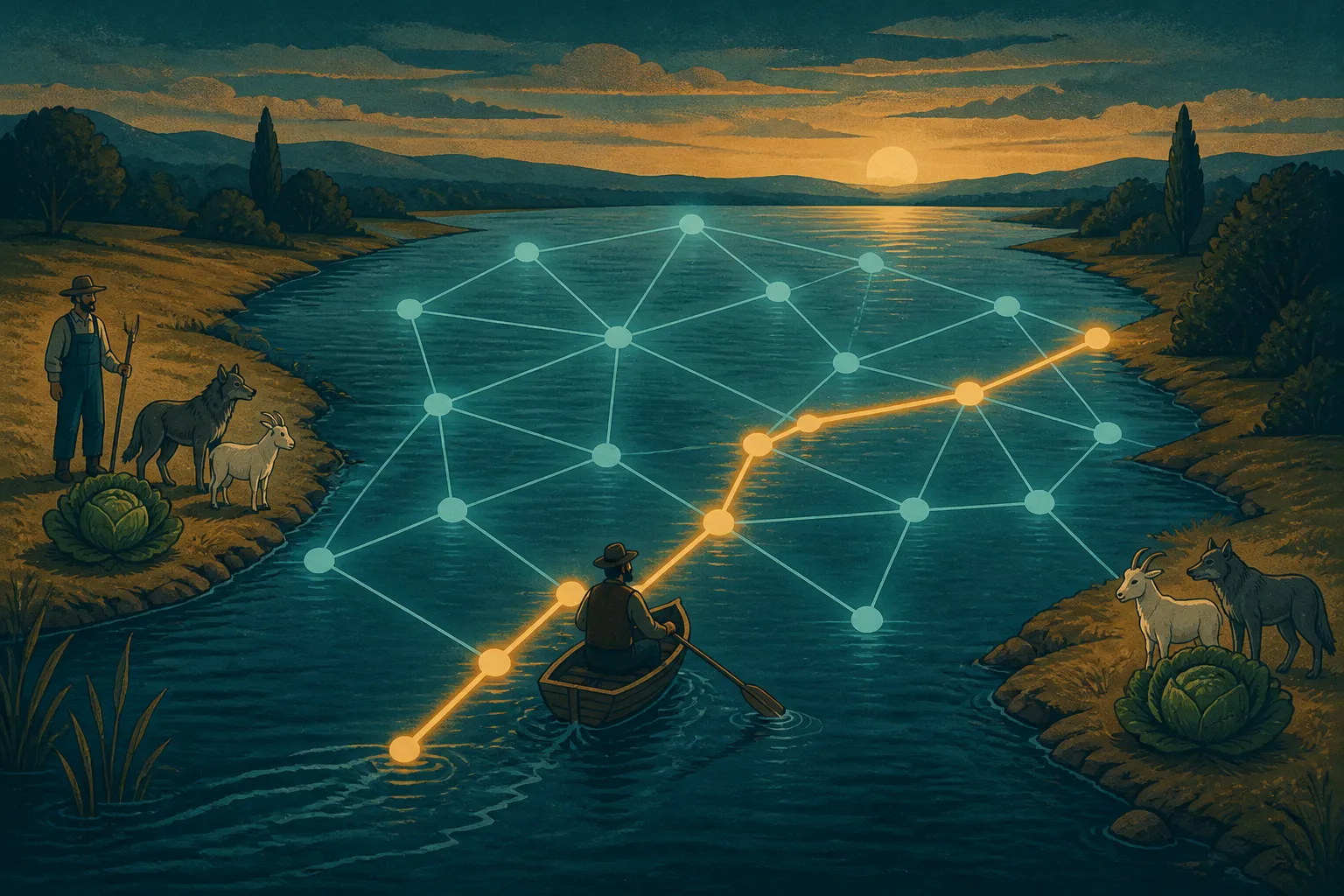
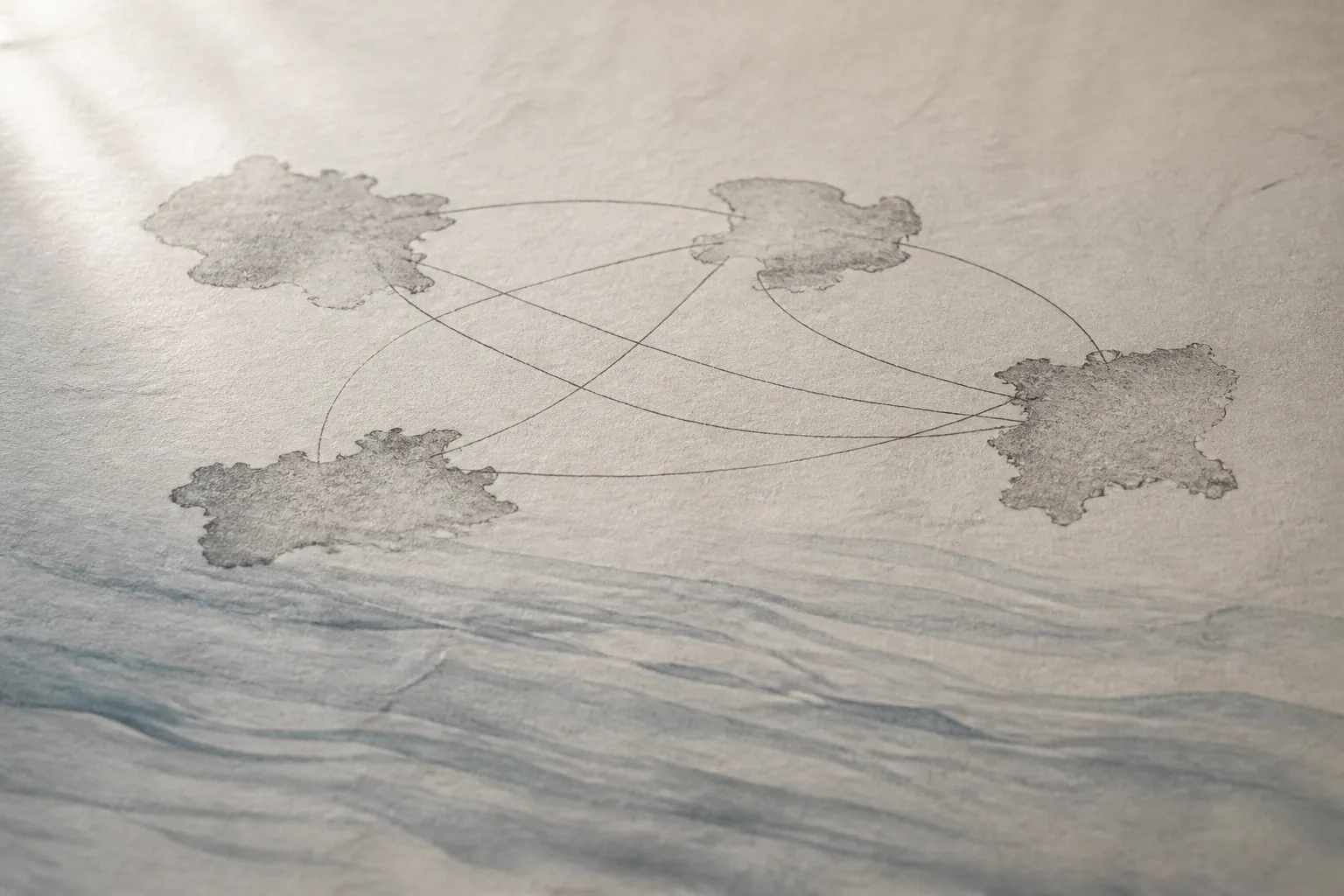
Draw four patches of land, then connect them with seven lines. Now try to trace every line once, without lifting your pencil, and finish where you began. The puzzle is easy to carry in your head and stubborn on the page. One crossing too many, one left behind, and the route falls apart.
Act I: The Question That Started It
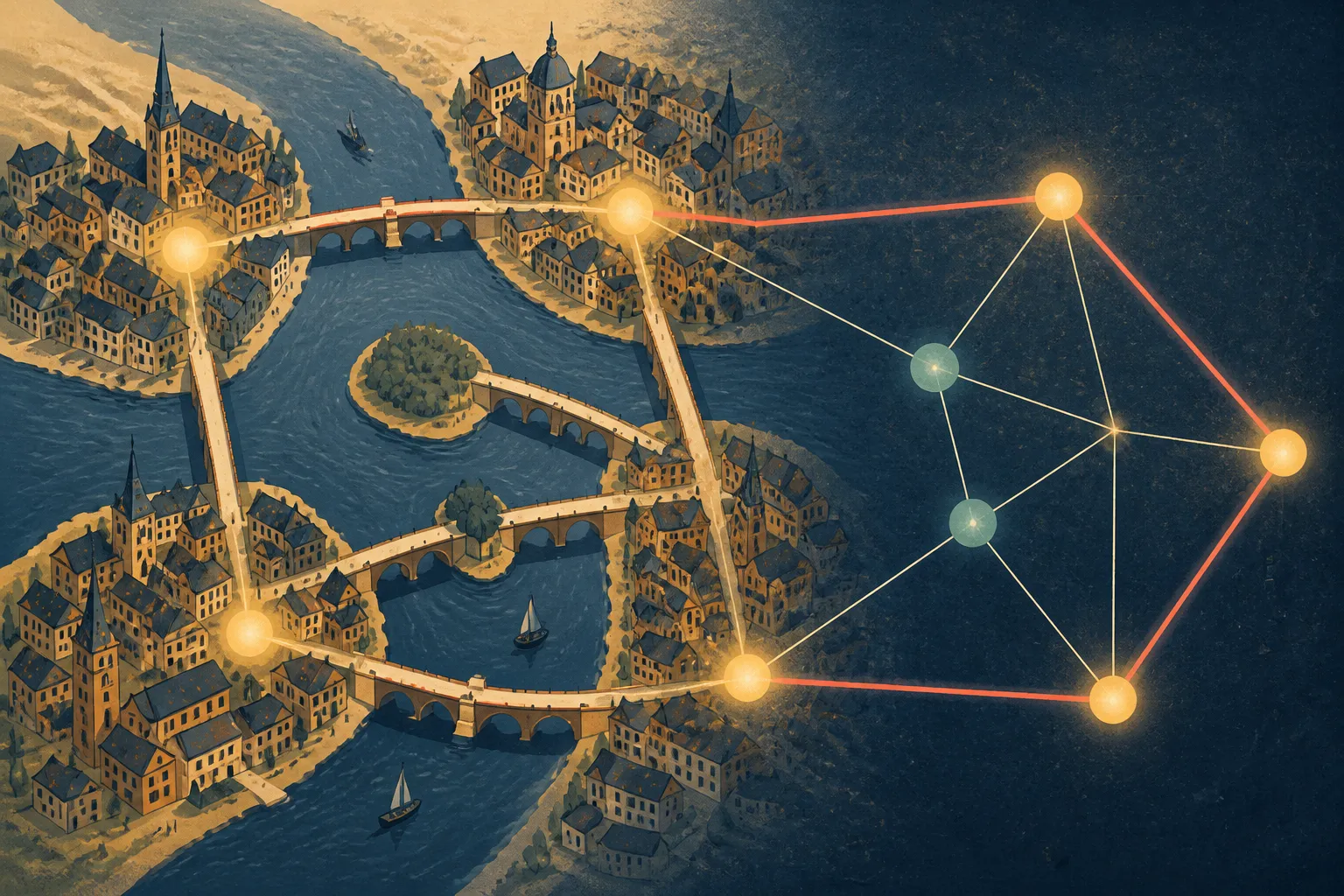
The drawing stands for Königsberg, a city divided by the river Pregel and its islands. Seven bridges joined the riverbanks and two islands. The question was whether one walk could cross every bridge exactly once and return to its starting point. That final condition matters: the walk must close into a loop.
Try a route and the difficulty appears quickly. A bridge you have crossed cannot be used again, so each crossing changes which land areas remain reachable. A promising path can strand you on the wrong bank with a bridge still unused. The puzzle invites trial, but trial alone offers no easy way to know whether a better route is waiting.
The city itself has moved through history. Königsberg, formerly in Germany, is now Kaliningrad, part of Russia. The old place-name remains attached to a question whose map can be reduced to a few marks. First, though, the city has to be made small enough to reason about.
Act II: Turn the City into a Graph
Leonhard Euler’s move was to stop treating the bridges as pieces of scenery. Each separate land area became a node, and each bridge became an edge connecting two nodes. The result is a multigraph: a graph that allows more than one edge between the same pair of nodes. Königsberg’s puzzle becomes a question about four nodes and seven edges, rather than a question about the shape of a river.
This translation discards a great deal. The width of the Pregel, the length of a bridge, and the exact outlines of the banks do not determine whether the route exists. What matters is which areas each bridge connects. The diagram is useful precisely because it keeps those relationships and lets the rest fall away.
Euler answered no in 1736. His paper had been presented to the St. Petersburg Academy on August 26, 1735, and appeared in the academy’s Commentarii in 1741. The paper is often treated as a beginning for graph theory and cited as an early work in topology as well. The Euler Archive’s record of the paper preserves its title, “Solutio problematis ad geometriam situs pertinentis,” a solution to a problem concerning the geometry of position.
Why the Route Fails
The key is to count how many bridges meet at each land area. Each of the four nodes in the Königsberg graph has an odd number of incident edges. For a closed walk, every time a traveler arrives at a node, another unused bridge must carry the traveler away. Arrivals and departures pair up. That makes the number of used edges at each node even.
Because the original map has four nodes with odd degree, it cannot support a closed walk that uses every bridge exactly once. The problem is settled without testing every possible sequence. The count of connections rules the route out before anyone needs to draw it.
This is the satisfying turn in the puzzle: the answer concerns a walk through a city, but the proof depends on a property of a diagram. Euler’s paper is often described as the starting point of graph theory because it treats connection itself as something that can be studied. The Wolfram MathWorld account likewise recasts the question as whether the graph has an Eulerian cycle, a closed route using every edge once.
A Cycle Is Not the Same as a Path
“Can you cross each bridge once?” leaves out a useful detail. Must the walk return to its starting point, or may it end somewhere else? A closed route is an Eulerian cycle. A route that uses every edge once but can finish at a different node is an Eulerian path. The words separate two questions that can have different answers.
For the original Königsberg layout, neither route works. Four odd-degree nodes are too many for a complete trail, whether closed or open. In a general graph, a closed route requires every node to have even degree; an open route can accommodate two odd-degree nodes, one for each endpoint. The distinction makes the test more precise, and it shows why changing the ending condition does not rescue the original arrangement.
That small clarification is a practical habit. Two people may argue over a route while silently imagining different rules. Asking where the walk must end can reveal that they are not answering the same question.
The City Changes, the Question Returns
The modern bridges do not reproduce the original puzzle’s map. Two bridges no longer exist, and two others have been replaced by a single bridge passing above, with a stairway in the middle leading down. In this changed layout, there is still no Eulerian cycle, but an Eulerian path does exist, according to the MathWorld account.
The city’s altered crossings make the puzzle recur in a new form. “Can every bridge be crossed once?” now depends on which version of the city is meant and whether the route has to come back to its start. A familiar name can conceal a changed network; a familiar question can conceal a different condition.
What the Diagram Does Not Tell Us
The compact proof answers the route question, but it does not answer every historical one. The available accounts do not establish in detail why Euler was asked about the bridges or trace the full reach of the paper’s influence. The result is well known; the circumstances around it should not be filled in with guesswork.
Readers who want Euler’s argument in full can consult English translations included in Newman’s World of Mathematics and in Biggs, Lloyd, and Wilson’s Graph Theory 1736-1936, as noted in the Euler Archive record. The bridge puzzle remains a small and unusually clear demonstration of a larger intellectual act: keep the connections, set aside the scenery, and see what the structure permits.
Sources
- E53 -- Solutio problematis ad geometriam situs pertinentis
- Königsberg Bridge Problem -- from Wolfram MathWorld
- How Does Graph Theory Shape Our World? | Quanta Magazine
- Seven Bridges of Königsberg : Networks Course blog for INFO 2040/CS 2850/Econ 2040/SOC 2090
- https://vertexaisearch.cloud.google.com/grounding-api-redirect/AUZIYQFCEQtiK23o9wJYGk02jtmjxaonV_SZfHbuuI5bwZL47ntKsQlP8KH6LwAdhKGot33rjl40b0lfv6SBRkF9WywB8jYNwbSLE6770zBBtmgTDMEVOcgIdyqc9Z35WjRhyw5rsvjproZgStywCKifUWkP_H_nzLWVaPNP6e-BAja8NRjmZFYXtUZC5ZqMFgVevPIrKHS20xqPZYz_mkwJqmRzivxbyWQdYwxHn2X7yo3TA6Qf3ZA=
- 5.2 Euler Circuits and Walks
An exceptional writer at Deeperpectives, she covers public memory, family archives, and the histories held in ordinary objects. Before joining the desk, she cataloged oral histories for a neighborhood museum, where she learned to treat a small detail as a door, not a conclusion.