

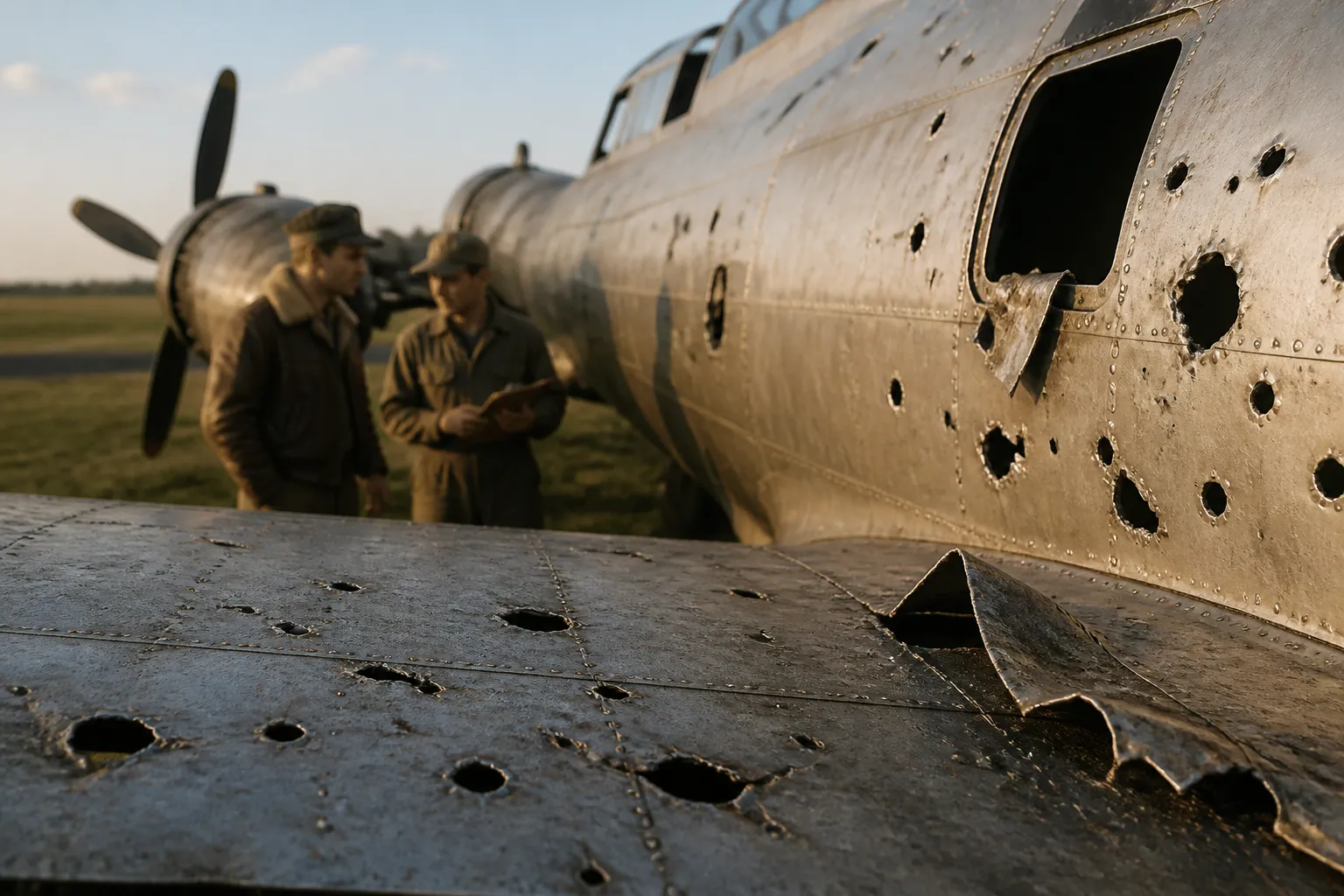
A bomber comes home with its wings pocked and its tail section chewed. A ground crew counts the holes, and a planner looks at the count and sees an obvious job: put the metal where the damage is. It is a reasonable instinct. It is also the kind of reasoning that Abraham Wald's wartime work was built to question.
The Setting: Armor for Bombers Coming Home
During the Second World War, planners had a practical problem. Armor adds weight, and weight costs range, speed, and payload. Every plate had to earn its place. The records on hand described the damage aircraft brought back, and the natural reading was to reinforce the areas with the most holes.
Wald worked on this at the Statistical Research Group at Columbia University. His memoranda were written for that wartime setting and never published externally, though copies circulated. CNA later issued a reprint, dated 7/7/1980, running 100 pages under the title "A Method of Estimating Plane Vulnerability Based on Damage of Survivors." CNA describes the methodology as still relevant and publishes it as a matter of historical interest.
What Survivorship Bias Means
Survivorship bias is the error of drawing conclusions from the cases that made it through a selection process while ignoring the ones that did not. The missing cases are often the ones that would change the answer. Here, the planes that returned are the survivors, and the damage they carry is a filtered sample, not a random one.
The idea is easy to state and oddly hard to catch in the act. A reader looks at visible results and asks what they show. The better question comes second, and usually too late: what process put these results in front of me? Which hits would have kept a plane from coming home at all?
Wald's Method: Reasoning From the Damage That Survived
According to the CNA catalog description, Wald's method estimates plane vulnerability from the damage pattern on planes that returned. The move is to treat survivors as evidence about what a hit can do, not merely as a map of where fire landed. Regions that look clean on returning planes may be regions where a hit was fatal. Those are the places that may most need protection.
I should be plain about limits. The material behind this piece is a catalog page and a PDF of the reprint that I could not read in detail. It does not give me the damage locations, the sample sizes, or the mathematics. Anyone who wants the argument itself should open the reprint. What can be said is that the method starts with the survivors and asks what must be true of the planes that vanished.
The Anecdote and Its Limits
The popular retelling is tidy: armor goes where the returning planes were undamaged. It is memorable and it catches the spirit of the reasoning. But nothing I reviewed confirms that this phrasing matches Wald's written conclusions, so it belongs in the category of retelling, not quotation.
Careful writing keeps the lesson apart from the legend. The durable point is about method. When survival filters a sample, an absence of damage in some region can be evidence of lethal damage, and the analyst has to reason about the missing cases rather than wave them off.

Other Places the Pattern Appears
The same filter operates far from airfields. Investors study funds that still exist and credit a strategy, while the funds that closed after poor results drop out of the data. Business writers profile thriving companies and list their habits, without counting the failed firms that kept the same habits. Success stories are published mostly by those who prevailed.
The remedy is modest. Picture the missing group. Who is not in this sample, why not, and would their presence change the conclusion? No special training is required, only the willingness to treat visible data as one side of a selection process.
Arguing Well About Filtered Evidence
Good argument asks what would count against a claim. When someone offers survivors as proof that a practice works, a careful listener asks how many tried it and failed, and whether anyone recorded them. Both sides can be fair here. The survivors may carry real information, and the missing cases may be hard or impossible to measure.
Wald's case earns its fame because it does not throw out the observed data. It uses the holes, and it accounts for the filter that produced them. That is a decent habit for any question where the results in view are only part of the story: take the evidence seriously, then ask what it cannot show.
Sources
- A REPRINT OF "A METHOD OF ESTIMATING PLANE VULNERABILITY BASED ON DAMAGE OF SURVIVORS" BY ABRAHAM WALD | CNA
- https://vertexaisearch.cloud.google.com/grounding-api-redirect/AUZIYQHwMv1EqNs2vWpsq4TQW-Wr_UWiGeJwN07ppqdARjEAj5ZQLI_A7NqdSf8reeNFv3itffA1d88GFjwaMRLRXPFZX0i4TM0QzasETmqZMEhyYlwoYnMp-B7f-cc0aeh-qkfzGwLSAQ==
- Survivorship bias - Wikipedia
- Bill Casselman’s Column Archive – Feature Column
- The Once and Future Feature Column – Feature Column
Marcus Adeyemi-Holt is a house writer for Deeperpectives, where he examines how ordinary routines reveal larger patterns in work, memory, and place. He draws on years of reporting on municipal records and oral histories to trace the quiet forces that shape everyday life.