Most teams study failure after it happens. The pre-mortem moves that exercise to the start. Before launch, the group assumes the project has already gone wrong and works out why. The aim is to give doubts a safe place to land while the plan can still change. The steps below combine the UK government digital health team's 2018 blog post with guidance from the Association for Project Management (APM) and the Public Health Foundation (PHF).
How to Run One
The core move is simple. You tell the room the project failed, and then everyone explains how. The steps below are a working outline, not a single canonical recipe.
- Imagine the failure has happened. Tell the group the project has already gone badly.
- Generate reasons. Each person writes down plausible causes, working backward from the outcome.
- Invite different perspectives. Bring in the project team, stakeholders, and people on the edges of the service.
- Consider splitting the room. The government digital health team had one group imagine disaster and another imagine a glorious success.
- Turn risks into actions. The aim is practical work that can be assigned to people straight away.
- Name owners. Each big risk area needs someone who owns it.

Sample prompts help a quiet room get moving. The sources suggest several. What could slow us down or make us miss the deadline? What are we already nervous about? Where did we miss blind spots on past projects? How quickly can we respond when something goes wrong? Who could own each of our biggest risk areas? One more is worth adding: what are we assuming here, and what if we are wrong?
Where the Idea Comes From
The method is credited to Gary Klein. Per the sources, he presented it in his 2004 book The Power of Intuition. A short Harvard Business Review item followed in September 2007, titled "Performing a Project Premortem." The sources disagree on its length. One summary calls it a two-page item at pages 18 and 19, while the store listing says four pages. The full text was not available for this piece, so treat the page count as unsettled.
A framework-list site describes Klein's method as taking 30 to 60 minutes at beginner difficulty. That is the site's characterization, not a figure from Klein himself.
Others have adapted the idea. Sonja Armbruster and Jack W. Moran, with Jane Shirley of the Kansas Department of Health and Environment, developed the PHF version for public health. Peer-assisted pre-mortems add another layer. A team that recently closed a similar project hears the new team's objectives and challenges, then says how it would handle them. APM's guidance puts these sessions at 60 to 90 minutes, with no more than 12 people, ideally at project initiation or early planning.
Why Imagining Failure Helps
Optimism bias is the target. Teams expect better outcomes than the record supports, and overconfidence lets judgment run ahead of the evidence. Asking "what are the risks?" can sound like dissent, or like doubt about the people who made the plan. The pre-mortem changes the question.
Klein frames the technique as prospective hindsight. The idea is to borrow the clarity of hindsight before launch, while changes are still possible. According to the framework-list site, people criticize a plan better when told to assume it already failed than when asked to flag abstract risks.
The same source says Klein's technique draws on a 1989 study by Mitchell, Russo and Pennington. That study found that describing an event as certain rather than possible produced longer explanations with more concrete reasons. The study was about explanation, not project outcomes, so it is a rationale for the method and not proof that it works.
There is a social effect too. If failure is treated as settled, raising a worry becomes a contribution and not an objection. People with reservations can speak at the start. The project gets improved, not just autopsied.
What a Session Looked Like in Practice
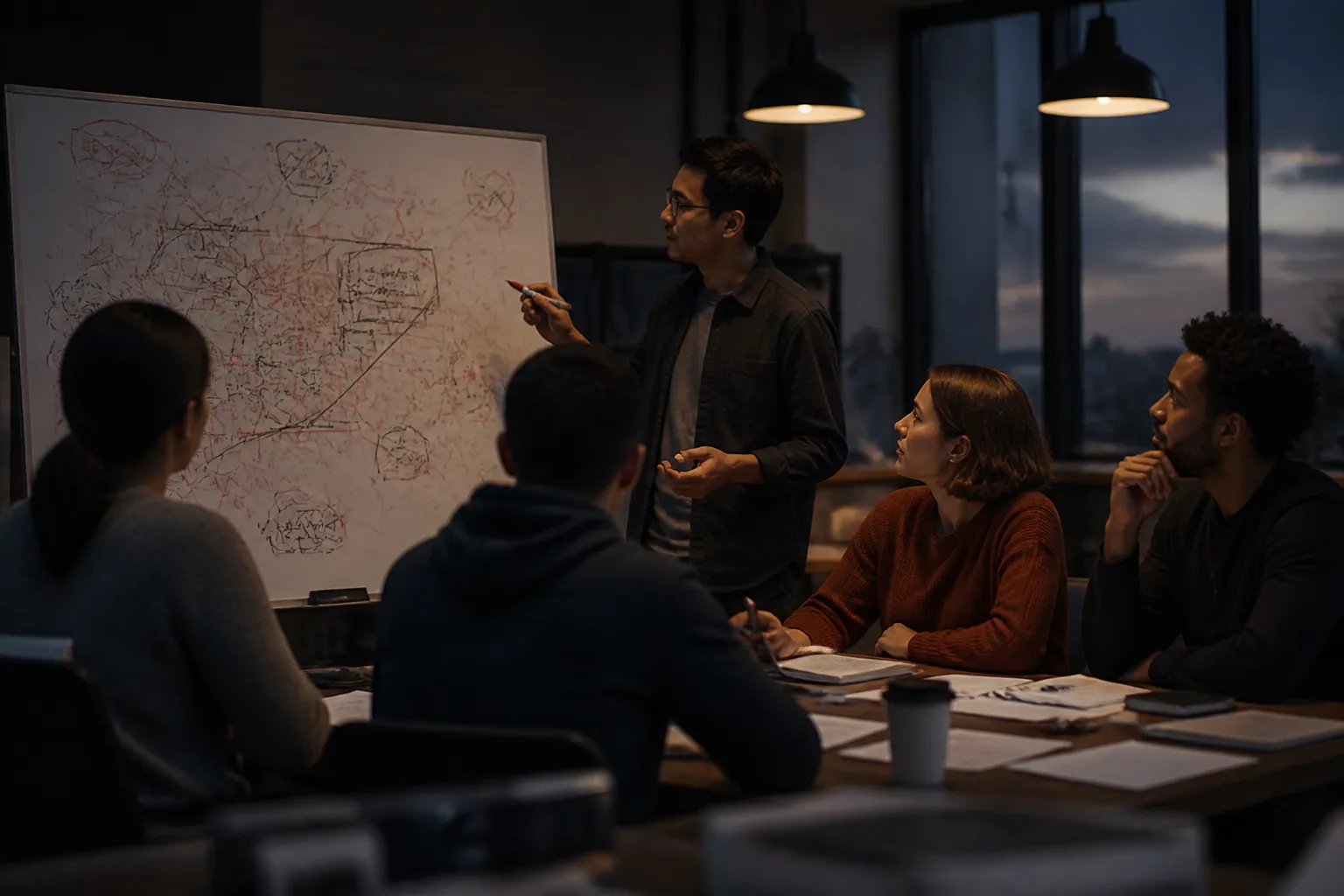
The UK government digital health team blogged about its session in September 2018. Invitations went out a few weeks ahead. Pre-session questions followed 24 hours before the event. They booked a room for two hours. Introductions took five minutes and context another five. Splitting into failure and success teams took 30 minutes.
They also set a future date. It was winter 2020, about two years out, with the revamped service live for six months. That detail belonged to their project and is not a rule of the method. One team wrote scenarios for the worst possible failure. The other wrote scenarios for a glorious success. Both started from the same question: how did we get here?
Choosing the guests mattered as much as the agenda. The team invited people from across the organization, not only the project team. Project teams can be blinkered by the honeymoon phase and by established ways of working, which limits critical thinking. The team did not invite real users. In hindsight, they thought users would have been valuable.
Watch-Outs and Open Questions
Two warnings recur in the sources. Loud voices can dominate, and quiet people often hold the sharpest insight. Build in ways for people to contribute in a style that suits them, such as writing ideas down before anyone speaks. The second warning is about treating the session as a form to complete. Risk is an everyday conversation. A one-off exercise may mean problems surface too late.
Daniel Kahneman's 2011 book Thinking, Fast and Slow is cited as calling the pre-mortem a practical remedy for overconfidence. That claim reaches us through a secondary site, not the book itself. The logic is plausible, and the method is cheap and quick. Still, the evidence is thin. Most sources are practitioner blogs and organizational guides. They offer little data on how often a pre-mortem actually prevents failure, and no comparison with other risk methods.
Several practical gaps remain. The sources do not say how to handle conflict between the failure and success teams. They do not explain how to run a session remotely or with large groups. They do not say how to turn the risk list into a ranked plan or how to track countermeasures afterward. One simple approach, offered here as a suggestion and not as sourced guidance, is to have each person mark their top three risks and give the most-marked ones an owner first. The method has a sound psychological rationale and respected supporters. Its real-world payoff remains mostly untested in the material reviewed here.
Sources
- Pre-Mortem Analysis | PHF
- Pre-mortems: identifying opportunities and risks – Digital health and social care
- Test, Learn and Grow Playbook - Designing test ideas (phase 3) - Guidance - GOV.UK
- Nine tips on kicking off a project the right way
- How to run peer-assisted project pre-mortems
- Pre-Mortem: Gary Klein's Technique for Spotting Project Failure Early
- Pre-mortem Exercise: Gary Klein's Method and Its Origins — Framework
- Performing a Project Premortem
Siobhan O'Reilly investigates the friction between urban decay and digital expansion for Deeperpectives. She spent a decade reporting from transit hubs and temporary settlements across the rust belt. Her work prioritizes the raw data of lived experience over polished corporate narratives.