Search for Einstein's Riddle and you will find the same story again and again. A young Albert Einstein supposedly invented it, and he claimed only two percent of people could solve it. Some versions hand the credit to Lewis Carroll instead. The Wikipedia article on the Zebra Puzzle calls the Einstein story an urban legend. It also says there is no evidence for either attribution.
The puzzle is worth knowing for two reasons. It is a good exercise in deduction. It is also a tidy case study in how a famous name gets attached to something nobody can trace to that person.
Where the Puzzle Came From
Many versions of the Zebra Puzzle exist. One of them ran in Life International on December 17, 1962. That is the earliest appearance the sources here point to. It is not proof that nobody wrote the puzzle earlier. It only marks the earliest public version we can cite.
The magazine followed up in its March 25, 1963 issue. That issue printed the solution and the names of several hundred solvers from around the world. The Life version also mentions cigarette brands that did not exist in Carroll's lifetime or in Einstein's boyhood. That detail makes the legend hard to believe. The author of the Life puzzle is unknown, and the sources do not say who wrote it.
How a Clue Works
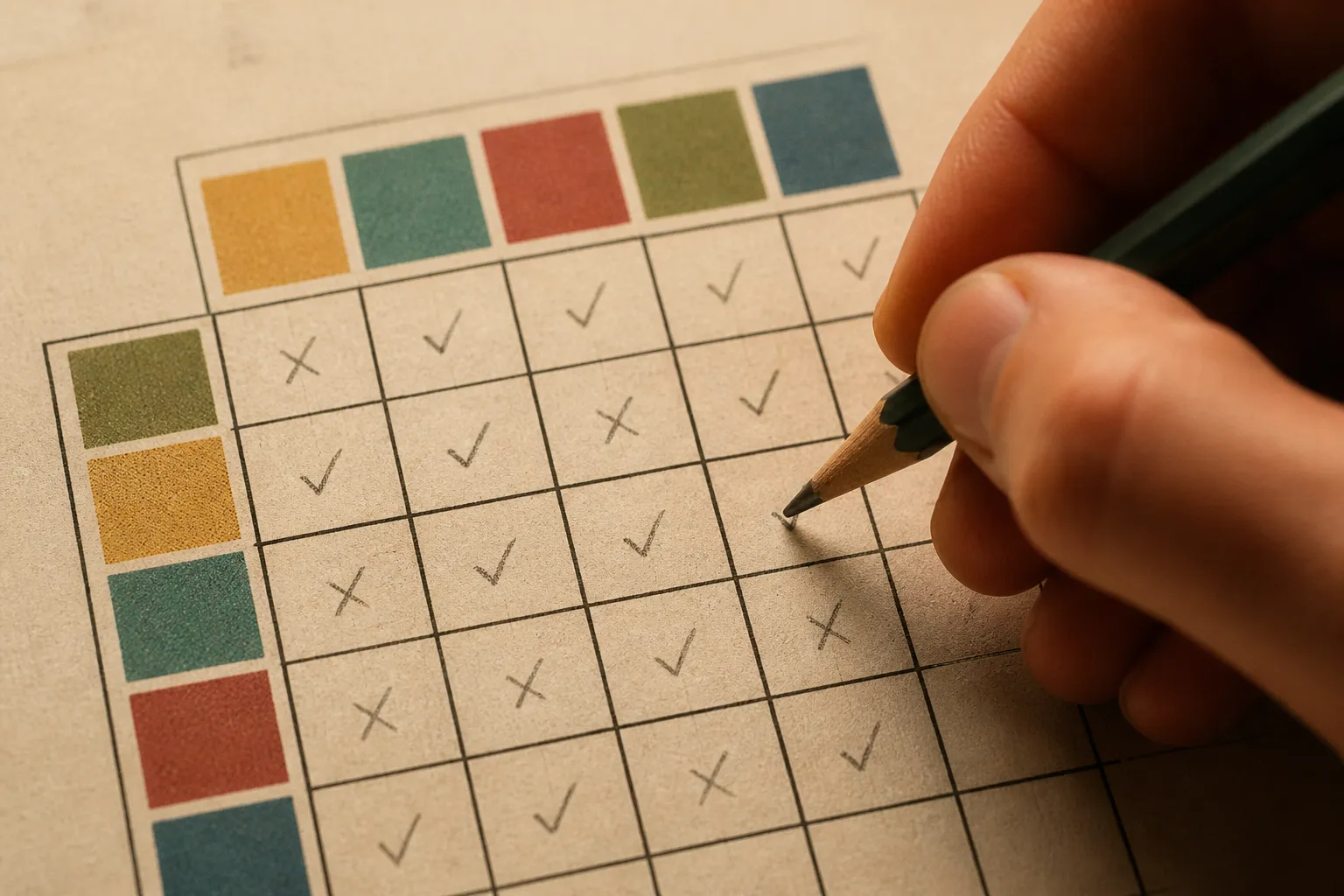
The setup is simple. Five houses stand in a row. Each is painted a different color. Each resident has a different nationality, pet, drink and cigarette brand. The solver links every attribute to a house using only the clues. The usual closing questions are who drinks water and who owns the zebra.
Some clues give a fixed position. One says the Norwegian lives in the first house. That settles one cell of the grid at once. Other clues are relative. One says the green house is immediately to the right of the ivory house. Read the word "right" from the solver's point of view, as the source notes. If you flip it, the whole grid collapses.
Here is how one clue can chain into another. Suppose a clue says the Norwegian lives next to the blue house. The Norwegian is in house one, and house one has only one neighbor. So the blue house must be house two. One fixed fact plus one relative clue gives a second fixed fact. Solvers repeat that move until the grid fills in.
How to Check an Attribution
Calling the puzzle "Einstein's" is a misattribution. A famous name makes a claim sound weightier, but the name is not evidence. The fix is to ask for the paper trail. You can do this in a few minutes.
- Look for the earliest dated primary source, such as a scanned magazine issue, not a repost or a quote of a quote.
- Compare the wording of the version you are reading with that original. Clues drift as puzzles get copied.
- Look for anachronisms. Products, brands or customs that postdate the supposed author are a strong warning sign.
- Ask who first made the claim and when. If the answer is nobody you can name, treat the attribution as unsupported.
Applied here, the steps lead to Life International in 1962 and to cigarette brands that do not fit the lives of Einstein or Carroll. They do not name an author. That is a fair place to stop, and the honest answer is that the author is unknown.
Why Computers Still Study It
The Zebra Puzzle has long served as a benchmark for algorithms that solve constraint satisfaction problems. Those are problems where many variables must satisfy many rules at once. More recently it has been used to test the logical reasoning of large language models.
A February 2025 arXiv preprint, ZebraLogic: On the Scaling Limits of LLMs for Logical Reasoning, is one example. As a preprint, it had not necessarily been peer reviewed when it appeared. The authors built logic grid puzzles from constraint satisfaction problems with adjustable complexity. They tested models including Llama, o1 models and DeepSeek-R1. Accuracy fell significantly as puzzles got harder, a pattern they call the curse of complexity.
They also looked at ways to help the models. These included Best-of-N sampling, which picks the best of several attempts, backtracking, and self-verification prompts. The sources here do not give accuracy figures for specific difficulty levels, so treat the trend as the finding and not any exact number. You can read the preprint at arxiv.org.
What We Still Don't Know
Several questions remain open. Nobody has shown who wrote the Life puzzle. The sources do not say how the magazine checked the several hundred solver submissions it credited in 1963. They also do not lay out a step-by-step solving method, and the full solution is cut off in the main source.
That leaves a modest conclusion. The 1962 magazine is the earliest appearance we can document, and the Einstein story has no evidence behind it. If you want to solve the puzzle, start with the clue that pins the Norwegian to house one and let the rest follow from it.
Sources
Siobhan O'Reilly investigates the friction between urban decay and digital expansion for Deeperpectives. She spent a decade reporting from transit hubs and temporary settlements across the rust belt. Her work prioritizes the raw data of lived experience over polished corporate narratives.