
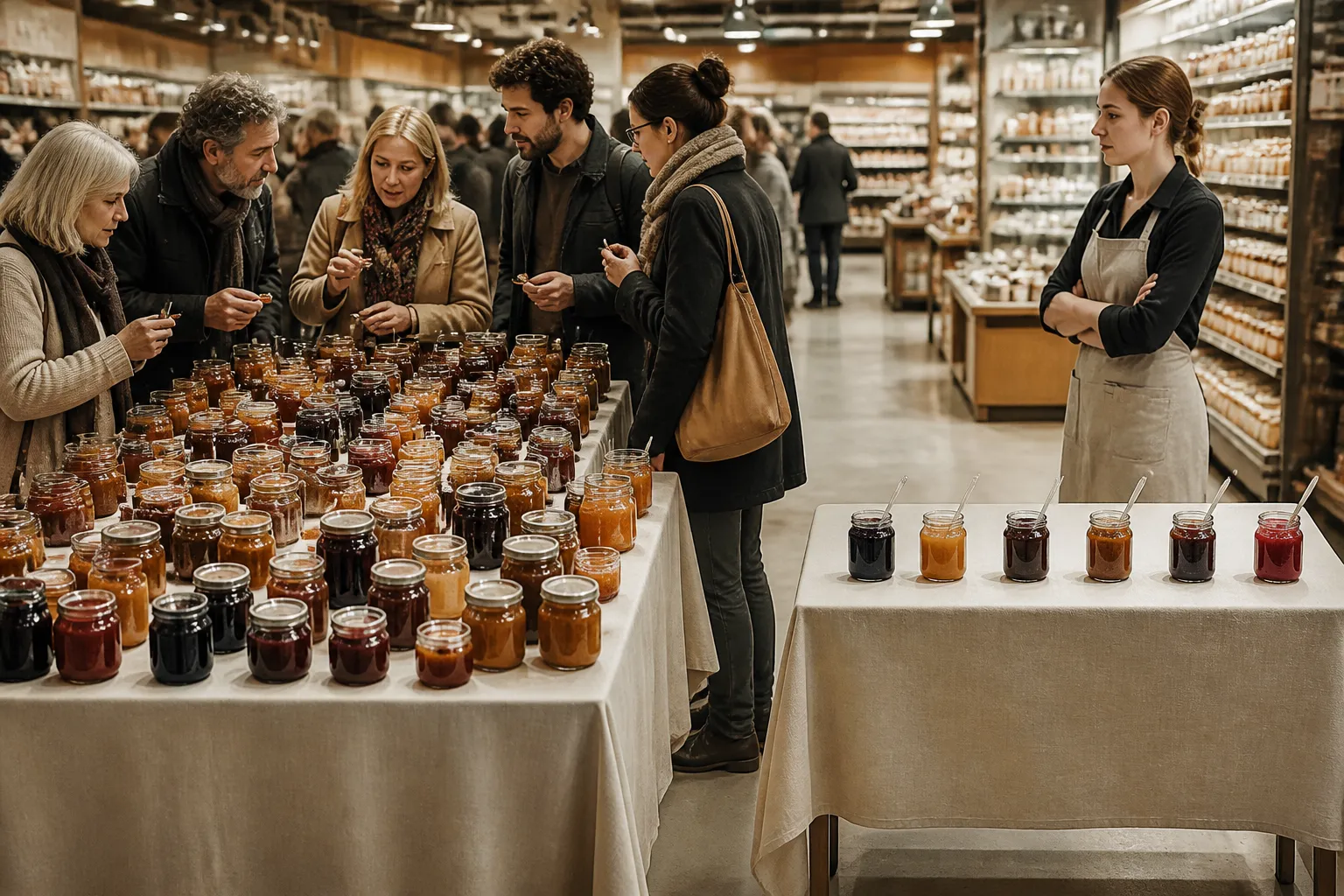
A supermarket table of jam sounds like an unlikely foundation for a theory of modern life. Yet since 2000 it has carried a good deal of weight. The story goes that shoppers faced with too many jars freeze, and that a seller who trims the shelf will be rewarded. The story is tidy. The evidence behind it is less so.
The original jam study and what it measured
Sheena Iyengar and Mark Lepper published the experiment in the Journal of Personality and Social Psychology in 2000. They set up a tasting table and varied it: one version offered 24 jam varieties, the other 6. It was a persuasive design because it happened in a real shop, with real passersby, and it measured what people did rather than what they said they would do.
The reported figures pulled in two directions. Roughly 60% of passing shoppers stopped at the 24-jam table, against about 40% at the 6-jam table. Variety attracted a crowd. But about 30% of those who stopped at the smaller table went on to buy, compared with about 3% at the larger one (as summarized here). Attention was not purchase.
The coupon is what made that comparison possible. Shoppers who stopped received a discount coupon, so the researchers could link a visit to the booth with a later purchase. Without that thread, the gap between 30% and 3% would have been a guess. With it, the gap became the centerpiece.
A second experiment used chocolates and reported higher satisfaction among people who chose from smaller sets. It is usually cited alongside the jam result, as a second leg under the same table.

Why the effect is disputed
The trouble came later. A commonly cited follow-up combined dozens of attempts to replicate the effect and reported an average close to zero. If more options reliably cut purchases or satisfaction, that average should not sit near zero.
The limits here matter. The material I could read does not give the number of studies, the analytic method, or the exact effect size. So the honest summary is that the result is reported as near zero, and no more precise than that. The full text of the 2000 paper and of the 2010 meta-analysis by Scheibehenne, Greifeneder and Todd was unreadable in the files provided. Anything said here about their methods comes from secondary summaries and should be treated as unverified.
The other side deserves a fair hearing. An average of zero across many studies does not prove the effect never happens. It can also mean the effect appears in some settings, vanishes in others, and washes out in the mean. Commentators have argued that conditions matter more than the headline number.
Hard choice, not the number of options alone
One source argues that difficulty, not count, drives overload. When options are hard to tell apart and the chooser does not know what they want, even a modest number can feel heavy. Twenty-four jams that differ in obvious ways may be easier than six that blur together.
That changes the question a seller or designer should ask. Not how many to offer, but whether customers can distinguish the choices, and whether they have any sense of their own taste. The same source says overload appears under specific conditions and disappears under others. It refers to four triggering conditions without listing them, so I will not guess at them.
There is also a gap in the balance. More choice plainly helps in many settings, especially when an option fits a specific need. The readable sources do not summarize studies making that case, so the argument for abundance goes mostly unrepresented here.
Cautions when the jam study gets cited
Be wary of the talk that uses the jam table as proof that a business should cut its range. That claim may leave out the near-zero replication result. A single vivid experiment is easy to remember. An average of many is not.
A careful reader can ask three things of any overload claim:
- Has it been replicated, and what did the replications find?
- Under what conditions did the effect appear?
- Was the outcome measured choice, satisfaction, or later purchase?
One boundary also applies. The evidence summarized here concerns shopping. The sources do not say whether it carries over to health or financial decisions, and it would be a stretch to assume so.
Making a decision when options multiply
For personal choices, a modest method follows from all this. First sort options into those that differ in ways that matter to you. Then narrow to a shortlist using priorities you already know, rather than comparing everything at once.
The old split between maximizing and satisficing is one way to frame it. A maximizer hunts for the best. A satisficer takes the first option that clears the bar. Neither is a settled rule, and each suits some decisions better than others.
The central tension holds. More options can widen what a person can get while making the choice harder. Where the balance lands seems to depend on how distinct the options are and how clearly the chooser knows what they want. That is less catchy than a jam table, but it fits the evidence better.
Sources
Marcus Adeyemi-Holt is a house writer for Deeperpectives, where he examines how ordinary routines reveal larger patterns in work, memory, and place. He draws on years of reporting on municipal records and oral histories to trace the quiet forces that shape everyday life.