
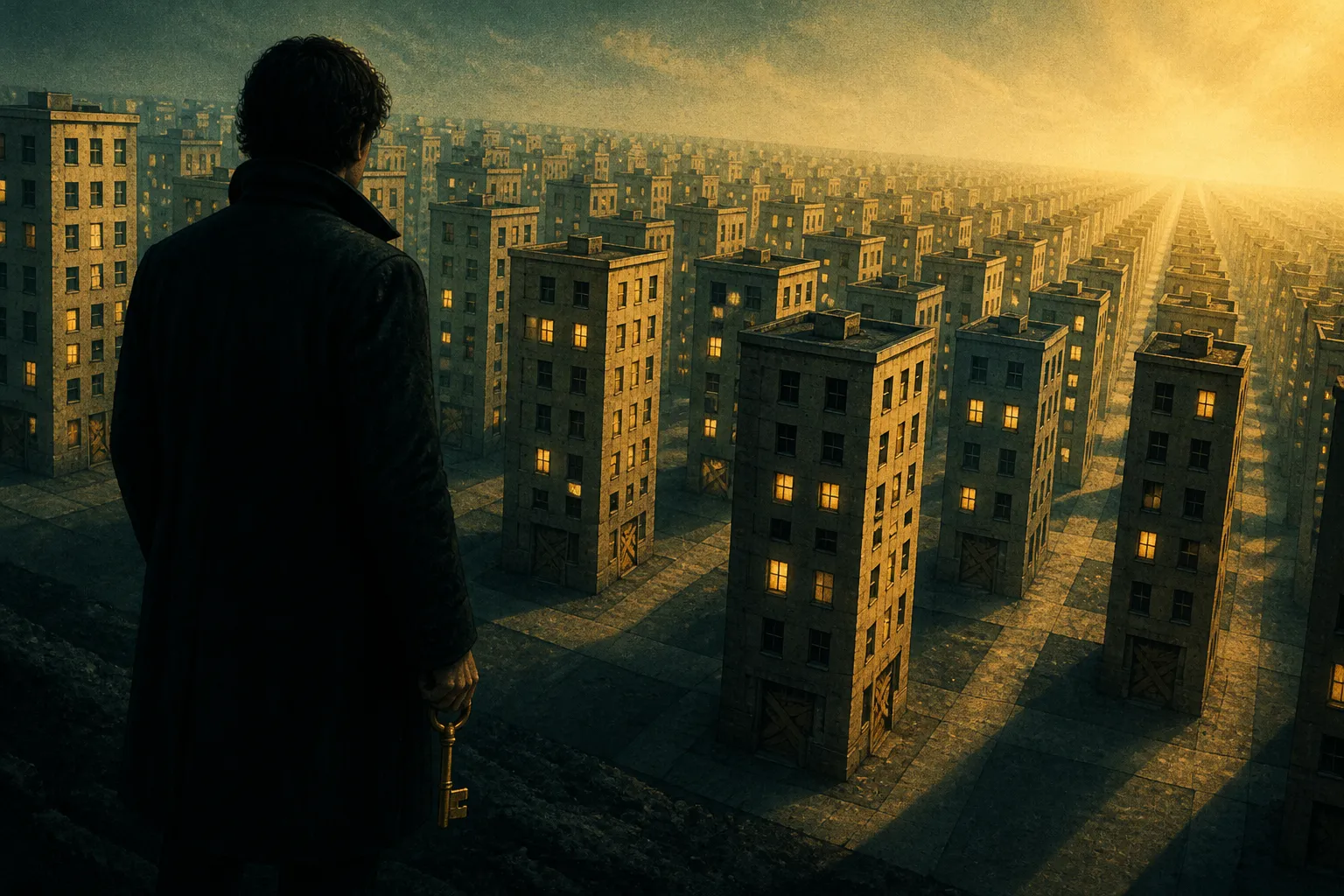
Imagine a city. A place with no edge, no limit. It can always build more. More towers, more blocks, more homes. Every newcomer finds a unit. Every family, a door. Sounds like a dream. It is not. It is a thought experiment, a puzzle that breaks if you push it hard enough.

This infinite city, this urban fantasy, asks us to believe. Believe in endless land. Endless money. Endless time. And, crucially, it asks us to ignore who decides where new units go. Who gets them. Who pays. It strips away friction. It promises an easy fix to a grinding reality.
No real city is infinite. We know this. But the thought experiment has value. It isolates a single, seductive claim: that supply alone solves housing pressure. It lets us test that claim, stripped of local political noise.
A city can grow. It can add millions of units. That is one thing. Making room for specific people, people with specific needs, specific budgets, that is another. Total capacity and real access for the displaced are separate questions. The puzzle only works if we keep them apart.
The Numbers Lie, Or They Hide
Average figures can conceal brutal exclusion. A city might boast millions of new homes. Yet, a particular group, a vulnerable cohort, remains without secure shelter. Why? The new units are priced out of reach. They are too far from work, too far from schools, too far from essential services. What is built is not always what is needed, nor for whom it is needed.
Look at the global data. Housing costs have outpaced incomes. The global price-to-income ratio climbed from 9.3 to 11.2 between 2010 and 2023. This is almost four times the traditional affordability benchmark of 3.0. A growing stock of homes does not automatically reach everyone. It leaves 44% of renters facing unaffordable costs. The math does not lie. The priorities do.
The global housing shortfall exceeds 268.8 million units. This is not a slight deficit. It is a chasm. What is true for the city in aggregate, for its total inventory, is not true for each household within its concrete walls. The fallacy of composition proves fatal here. More houses, yes. Homes for all, no.
Supply Is Not Enough
The supply-first argument has its defenders. Build more homes. This eases competition. Many economists argue that restrictive rules have stifled construction for too long. They say the market will correct itself with enough inventory. It is a straightforward vision. It is also incomplete.
UN-Habitat offers a different pathway. Expanding supply alone will not deliver affordability. They call for integrated strategies, both demand- and supply-side measures. New construction often targets higher-income buyers. It does not always touch low-income renters. The issue is not just volume. It is about tenure options. Social housing. Cooperative models. Incremental solutions. These matter as much as the sheer number of units. More building is not a magic wand. It is one tool among many.
The Displaced Are Invisible
This is where the infinite city model truly collapses. It ignores the sudden, violent shifts of displacement. Conflict. Disaster. People lose everything overnight. They arrive with nothing. The demand picture changes sharply, instantly. An infinite-supply model that ignores these arrivals measures the wrong thing. It dismisses the core of the crisis.
Up to 3.4 billion people lack access to secure, safe housing globally. This figure is up from 2.8 billion just last year. Over 1 billion live in informal settlements. Insecure tenure. Overcrowding. Environmental hazards. Limited services. This is not some abstract housing challenge. This is a human catastrophe, unfolding now. When someone says a city has room, ask: Room for whom? On what terms? How quickly? The answers reveal the lie. The available reports describe the scale of need, the drivers of crisis. They do not describe how a perpetually expanding city would specifically treat displaced people. Any confident answer should be treated with extreme caution. The space is not for them.
How to Spot the Smoke Screen
When you hear a housing proposal, ask sharp questions. Does it address supply? Demand? Both, as UN-Habitat urges? What tenure options exist locally? Rental, cooperative, social, incremental housing. Are these part of the plan? Most critically, does it account for displacement as a cause of need? Does it make space for those with nothing left?
Beware the red flag. Treating shortage as solvable by new supply alone. This skips the most vital step. It ignores affordability. It ignores access. It sidesteps the very people who need a home most. An infinite city, one that truly leaves no one out, needs answers to all these questions. The thought experiment proves this. Room on a blueprint is not a place to live. Not for everyone.
Sources
Siobhan O'Reilly investigates the friction between urban decay and digital expansion for Deeperpectives. She spent a decade reporting from transit hubs and temporary settlements across the rust belt. Her work prioritizes the raw data of lived experience over polished corporate narratives.