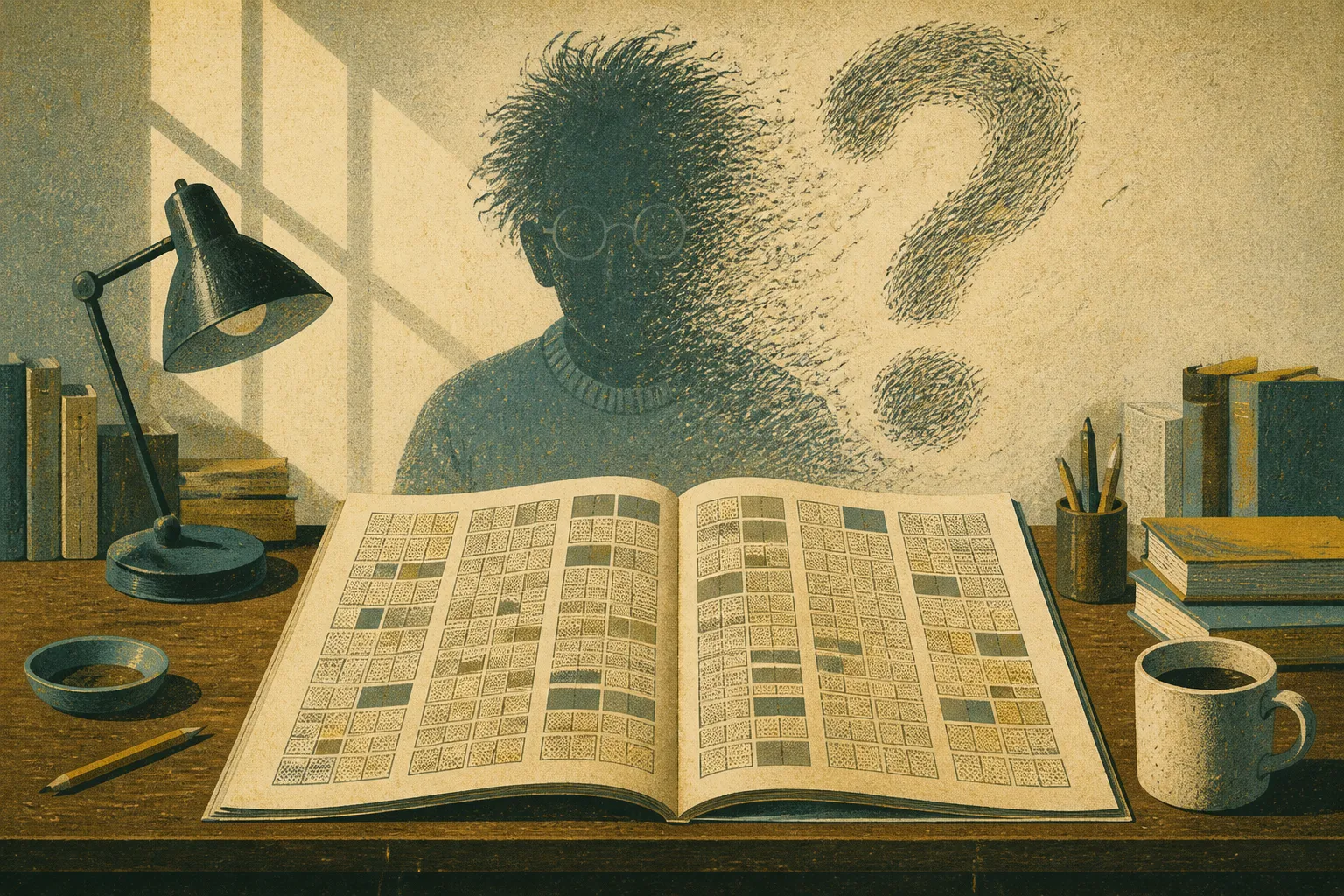

On a Tuesday morning, you write down that you expect a new project to take six weeks. You note the budget, the deadline, the reason you think the schedule is realistic, and the small worry you are setting aside: one supplier has not confirmed. Months later, the project is finished. Your memory now has an ending to organize everything around. The journal keeps the Tuesday morning intact.

The Problem With Learning From Outcomes
Once we know how a choice turned out, it is difficult to see it as we saw it then. A successful gamble can make its author seem perceptive. A failure can make the same choice look careless. The result becomes a kind of caption, placed beneath the memory and mistaken for an explanation.
This is the pull of outcome bias: judging a decision by what happened rather than by the information and reasoning available when it was made. The distinction is easy to state and surprisingly hard to keep. Knowing the ending changes the shape of the beginning. We remember the warning that came true and lose track of the other warnings that did not. We can also forget that a risk seemed remote, or that the evidence was incomplete.
That makes ordinary “learning from experience” a somewhat unreliable archive. Memory is not a recording device. It is a narrator with access to the final page, and it can quietly revise earlier scenes to make the ending feel inevitable. A decision journal gives the earlier scene a date and a witness. It records the uncertainty before the result has a chance to tidy it away.
What Goes Into the Capsule
A useful entry is more than a note that says what you chose. A decision journal template inspired by the Farnam Street method suggests recording the situation, the decision, the expected outcome, a confidence estimate, and the reasoning behind it. You might also write down what you were feeling and what information you noticed but chose not to act on.
That last detail can be especially revealing. Perhaps you saw that the supplier had not confirmed, but believed the relationship was reliable enough to proceed. Perhaps you noticed you were tired and told yourself the decision could not wait. At the time, these details may seem secondary. Later, they can show whether the choice rested on a deliberate judgment or on an assumption you barely examined.
Think of the entry as a small deposition, not a performance review. Give it a date. State what you know, what you do not know, and what you expect. A confidence score can help make “pretty sure” more specific, but it does not need to pretend that uncertainty can be measured perfectly. The point is to preserve your estimate in a form your future self can understand.
Writing also adds a little friction. Before the choice is made, putting the rationale into words can expose a hidden premise: that the outcome is more predictable than it really is, or that speed itself counts as evidence. The page does not decide for you. It makes the structure of your decision easier to see.
The Review as Archaeology
The journal becomes most useful when you return to it after the decision has played out. Read the old entry before writing an account of what happened. Notice the gap between your expectation and the result, then ask what that gap can actually tell you. The answer is not always that you should have chosen differently.
A good result can follow thin reasoning. A poor result can follow a careful process. If the supplier confirmed late and the project finished on time, that does not prove the original schedule was well supported. If the supplier never came through, that does not automatically mean proceeding was irrational. One outcome cannot show how every similar choice will turn out.
Instead, compare the reasoning with the information that was available. Did you assign too much confidence to a convenient assumption? Did you overlook the cost of coordinating several people? Did urgency make the choice feel clearer than it was? The review is less a verdict than an excavation. You are looking for the layers beneath the result: expectation, evidence, feeling, and the moment one possibility seemed to become the only one.
Repeated entries may reveal habits that a single decision cannot. You might find that confidence rises when you are under pressure, or that you consistently underestimate the time required to put a plan into practice. These patterns are useful precisely because they are recorded across separate moments, not reconstructed from one memorable win or loss.
Time Capsule Logic and the Self You Were
Reading an old entry can feel like opening a letter from someone who shares your name but inhabits a different world. That person did not have the ending. They had a set of possibilities, an incomplete report, perhaps a deadline approaching. Their uncertainty was not a flaw in their intelligence. It was part of the situation they were trying to describe.
Keeping that distinction in view can soften the impulse to scold your past self for failing to know what came next. The point is not to excuse every choice. It is to judge the choice against its actual conditions, rather than against information that arrived later. You can still find a mistake. You can also find that the decision was reasonable and the outcome unlucky, or that a lucky outcome concealed a fragile process.
It helps to write for the person who will open the entry months from now. That reader knows what happened, but may have forgotten what the decision looked like before it did. Include the small particulars: the unanswered message, the deadline on the calendar, the concern you nearly left out because it seemed unimportant. Such details are not ornaments. They are the setting in which the choice made sense.
In this way, a decision journal becomes a modest family archive of one person’s changing judgment. It preserves not only what you chose, but what you could reasonably see. The future reader is not asked to admire the past self or condemn them. They are asked to meet them in the uncertainty that belonged to that day.

When you open the capsule, begin with the old page. Let it speak before the ending does. Then write down what the outcome changed, what it did not, and what you want the next entry to remember.
Sources
An exceptional writer at Deeperpectives, she covers public memory, family archives, and the histories held in ordinary objects. Before joining the desk, she cataloged oral histories for a neighborhood museum, where she learned to treat a small detail as a door, not a conclusion.