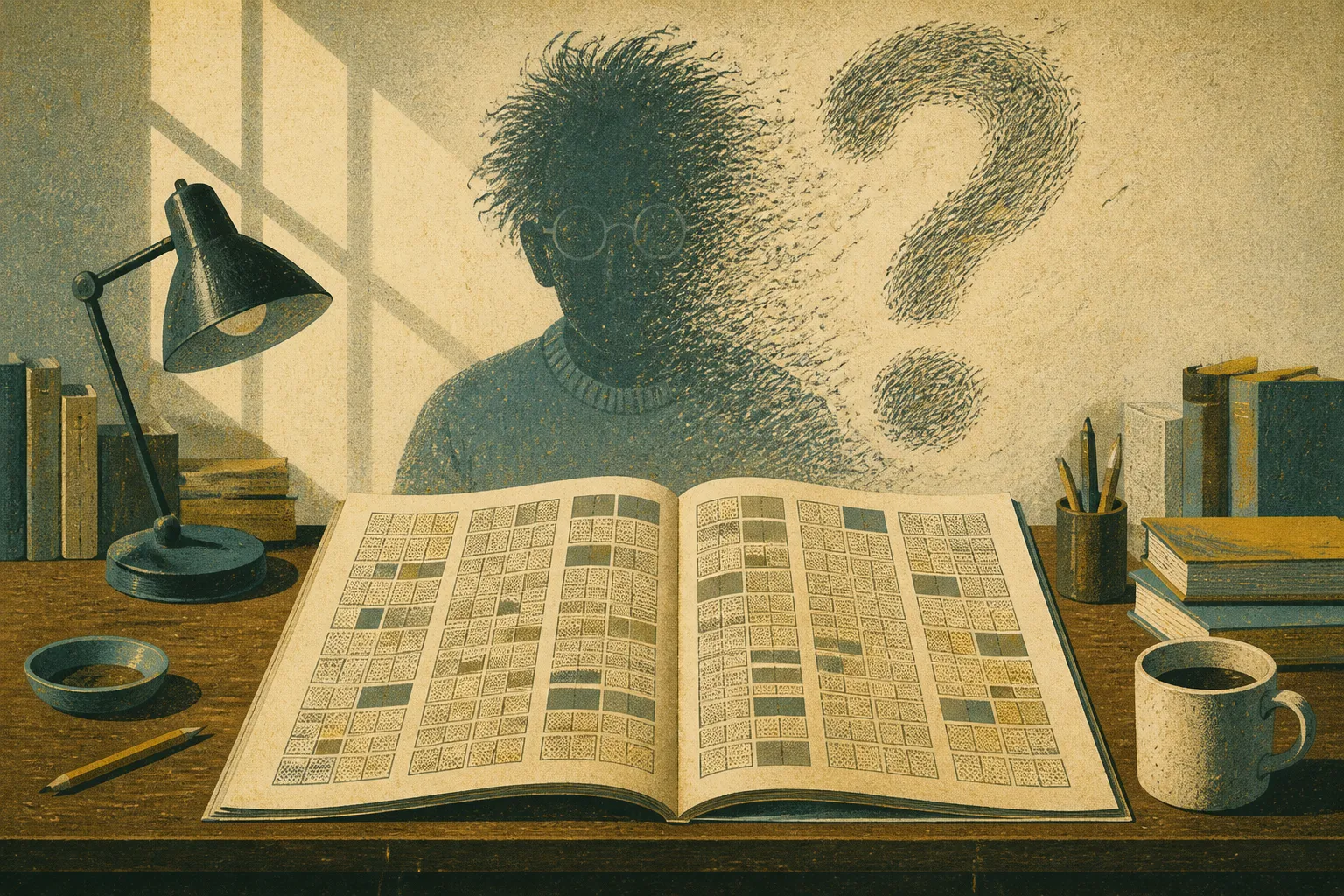
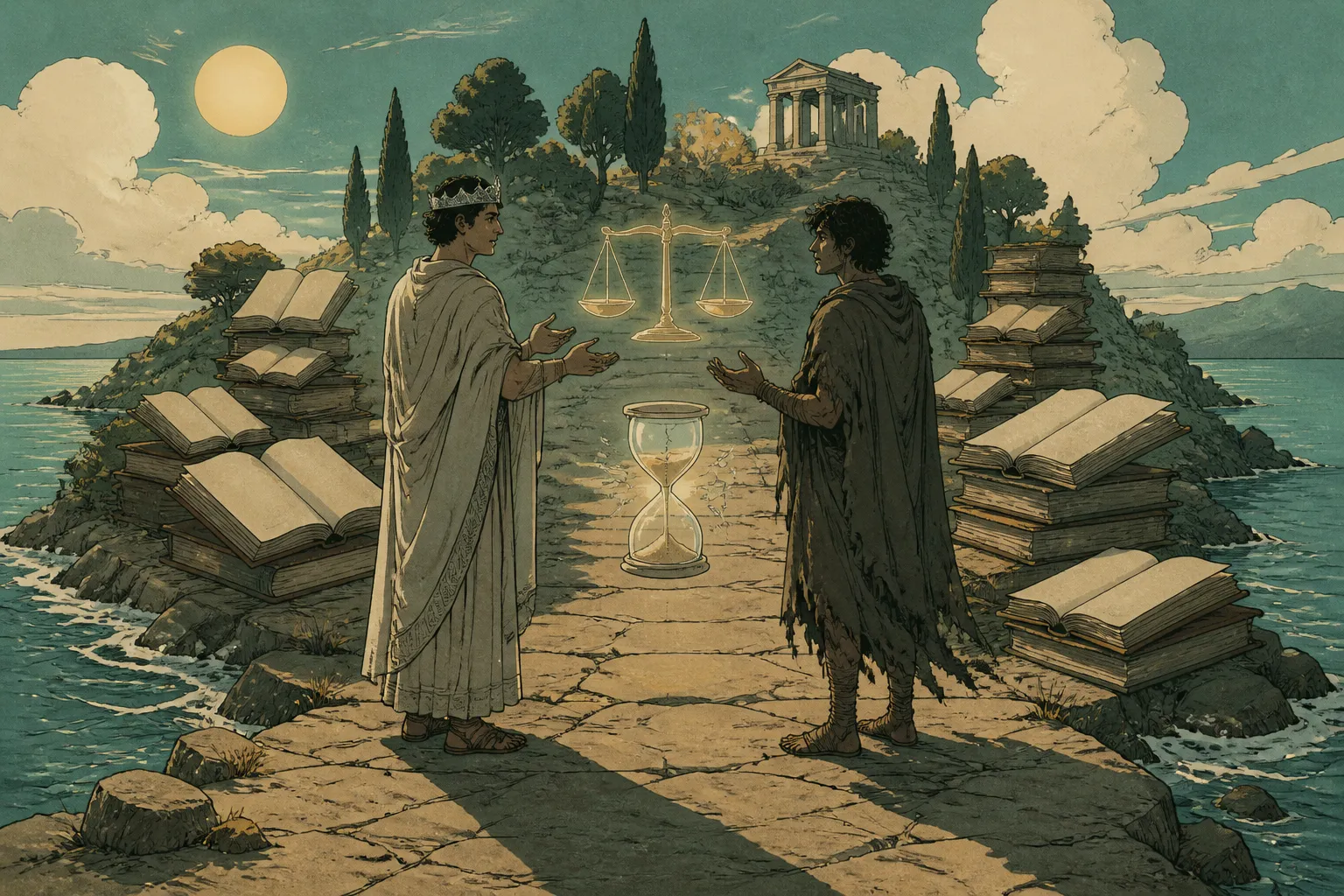
A man on an island says something to you. You know he is either a knight, who never says a false thing, or a knave, who never says a true one. You do not know which. That is the whole machinery, and it is enough to keep a patient person busy for an afternoon, or for 382 puzzles.
Where the puzzles come from
Raymond Smullyan, the logician and mathematician, popularized the format. He coined the name in his 1978 book What Is the Name of This Book? His island did a useful trick. It took questions about what a sentence asserts, and whether it can be true at all, and gave them a setting with people in it. A sentence stops being an object on a blackboard and becomes something a stranger said to you.
He was not the first to try something close. Maurice Kraitchik set a similar puzzle in his 1953 book Mathematical Recreations, using two groups called the Arbus and the Bosnins. The idea was already in the air. Smullyan gave it knights, knaves and a name that stuck.
The genre has also grown side branches. Some variants add alternators, who switch between lying and truth-telling, and normals, who can say anything at all. The sources name these types but do not explain how to handle them, so treat them as a later step.
The rules of the island
The rules fit on an index card. Knights always tell the truth. Knaves always lie. Everyone you meet is one or the other, with no moods and no exceptions. The task is to work out who is which, using only what they say.
This makes every remark a measurement. If a speaker claims something about his neighbors, you do not weigh his tone. You ask what the world would look like if he were honest, and what it would look like if he were not. One of those worlds usually breaks against the rest of the statements. Small talk turns into a constraint problem, and the dull sentences quickly become the useful ones.
Three tools and a worked case
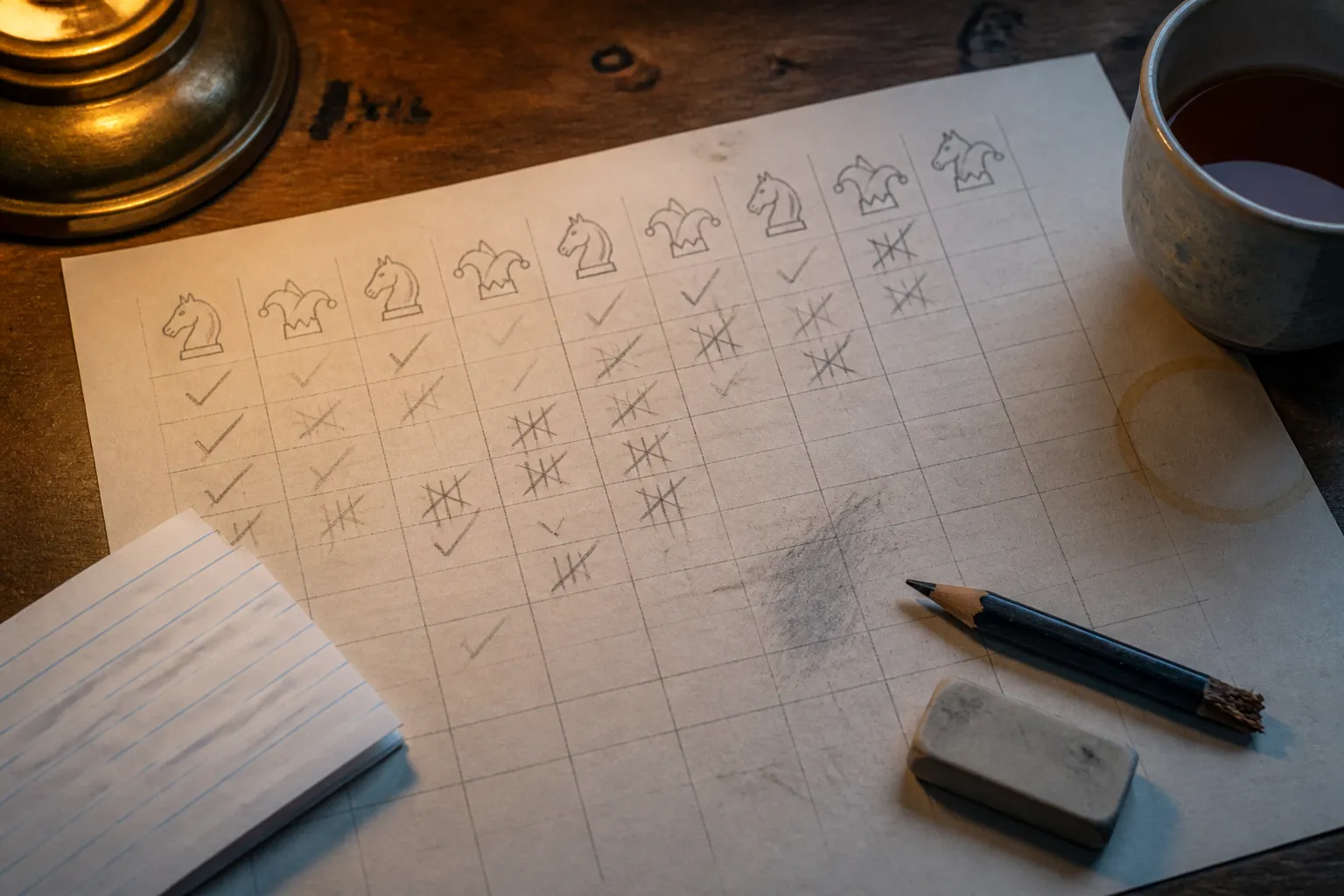
The first tool is the hypothesis test. Assume the speaker is a knight, then check whether his statement stays consistent. If it does not, he is a knave. Then run the same check the other way.
Take a small case. Red and Blue stand before you, and Blue says, "We are both knaves." Suppose Blue is a knight. Then the statement must be true, which would make Blue a knave. That is a contradiction. So Blue is a knave. His statement is false, so they are not both knaves, and since Blue is one, Red must be a knight.
The second tool is a question to ask yourself: can anyone truthfully say this at all? No inhabitant can honestly claim to be a knave. A knight would be lying, and a knave would be telling the truth. Any speaker who says it can be sorted out at once, and that shortcut often unlocks the rest of a puzzle.
The third tool is a better question. Suppose you stand at a fork with two guards, one a knight and one a knave, and you need the right path. Ask either guard which path the other would call correct. Whichever guard you ask, the answer is the wrong path, so you take the other one. The question routes the lie through the truth, or the truth through the lie, and both ways land on the same mistake.
When the answer is not fixed
Not every puzzle ends in a tidy answer. Smullyan's own case with A, B and C shows it. B says, "A said that they are a knave." C says, "Don't believe B." Since no inhabitant can truthfully call themselves a knave, B is lying, so B is a knave. C, who warns against B, is a knight. But A would say "I'm a knight" either way, so A's type cannot be determined.
That matters when you are stuck. Some puzzles are built so the answer cannot be fixed. Before you assume you missed something, check whether a unique answer can exist.
The 382-puzzle collection at the critical thinking site at the University of Hong Kong runs from easier to harder. A computer program generated it. The page gives no answers, so you will want another solver to compare notes with. Start at the first puzzle and move up. The early ones teach you the habit of testing a claim both ways.
The sources do not say how many of the 382 have a single clean solution. They also skip a long multi-speaker walkthrough beyond the short examples above. What they do give is enough to start: two rules, a few checks, and a long ladder of puzzles.
Sources
- Knights and knaves puzzles
- Knights and Knaves: Logic Puzzles Unveiling Medieval Spectacular Stratagems - LearningMole
- Knights & Knaves: Puzzle Logic - Apps on Google Play
- Knights and Knaves - Wikipedia
- Common Logic Puzzles – The Knights and Knaves, Monty Hall, and Dining Philosophers Problems Explained
- Knights and Knaves Puzzles – puzzlewocky
- https://pleasantonmathcircle.org/assets/mat/Knights_and_Knaves%20(1).pdf
- GitHub - SavinRazvan/knights: A Python program that solves Knights and Knaves logic puzzles using propositional logic and model-checking algorithms. Determine the truthfulness of characters based on their statements to solve these classic logic puzzles. · GitHub
Marcus Adeyemi-Holt is a house writer for Deeperpectives, where he examines how ordinary routines reveal larger patterns in work, memory, and place. He draws on years of reporting on municipal records and oral histories to trace the quiet forces that shape everyday life.