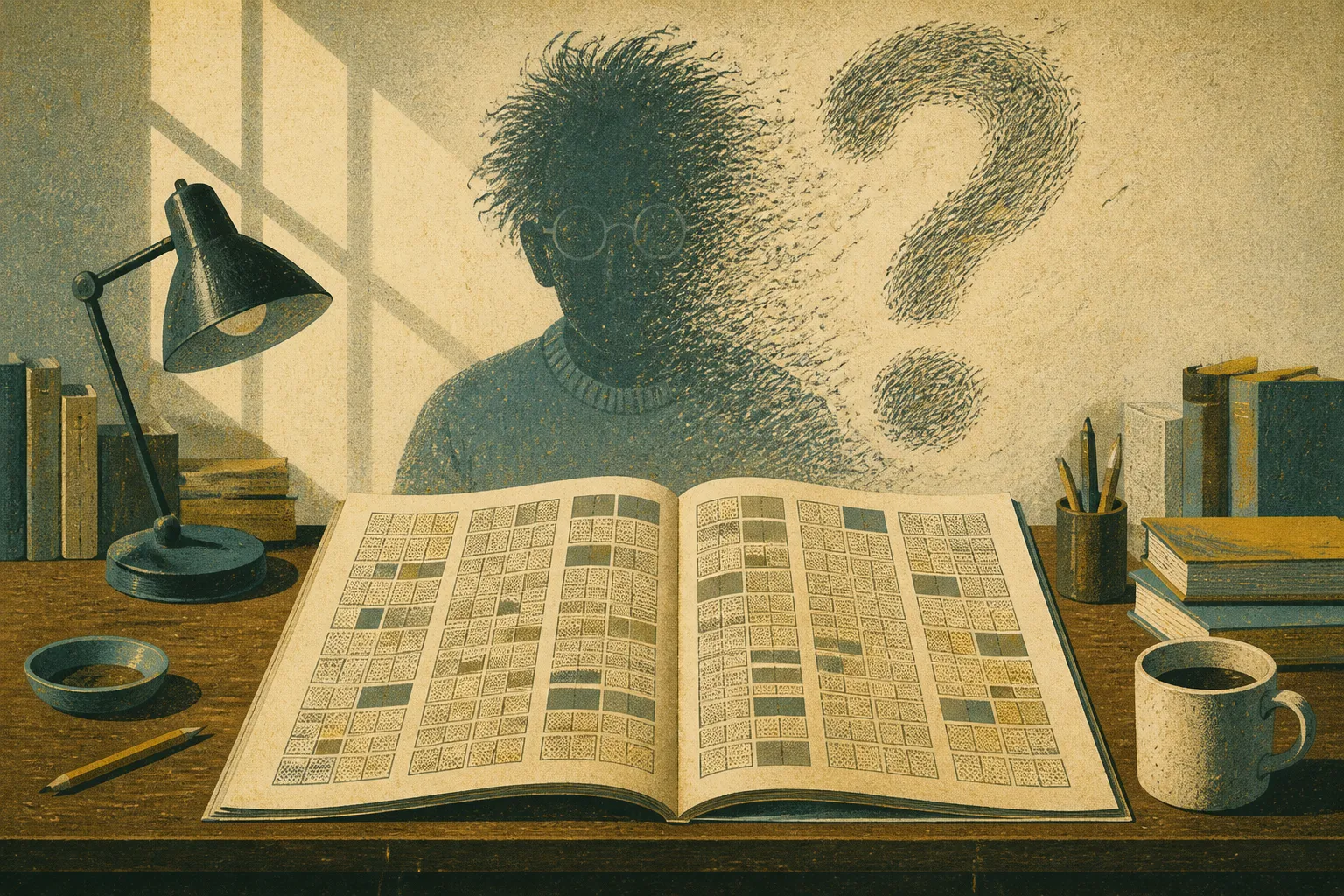

A story hooks us. It throws names, places, and motives at the wall. The texture feels real, lived-in. We taste the grit, see the faces in our minds. This vividness feels like truth. It fits our mental models, coherent and sharp. But coherence is not proof. In fact, it often signals a problem. The more details you add, the more compelling the narrative. And the less likely it is to be true.

The Trap of the Detailed Story
We crave detail. A bare summary? It feels empty. A fleshed-out account, though, it clicks. Extra names, clear motives, a background hum. It all feels 'lived-in.' This sense of fit, this coherence, it’s easy to mistake for evidence. We tell ourselves, 'It just sounds right.' That 'rightness' becomes our proof. This is the conjunction fallacy. It's judging a combined set of conditions as more probable than one condition alone. Our brains jump to the 'representativeness heuristic.' A detailed story fits a mental prototype. It feels typical. And when something feels typical, our brains grant it a higher plausibility. That plausibility then gets cashed in as probability. A dangerous trade.
The Logic That Cannot Be Escaped
Probability theory draws a hard line. The conjunction rule is simple, brutal even. For any event 'A,' and any extra detail 'B,' the probability of both 'A' and 'B' happening cannot be greater than the probability of 'A' happening alone. It's a fundamental truth. Adding a condition, a new claim, can only reduce the chances. Or, at best, keep them the same. It can make a true statement false. It can never make a false statement true. Think about it. If 'A' is false to begin with, then 'A and B' is automatically false, no matter how much sense 'B' makes. Even if 'A' is true, 'A and B' can still be false, should 'B' not hold up. The combined claim is only as strong as its weakest, simplest link. This rule stands. It doesn't care how sensible 'B' sounds. It ignores how interesting the detail is. This is why our intuition often fights it so hard. Our gut wants the good story. Logic demands the cold math.
The Linda Problem and Its Lessons
Amos Tversky and Daniel Kahneman nailed this dynamic. Their Linda problem is a classic. Participants read about Linda: sharp, outspoken, deeply concerned with social justice. Then they faced a choice. Which statement was more probable? Option one: Linda is a bank teller. Option two: Linda is a bank teller and active in the feminist movement. Most people picked option two. The richer, more specific narrative felt right. It fit the sketch. But it defies logic. The probability of 'Linda is a bank teller and active in the feminist movement' cannot be higher than 'Linda is a bank teller.' The second option is a subset of the first. It's impossible for a smaller group to be more numerous than the larger group that contains it. The issue isn't a lack of arithmetic skill. It's the powerful pull of the character sketch. The brain seeks narrative fit, even when it means ignoring basic probability. Once you see the options as sets, the answer is stark. The feminist bank tellers are inside the larger circle of all bank tellers. The truth becomes obvious. The struggle is in that first, intuitive leap.
Weighing Plausibility Against Probability
To be clear, not all detail is poison. Richer descriptions often carry real information. A coherent story can be a sensible reason to pay attention, to dig deeper. Good explanations are usually detailed, not stripped bare. Demanding every account be reduced to its simplest form would gut useful context, leaving us with nothing but dry facts. The line is fine. It runs between plausibility and probability. A detailed story, vibrant and specific, can make a claim far more persuasive. It makes it memorable, easier to grasp. But at the exact same moment, it lowers the actual odds that every single part of it is true. It’s a trick of the mind. When someone pushes a vivid chain of events as an argument, pause. Ask which individual links are shaky. Ask if the whole chain needs every single link to hold. Because the more conditions a claim relies on, the more opportunities it has to collapse.
Limits of What We Know and Practical Caution
The full mechanics of this cognitive glitch are still under review. Why does the brain default to narrative over numbers? Explanations lean on representativeness, on social dynamics, on implicit associations. Each theory captures a piece of the puzzle. None offers the whole picture. So, approach any single explanation with a dose of humility. The research notes do not offer a neat calculator. No one has quantified how much probability bleeds away with each added detail, beyond the cold logic. No step-by-step method exists here for applying this rule to your daily risk assessments or the stories you hear on the street. Debiasing strategies exist, but they are outside the scope of this particular data. What we do have, though, is a reliable mental checkpoint. When a story swells, grows more specific, more satisfying, hit the brakes. Ask yourself: Is each new condition independently supported? And would the simpler version of this claim, stripped of its narrative glitter, still stand a chance?
Sources
Siobhan O'Reilly investigates the friction between urban decay and digital expansion for Deeperpectives. She spent a decade reporting from transit hubs and temporary settlements across the rust belt. Her work prioritizes the raw data of lived experience over polished corporate narratives.