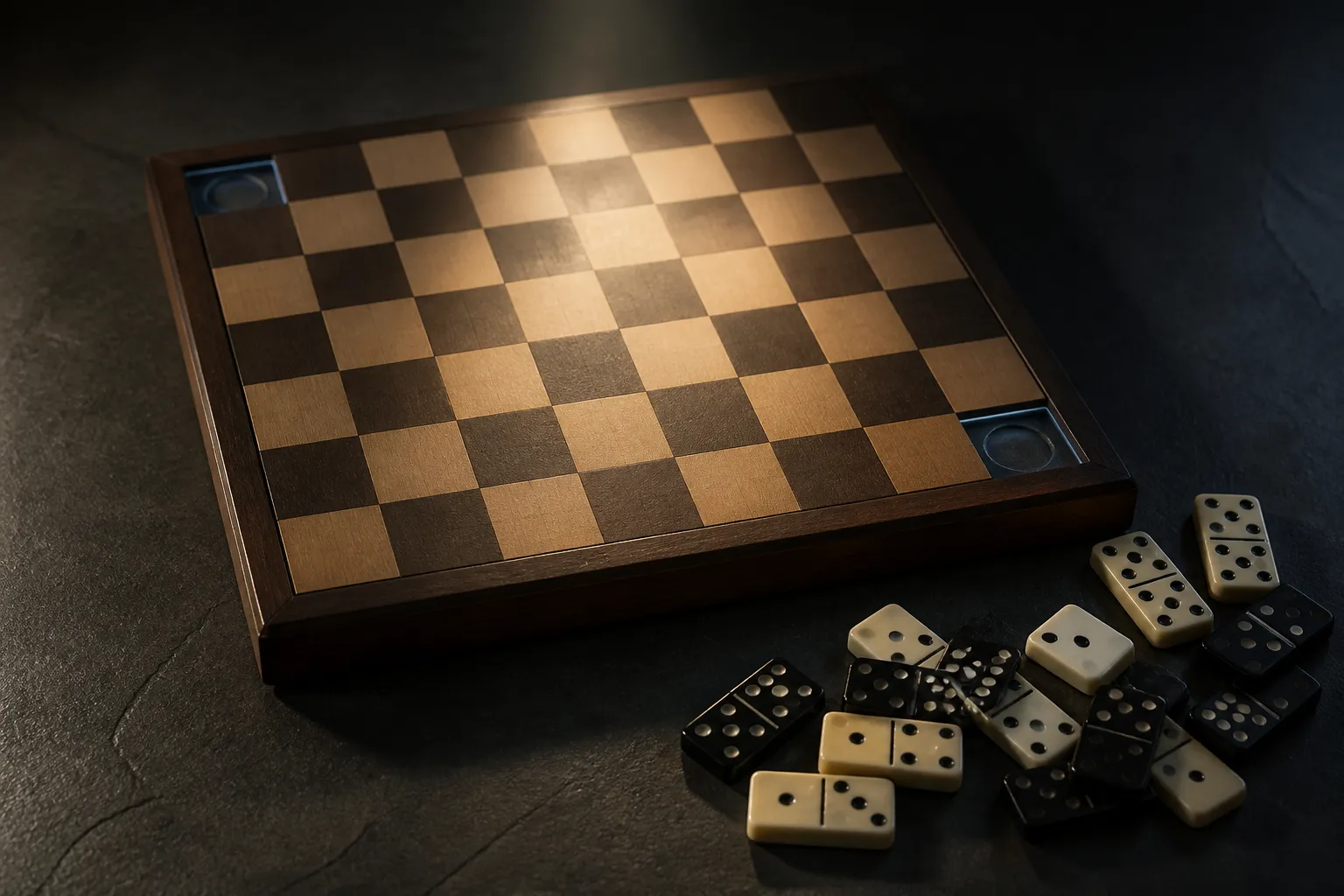
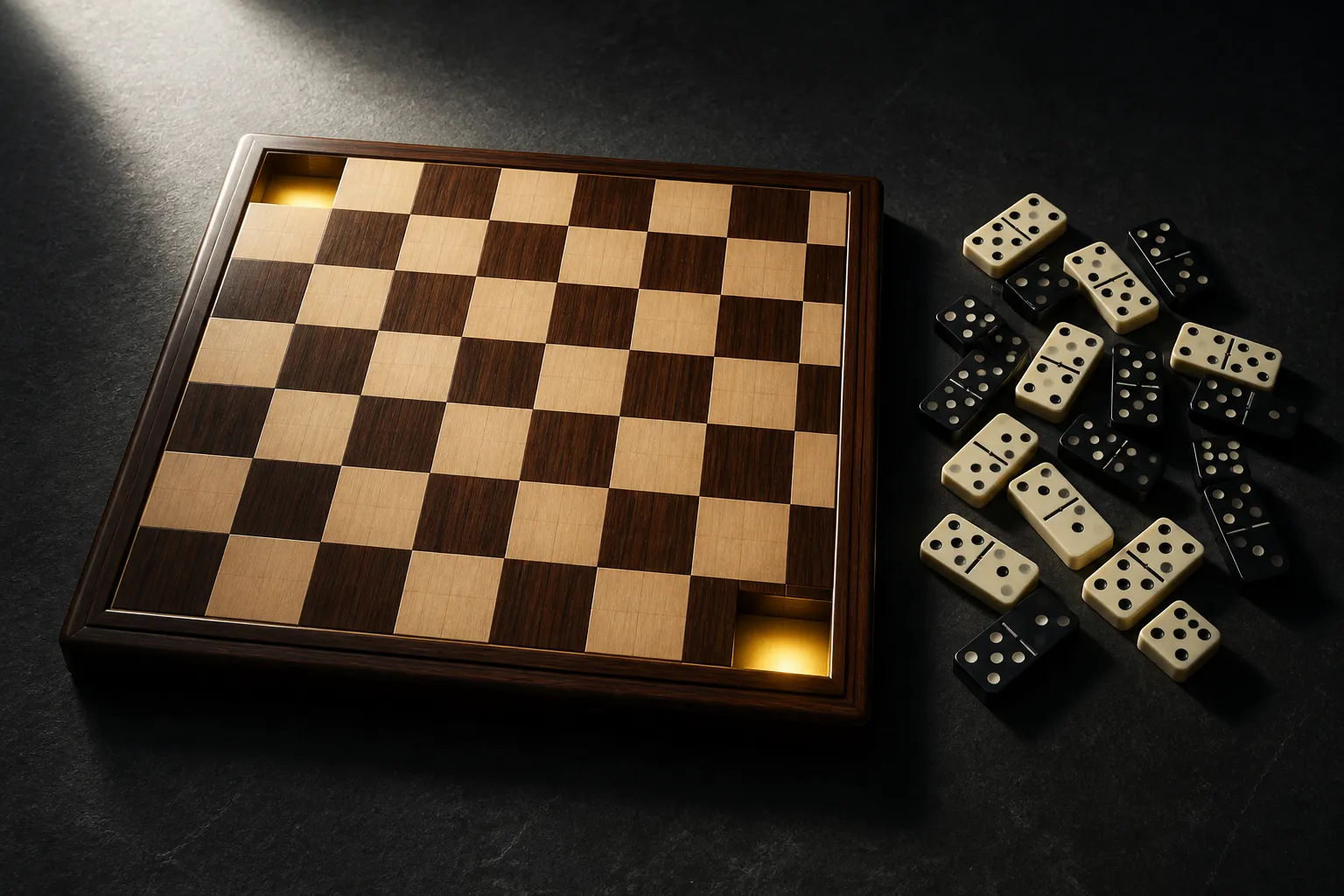
Set 31 dominoes beside an ordinary chessboard and remove two opposite corners. There are still 62 squares, exactly enough for the dominoes. The arithmetic offers no warning. Yet no matter how carefully you arrange the pieces, the board cannot be covered. Max Black posed the puzzle in Critical Thinking in 1946, and its small disturbance to a familiar board opens a larger question: what can a count tell us, and what does it leave out?
The puzzle and its counterintuitive answer
A domino covers two neighboring squares, either side by side or one above the other. The challenge is to cover every remaining square, without overlap or gaps, using 31 dominoes. Since each domino covers two squares, the total fits: 31 times two is 62. That first calculation is correct. It is also insufficient.
Try placing the pieces by hand and the problem seems to invite persistence. A promising arrangement closes off a narrow space. Another leaves a square stranded at the edge. Each dead end can feel local, as if one poor choice spoiled a solution that might still exist somewhere else. The puzzle’s force comes from the mismatch between that feeling and the actual answer. This is not a matter of finding the clever placement. There is no placement to find.
The problem became a familiar example of an impossible tiling, circulated in the 1950s by writers including Solomon Golomb, George Gamow and Marvin Stern, Claude Berge, and Martin Gardner. Its staying power depends on how little equipment the proof requires. No special vocabulary is needed. A board, two colors, and one rule about dominoes are enough.
The coloring argument changes the count
Color the squares alternately, as on a standard chessboard. Every pair of neighboring squares has different colors. A domino placed anywhere on the board must therefore cover one black square and one white square. This remains true when the domino is turned, moved to an edge, or placed in a crowded corner.
So a complete tiling has a requirement that the area count missed: it must pair every black square with a white one. The unaltered board has 32 of each. Opposite corners on an 8-by-8 board have the same color. Removing both leaves 30 squares of that color and all 32 of the other. Since each domino uses one of each, two surplus squares cannot be covered.
The argument rules out every arrangement at once. It does not need to predict which domino would go where or inspect a long sequence of placements. A color imbalance is already enough. The standard account of the mutilated chessboard problem states the proof in this form; a discussion of the puzzle also emphasizes the gap between matching the area and meeting the color condition.
That gap is worth keeping in view. The 62 squares are not a misleading number. They are simply not the only thing a tiling must respect. A count can establish that a solution is possible in one basic sense, while a different property shows it is impossible in another.
Why trial and error cannot settle it
Hand-solving the board is a useful way to encounter the puzzle, but it cannot establish the general result. A person may fill one corner, then another, and repeatedly reach a dead end. Those failures say something about the arrangements tried. They do not show that all arrangements fail. The search space contains billions of possible arrangements, far too many to check one by one in any practical way.
The coloring proof takes a different route. It identifies a feature that remains true for every legal move: each domino always covers one square of each color. In mathematics, such a feature is often called an invariant. Here, the invariant makes the mismatch visible before any domino is placed. The board begins unbalanced, and no collection of two-square pieces can restore balance while covering it exactly.
This is why the proof feels like a change in the question. Instead of asking, “Where should the next domino go?” it asks, “What must be true if a tiling exists?” The answer supplies a test. If the colors do not balance, there is no need to keep arranging pieces. A neat proof can save effort, but it also changes what counts as evidence: failed attempts become unnecessary once a condition rules out every possible success.
What the board carries beyond the puzzle
The same color test works if the removed corners are black rather than white. More generally, for this 8-by-8 board, removing two squares of different colors leaves a region that can be tiled by dominoes, while removing two of the same color creates the imbalance that makes tiling impossible. The position of the missing squares matters, but color gives a quick first account of why.
The puzzle has also traveled beyond recreational mathematics. John McCarthy proposed it as a test case in automated reasoning in 1964. Researchers in cognitive science have used it to investigate insight, and philosophers have discussed what makes a proof convincing. Those uses pose different questions from the tiling problem itself. The coloring argument shows a decisive reason that no tiling exists; it does not, by itself, settle what makes someone notice that argument or how well the puzzle measures creativity.
There is another history in the dominoes. In statistical mechanics, pairs of neighboring sites are studied as dimers, and work by Ralph Fowler and George Rushbrooke in 1937 connected dimer arrangements with physical theory. Domino tilings also appear in practical arrangements such as pavement and tatami flooring. A small rectangle can belong to several kinds of inquiry at once: a recreational challenge, a formal proof, and a model for how paired pieces occupy a larger surface.
Return to the board with its two empty corners. The first count still holds: 31 dominoes have enough area to cover 62 squares. But the squares remember a pattern the count cannot see. Every piece must take one of each color, and the missing corners have taken two of the same. That is the whole obstruction, resting quietly in the checkerboard before the first domino is touched.
Sources
- Mutilated chessboard problem - Wikipedia
- The Mutilated Chessboard: When Math Beats Brute Force
- https://vertexaisearch.cloud.google.com/grounding-api-redirect/AUZIYQEceenZbPGnq9jSGkTcDy6N2sdGd3etcmdlIq4V_3qTEYH6Qp3QxtVHlA6iymk2zpaNYizDCZbkR96MCD4ZsTuu_UrE4L1xKKK031mvF3yzmp6oBId17ZQ-_MyWltQvvDiPX4_CxkY1riXnZbausClFWIbX
An exceptional writer at Deeperpectives, she covers public memory, family archives, and the histories held in ordinary objects. Before joining the desk, she cataloged oral histories for a neighborhood museum, where she learned to treat a small detail as a door, not a conclusion.