
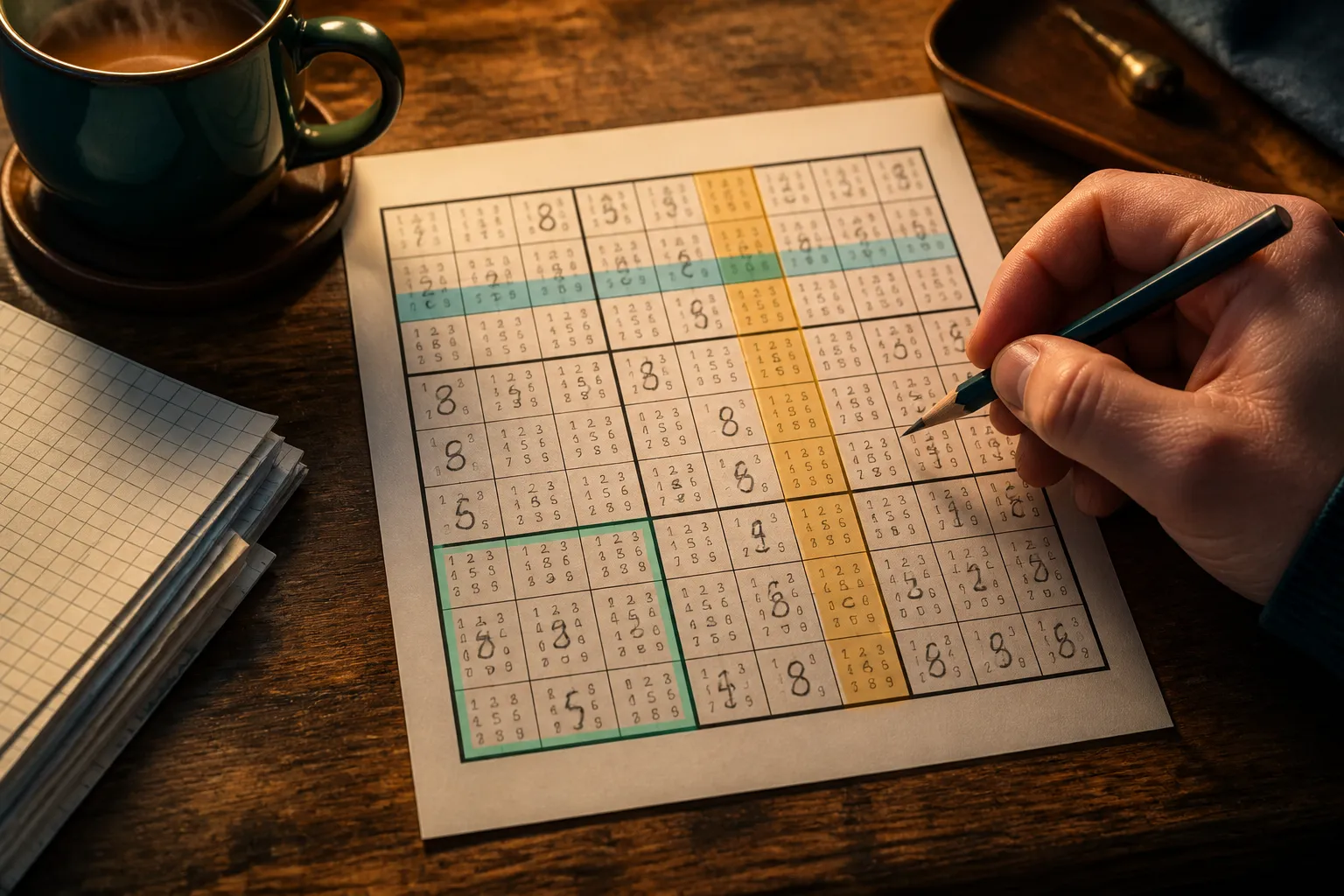
A blank Sudoku grid looks like a lottery. Eighty-one cells, nine possible digits in most of them, and a pencil that seems to invite a flutter of hope. Yet the people who finish these puzzles quickly are rarely lucky. They are bookkeepers. They keep track of what each cell is still allowed to hold, and they cross things out.
Why Sudoku Looks Like Guessing
The rules fit on a napkin. Every row, every column and every 3×3 box must contain the digits 1 through 9 exactly once. That is the whole contract. The standard version is a 9×9 grid, though the general form is an n² × n² grid with n×n boxes, and n is most commonly 3 (Illumin).
What a newcomer misses is that each filled cell speaks to three groups at once. Place a 5 and it vanishes from the candidate lists of its row, its column and its box. A grid that seemed wide open begins to narrow with every clue.
Computer scientists file Sudoku under Constraint Satisfaction Problems, where variables must take values that obey a set of rules. The framing changes the question. You stop asking where the hidden answer is and start asking what each cell is still permitted to be. The Illumin article goes further and argues that no guessing is required, because every part of the solution can be derived from the constraints already on the page.
Elimination as the Core Skill
Most solving starts with plain bookkeeping. List the candidates for an empty cell, strike any digit already present in its row, column or box, and see what is left. If one digit remains, it is forced. Place it, and the strike-outs ripple outward to neighbouring cells, which may now be forced in turn.
The same article holds that machine methods mostly formalize, refine and scale this kind of reasoning, which people already do by instinct. That is a modest claim, and a believable one. A solver who scans for cells with few candidates, or asks whether a digit has only one legal home within a row, is doing by hand what a program does by rule.
The sources stop short of cataloguing named human techniques, so anyone hunting for a vocabulary of strategies must look elsewhere. What they do support is a discipline: each step should be justified by a constraint, not by a hunch that happens to feel right.
Backtracking Versus Constraint Propagation
A comparative study put two computer approaches against 500 puzzles spread over five difficulty levels, Beginner to Expert (arXiv study). Backtracking is the plodding one. It visits empty cells in a fixed order, tries digits 1 through 9, checks each for validity, and steps back to change the previous cell when nothing fits. It needs little setup. It can also waste a great deal of effort on branches that were doomed early.
The heuristic method does its thinking first. It uses constraint propagation to narrow possibilities before any value is tried, and its ordering rules, most constrained cell first and least constraining value first, aim to surface contradictions early. The study found it consistently outperformed backtracking, with speedups from 1.27 times on Beginner puzzles to 2.91 times on Expert ones. The authors describe it as combining human intuition with optimization.
Precision matters here. Backtracking is trial and error, plainly. The heuristic method still tries values, but only after propagation has thinned the field. The gap between them is the lesson: a search that spends more logic before it guesses throws away less work.
Limits and Open Questions
Logic-first solving does not promise a guess-free finish for every grid. Some hard puzzles stall under pure elimination, and the solver must test a hypothesis and watch for a contradiction. Whether that counts as guessing or as disciplined reasoning is a fair argument, and the sources treat it as a question of method more than a verdict.
Other gaps remain. The study reports that the minimum number of clues for a unique 9×9 solution is 17, but it does not say how that was established. It also does not explain how difficulty levels were defined, where the puzzles came from, or whether the heuristic's edge would survive a different collection. Those are reported findings, not settled facts.
A decent self-check fits on one line. Does this puzzle have a unique solution, and is my next move forced by a constraint, or am I just trying something to see what happens? The honest answer tells you how much of your solving was deduction and how much was search.
Sources
- Beyond the Grid: How Sudoku Reflects Computational Thinking – Illumin Magazine - USC Viterbi School of Engineering
- A Study Of Sudoku Solving Algorithms: Backtracking and Heuristic
- https://vertexaisearch.cloud.google.com/grounding-api-redirect/AUZIYQFKR0c-e1Nq7o_dEjRHS3OSoUjvxayq3n3822TOkahY0dtJ_l8UkTZiQnGefdwUgjiC1CmDOfTH4JBMpmMXyLdlveS6YE83xwG8lHb3k6mEvHoWuBvdK31zXwSjtXHOW3jR2w==
Marcus Adeyemi-Holt is a house writer for Deeperpectives, where he examines how ordinary routines reveal larger patterns in work, memory, and place. He draws on years of reporting on municipal records and oral histories to trace the quiet forces that shape everyday life.