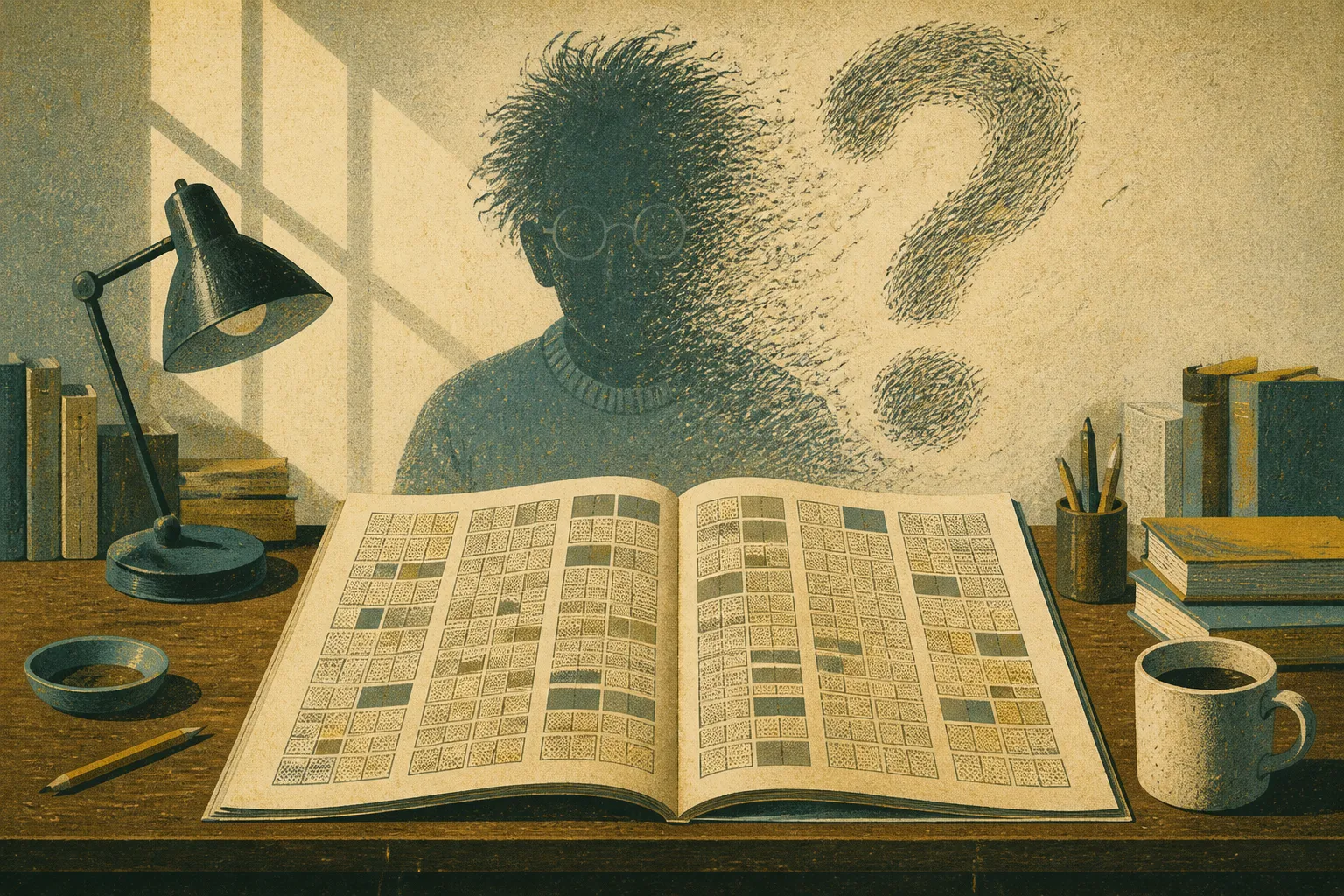

A teacher tells a class that a surprise test will be given sometime next week. One student, pleased with herself, works out that it cannot happen. The rest of the room keeps an eye on the calendar anyway. That gap between a tidy proof and ordinary experience is the whole story of the surprise test paradox.
The Puzzle as Stated
The setup is plain. The announcement makes two promises. There will be a test within the week, and its day will be a surprise. The student then reasons from the back of the week forward.
A Friday test would be predictable on Thursday evening, since no earlier test had come. So Friday is out. With Friday gone, Thursday becomes the last possible day, and a Thursday test would be predictable on Wednesday evening. Thursday goes too. Then Wednesday, then Tuesday, each falling to the same move. Monday falls last, because it would be predictable on Sunday. No day is left.
And yet common sense says a test can still arrive, and still startle. Picture the class on Wednesday morning, the student's proof tucked in her notebook, when the teacher hands out the papers. Most people expect her to be surprised. The Stanford Encyclopedia of Philosophy entry on epistemic paradoxes files the puzzle under riddles that turn on knowledge. That fits. The word "surprise" is defined by what the student knows beforehand, so the riddle concerns knowing as much as it concerns test days.
How the Elimination Argument Works
The reasoning moves one day at a time, and each step leans on the one before. The student must remember what she has already struck from the list. She must also hold that the test has to be unexpected on whatever day it falls. Take away either support and the chain sags.
Because the days fall in sequence, the argument looks like a formal proof. The Stanford entry credits a formalization to Holliday (2017). The excerpts used here do not say what that work contains, so it is only a pointer for readers who want the formal version.
The layout helps in one practical way. It lets you hunt for the weak joint. You can ask which premise carries the load, and whether the conclusion survives only if every premise holds at the same moment.
Where the Argument Can Be Challenged
The common-sense side has a simple case. Before the test arrives, the student has only the teacher's word that it will come and that it will be a surprise. If she cannot be sure the teacher will keep both promises, she cannot rule out a Wednesday test with confidence. Her proof must treat the announcement as something she knows to be true. Yet the proof concludes that the announcement is false. A premise that the argument itself destroys is a shaky premise. This framing is a standard reading of the puzzle and goes beyond what the cited excerpts say, so treat it as background, not as the Stanford entry's verdict.
Three questions do most of the work in pinning down the weak spot:
- Which premise is doubted: that the student would know the day in advance, or that the test must be a surprise on every eliminated day?
- Must surprise mean she cannot know the day, or only that she cannot be certain of it?
- What must "knowledge" mean for the announcement to come true at all?
The second question deserves a moment. Knowing a day and being certain of it are different conditions. A student might have good reason to think Friday is unlikely without being certain. Whether that gap rescues the teacher is a question the sources raise but do not answer.
Weighing the Two Answers
The sources set the matter up as a choice between two answers. One says no surprise test is possible. The other says one plainly is. Both arrive with credentials, so neither can be waved off just because the other feels more respectable. Accepting either as decisive too quickly is the main mistake on offer.
The excerpts do not describe the standard resolutions, the objections to them, or which answer the literature favors. So no winner is named here. The sources do say that, whichever answer you prefer, the value lies in the correction the riddle forces on how we think about knowledge, justification and evidence. The wider family of epistemic paradoxes has been discussed for about twenty-five hundred years, starting with Plato's dialogues featuring Socrates. That figure comes from the Stanford overview of the whole family, not from this puzzle alone.
A Habit Worth Keeping
The puzzle teaches one portable check. When a claim is defined by what someone knows, such as a surprise, a secret or a fair test, ask whether the reasoning treats that claim as known. If the argument assumes the claim is true and then concludes it is false, stop and look at the assumption. The same check works on plans that say "nobody will see this coming." It is worth running before you trust a tidy proof.
The two plates below hold the picture.


Sources
Marcus Adeyemi-Holt is a house writer for Deeperpectives, where he examines how ordinary routines reveal larger patterns in work, memory, and place. He draws on years of reporting on municipal records and oral histories to trace the quiet forces that shape everyday life.