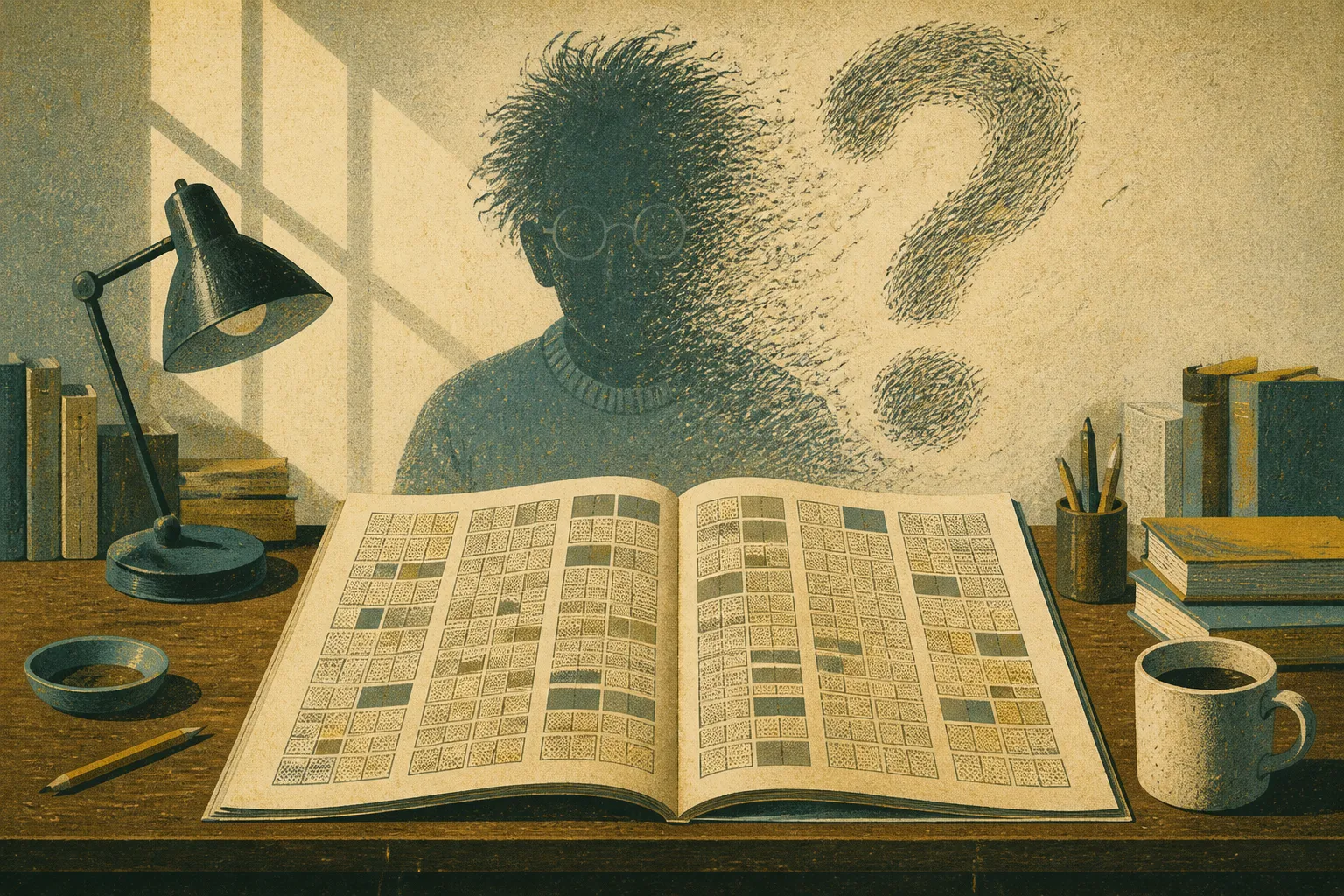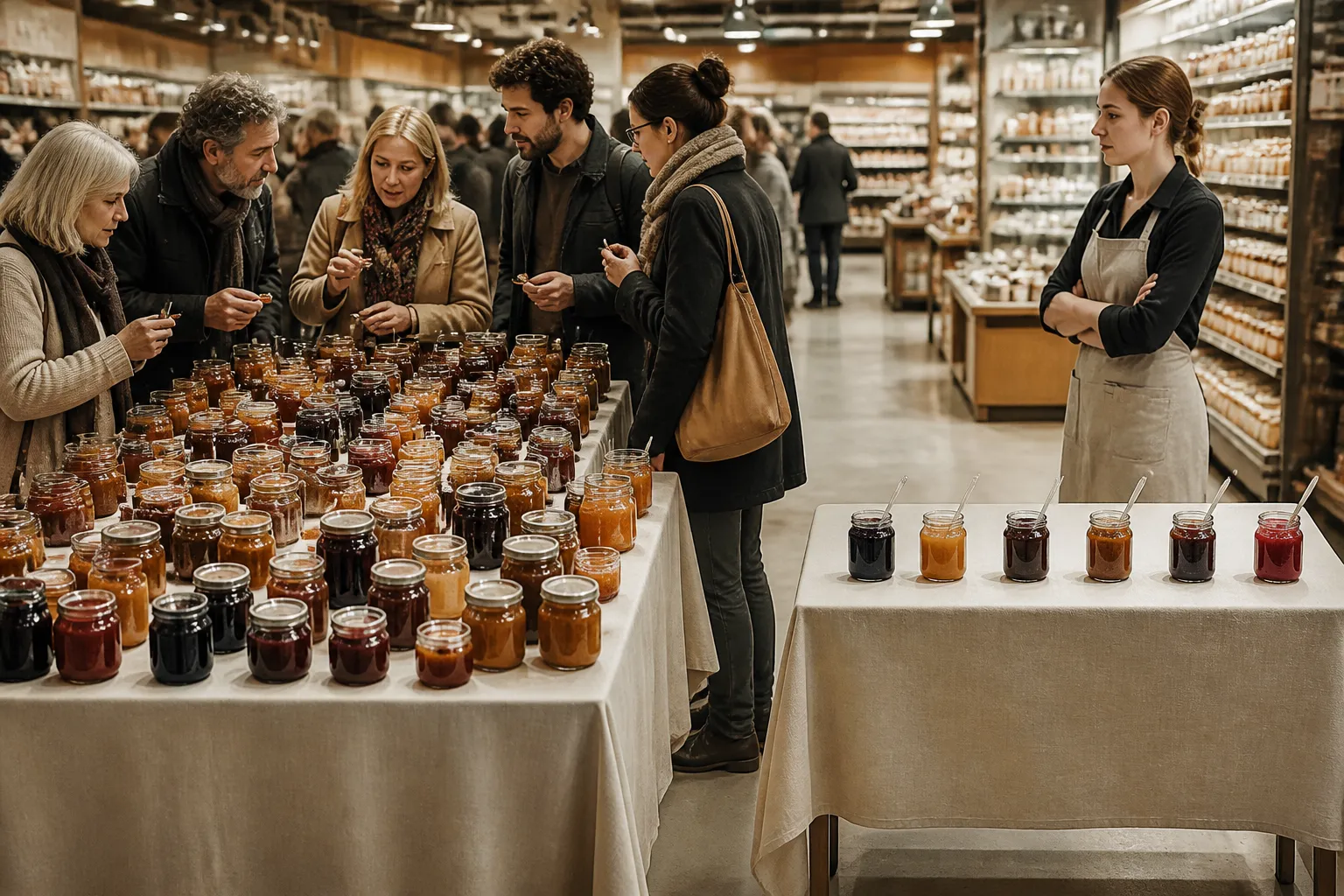
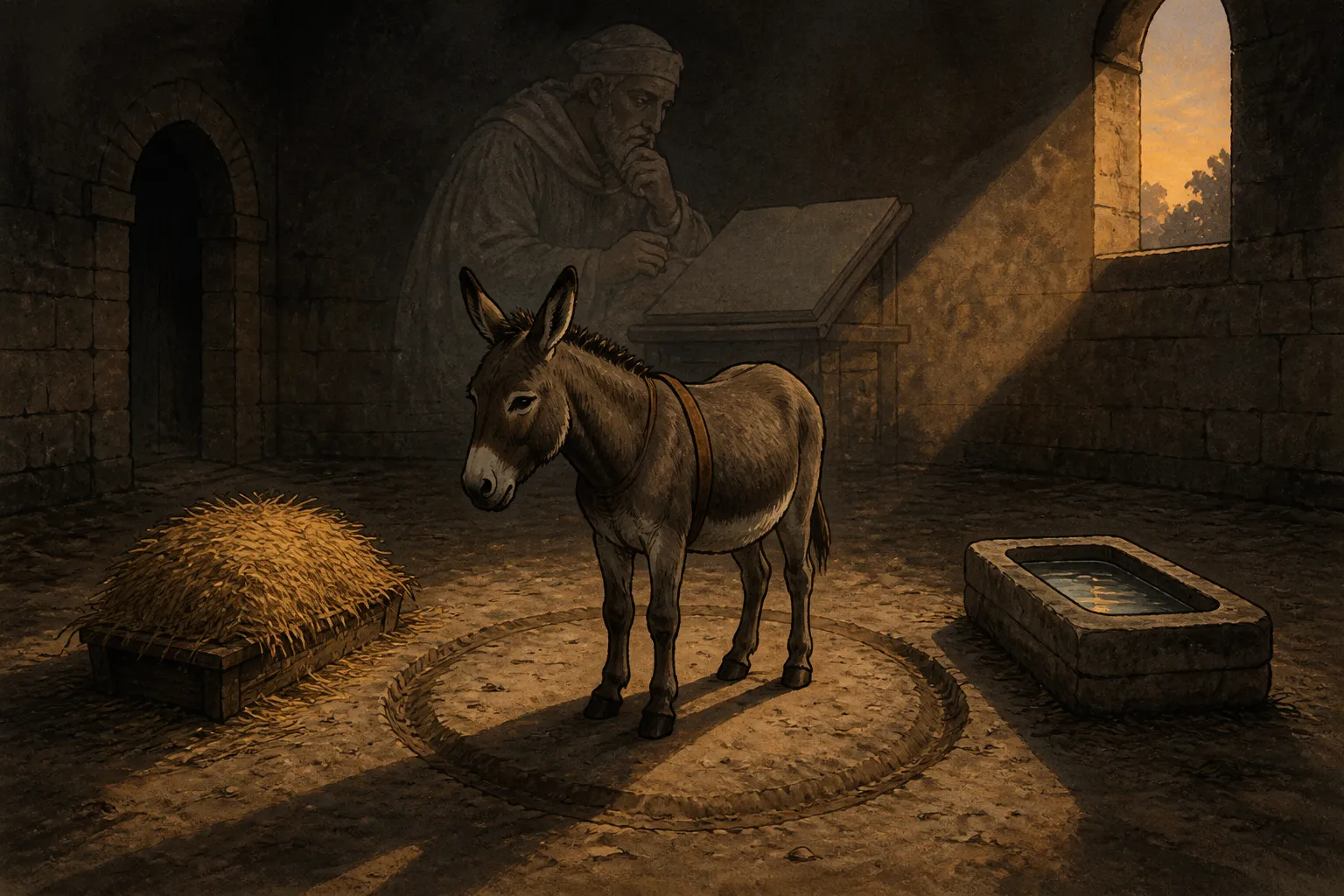
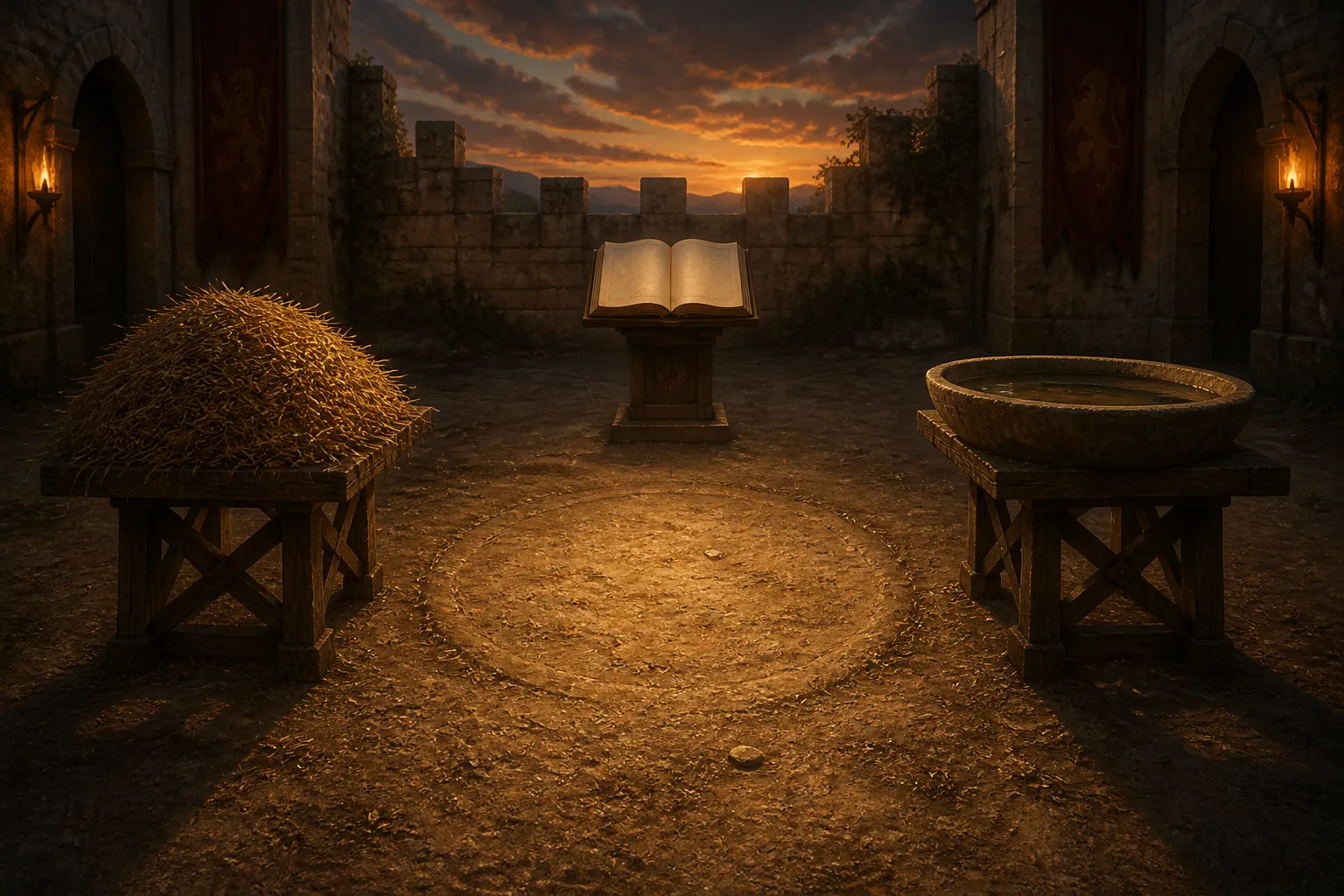
A hungry, thirsty donkey stands exactly between a pile of hay and a bucket of water. Nothing favors one side over the other. So, the story goes, it cannot decide, and it starves. The animal carries the name of John Buridan, a fourteenth-century master at the University of Paris. Buridan was a real person with a documented career. The donkey is a harder case.
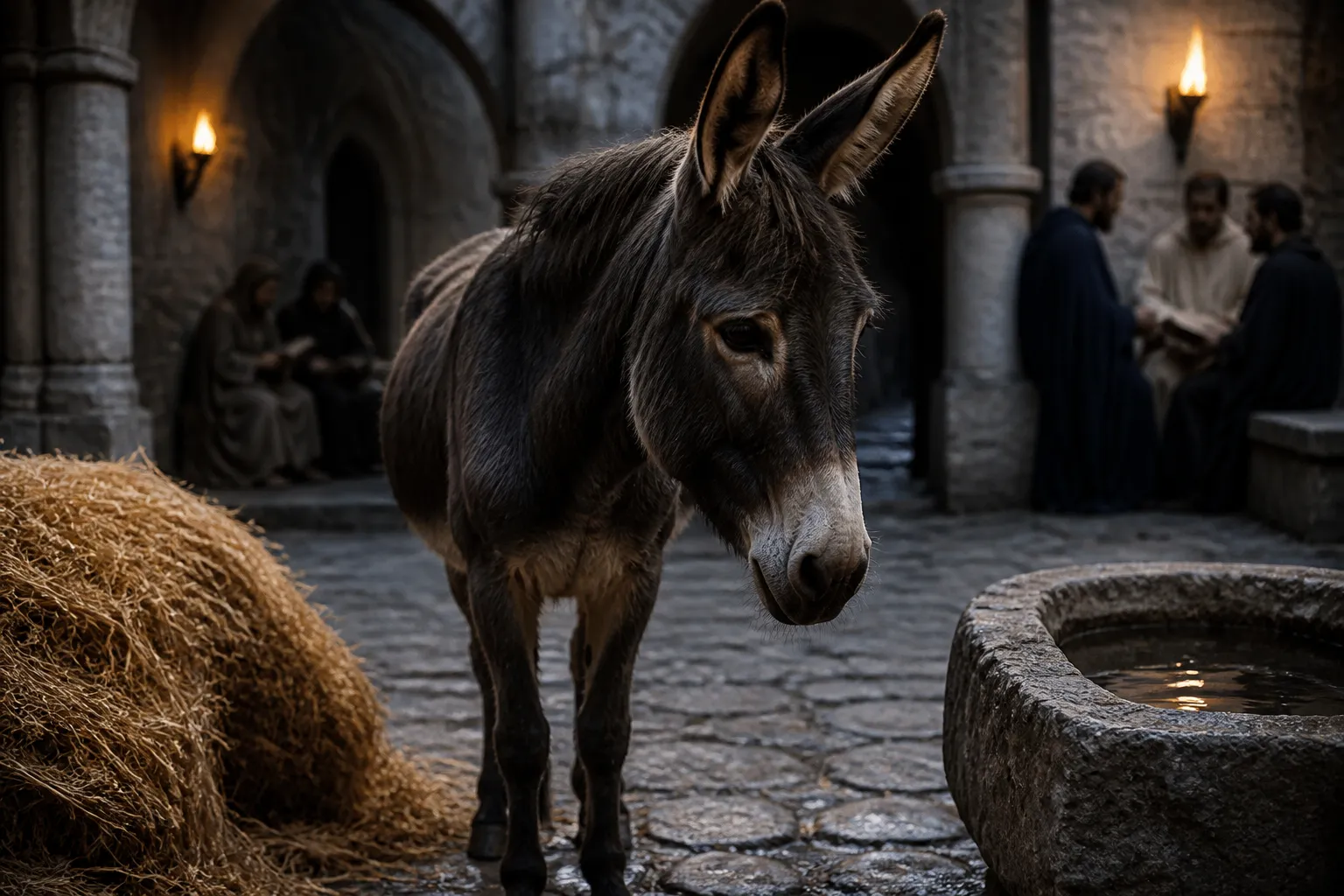
The puzzle is easy to remember, which is part of why the name has lasted. The history behind it is messier. The sources we can point to describe the man and his logic well, but they say nothing about the donkey itself. That silence is worth taking seriously before anyone repeats the tale as settled fact.
Who John Buridan Was
Buridan was born around 1300 near Béthune in Picardy. He spent his working life as a teaching master in the arts faculty at Paris, lecturing on logic and on Aristotle. He served as university rector in 1328 and again in 1340. He last appears alive in a document from 1358, and a benefice was reassigned in 1361, which suggests he died soon after.
His best-known work is the Summulae de dialectica, a text that updated Aristotelian logic with the methods of terminist logic. That is the solid ground. Around it grew a thick layer of legend. Stories that he drowned in the Seine, that he founded the University of Vienna, or that he had a shoe-related run-in with a future pope cannot be independently verified. Historians have debunked several of them. Even a commentary on Aristotle's Politics once credited to him turned out to be the work of Nicholas of Vaudemont. Buridan's name seems to have attracted stories, and a careful reader should expect that.
Where the Donkey Comes From
Many historians of philosophy note that the donkey does not appear in Buridan's surviving writings. That claim comes from the wider scholarly literature, not from the encyclopedia entries behind this piece, so treat it as a widely repeated point and check it against a specialist source before quoting it. The entries we drew on cover his life, logic and influence, and they never describe the animal. None of them says where the image first shows up.
The idea itself is older than Buridan. Commentators often point to Aristotle's On the Heavens, which imagines a person as hungry as he is thirsty, standing between food and drink and staying put. Medieval Islamic writers are also commonly cited for similar examples. So the puzzle of perfect balance has a long history, and Buridan's name arrived on it later.
Why his name stuck is a matter of debate. One reading is that critics coined the donkey to mock his view of the will. Another is that the label simply drifted onto a famous teacher, the way the Politics commentary did. We have no way to settle between them from the sources at hand.
What the Puzzle Is Meant to Show
The question underneath is old and hard. If an agent always acts on the strongest motive, what happens when two motives are exactly equal? A strict determinist seems to owe an answer, and the donkey makes that debt look embarrassing. Starving between two equal piles of hay looks absurd, and absurdity was the point.
Scholars read it two ways. On the first reading, the donkey is a weapon against a mechanical theory of choice. If motives alone decide, the animal should freeze, yet real creatures do not freeze. So something other than the strongest motive must be doing work, perhaps the will itself. On the second reading, the puzzle is a mild trap that proves little. Exact ties almost never occur, and in any real case some faint difference tips the balance without anyone noticing.
The link to Buridan's own views is contested. Some interpreters say he held that the will can hold back and keep deliberating before it commits, which would make him a poor target for the satire. Others read the same material differently. The sources used here do not explain how his account of free will connects to the donkey, so the safest statement is that the connection is an interpretation, not a documented fact.
The donkey is famous for starving. The person who named it may never have put it on paper.
How to Use the Puzzle Today
The practical lesson is smaller than the philosophical one. When two options look truly equal, the cost of agonizing is usually higher than the cost of picking either. A donkey that spends the afternoon comparing piles has already lost something that a coin flip would have saved.
A few habits follow from that:
- Set a deadline for the decision before you begin comparing.
- If the options still tie at the deadline, pick one by any arbitrary rule and move on.
- Ask whether a tiny difference you ignored is actually the answer.
The lesson about the story is just as plain. Check where a famous example comes from before you attach a name to it. A quick look at the record here turned up a missing donkey and a misattributed commentary, and both are the kind of gap that a confident retelling hides. Say what the sources show, say what they leave out, and let the puzzle do its work without borrowing authority it may not have earned.
Sources
Siobhan O'Reilly investigates the friction between urban decay and digital expansion for Deeperpectives. She spent a decade reporting from transit hubs and temporary settlements across the rust belt. Her work prioritizes the raw data of lived experience over polished corporate narratives.