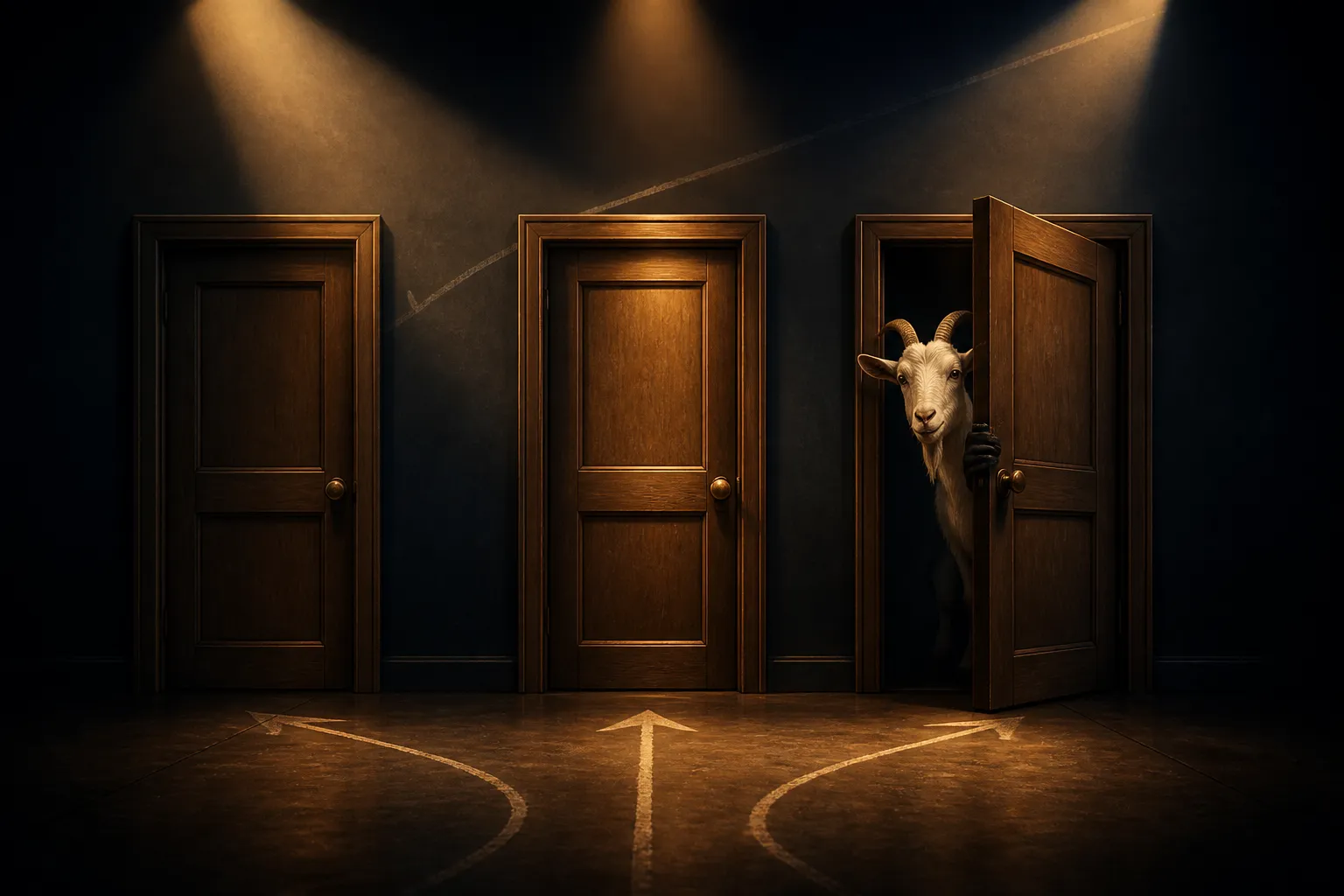
Three doors stand in a row. Behind one is a car; behind the other two, goats. A contestant points to a door. Then the host opens one of the other doors, showing a goat, and asks whether the contestant wants to stay or switch. The pause after that question is where the puzzle begins: what, exactly, has the host told us by opening that door?
The setup and the intuition it fights
The tempting answer is that the two closed doors now have equal chances. One hides a car, one does not; the revealed goat seems to have been removed from the game. The choice looks like a fresh coin toss, and staying or switching appears to make no difference. That first impression is common, and it has a sensible source: people often picture the host opening a door at random, with a lucky goat behind it.
But the host in the standard puzzle does not open a random door. The host knows where the car is, avoids it, and deliberately reveals a goat behind one of the doors the contestant did not choose. That rule is part of the evidence. The opening is not simply a door disappearing; it is an action shaped by what the host knows.
Before the reveal, the contestant’s first choice has a one-in-three chance of being the car. The two doors left unchosen together hold the other two-in-three chance. When the host opens a goat door among those two, the remaining closed door inherits that combined chance. Staying wins if the first pick was right, one time in three. Switching wins if it was wrong, two times in three.
Two looks at the same game
Now change the order. Imagine the host opens a goat door before the contestant makes any choice. The contestant then chooses between the two closed doors. For this version, assume the host follows a symmetric rule when there is more than one goat to choose from, so the reveal does not favor one remaining door. The contestant has no earlier pick to carry forward and no informed offer to switch from. The two closed doors are equally likely to hold the car.
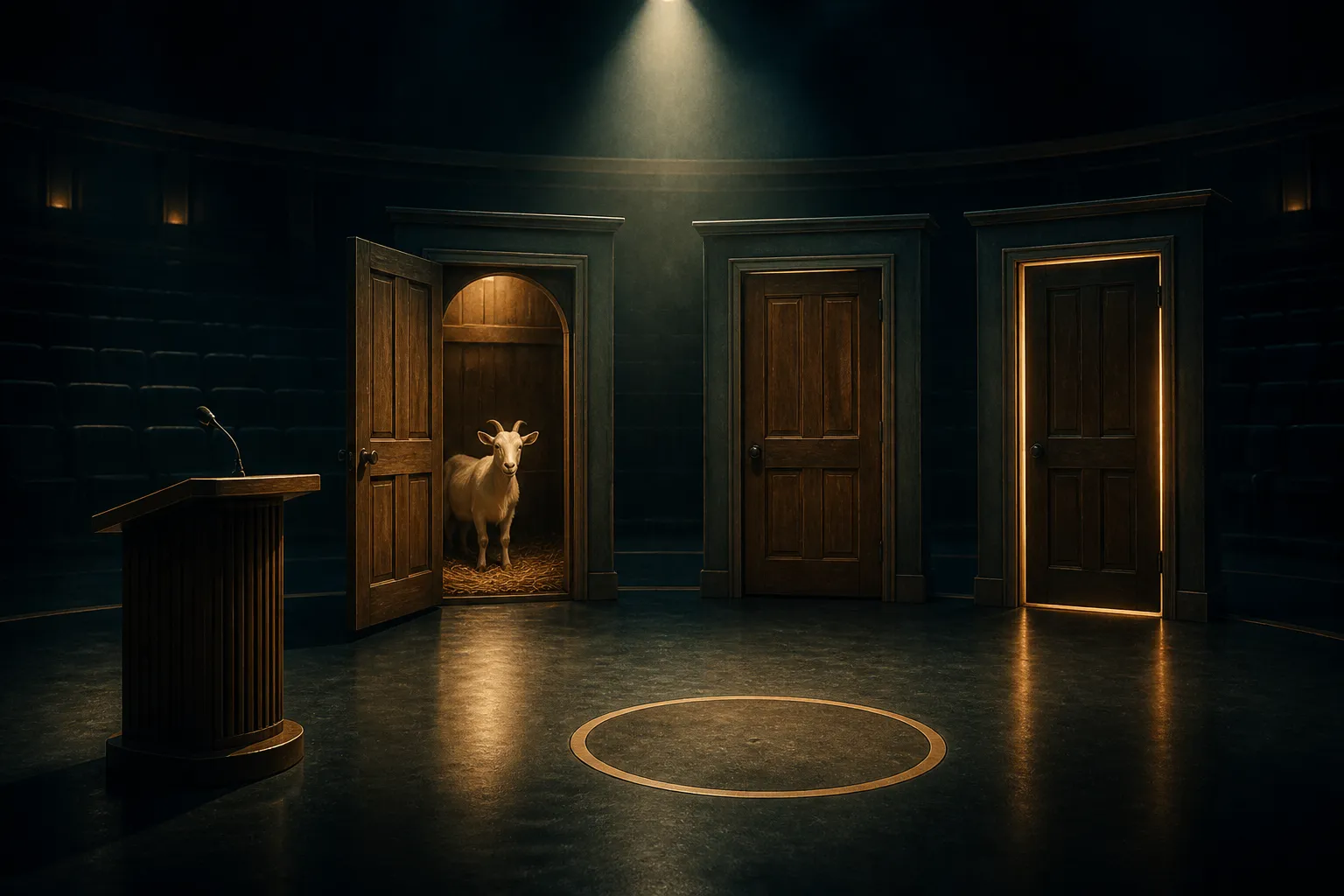
These scenes can look nearly identical in a quick retelling: one goat is visible, two doors remain closed. But they have different histories. In the standard game, a contestant’s original door keeps its one-in-three chance, while the host’s constrained choice identifies the other unopened door as the place where the remaining two-in-three chance sits. In the host-first version, no original pick has separated one door from the other two. The reveal leaves a genuinely even choice, given the symmetric procedure.
The host’s hand is part of the evidence
Probability questions are often written as if events arrive separately: first a car is placed, then a contestant chooses, then a door opens. It is easy to focus on the visible result, a goat, and forget the process that produced it. Yet the host’s knowledge connects the opening to the car’s location. If the contestant initially chose a goat, the host is forced to open the only other goat door. The car is then the sole unopened alternative. If the contestant initially chose the car, the host can open either goat, and switching loses.
That is the whole calculation in miniature. The first choice is wrong in two of the three possible placements of the car. In each of those cases, the host must leave the car behind the other closed door. The host’s action does not make the original choice better; it concentrates the two unchosen doors’ initial chance into the one door the host cannot open. A fuller discussion of the problem’s relation to informed selection appears in this article on the Monty Hall problem and false discovery rates.
A Bayesian solution can express the same update by asking how likely the observed evidence is under each possible car location. A probabilistic graphical model can make the dependencies visible: the host’s action depends on the car’s location and the contestant’s pick. The calculation matters, but so does the diagram of who knows what and which action follows from that knowledge. Without that structure, the answer can sound like a trick performed on the numbers.
A puzzle that kept finding new readers
The problem entered print through a 1975 letter to the editor of The American Statistician, then reached a much wider audience in a 1990 Parade column by Marilyn vos Savant. The answer drew objections from many readers, including mathematicians. Paul Erdős, the mathematician known for his work across probability and number theory, reportedly remained skeptical until he saw an empirical demonstration. The episode is a small archive of how stubborn a familiar intuition can be, even when the rules are stated plainly.
One way to see the result is to play the game repeatedly. Keep a record of the first choice, the host’s reveal, and the final outcome. Switching wins roughly twice as often as staying when the standard rules are followed. A simulation is not a replacement for understanding the rules, but it gives the abstract count a physical rhythm: most rounds, the first pick misses, and the host leaves the car visible only by process of elimination.
The puzzle is now often used to introduce Bayesian thinking, in part because the host’s knowledge is so easy to isolate. A recent discussion of why the problem remains difficult describes how the dependency between events can fade from view when probability is taught as a sequence of separate calculations. The paper’s account of the Monty Hall problem also points toward a useful habit: ask how the evidence was selected, not only what the evidence shows.
Where the analogy stops
The game offers a clean lesson about informed selection, but it is not a ready-made formula for every research problem. In large-scale data analysis, filters and decision rules can affect which results remain visible, yet those systems have more moving parts than three doors and a host. The useful question travels better than the game’s exact odds: what did the person or process choosing this evidence know, and what options were available?
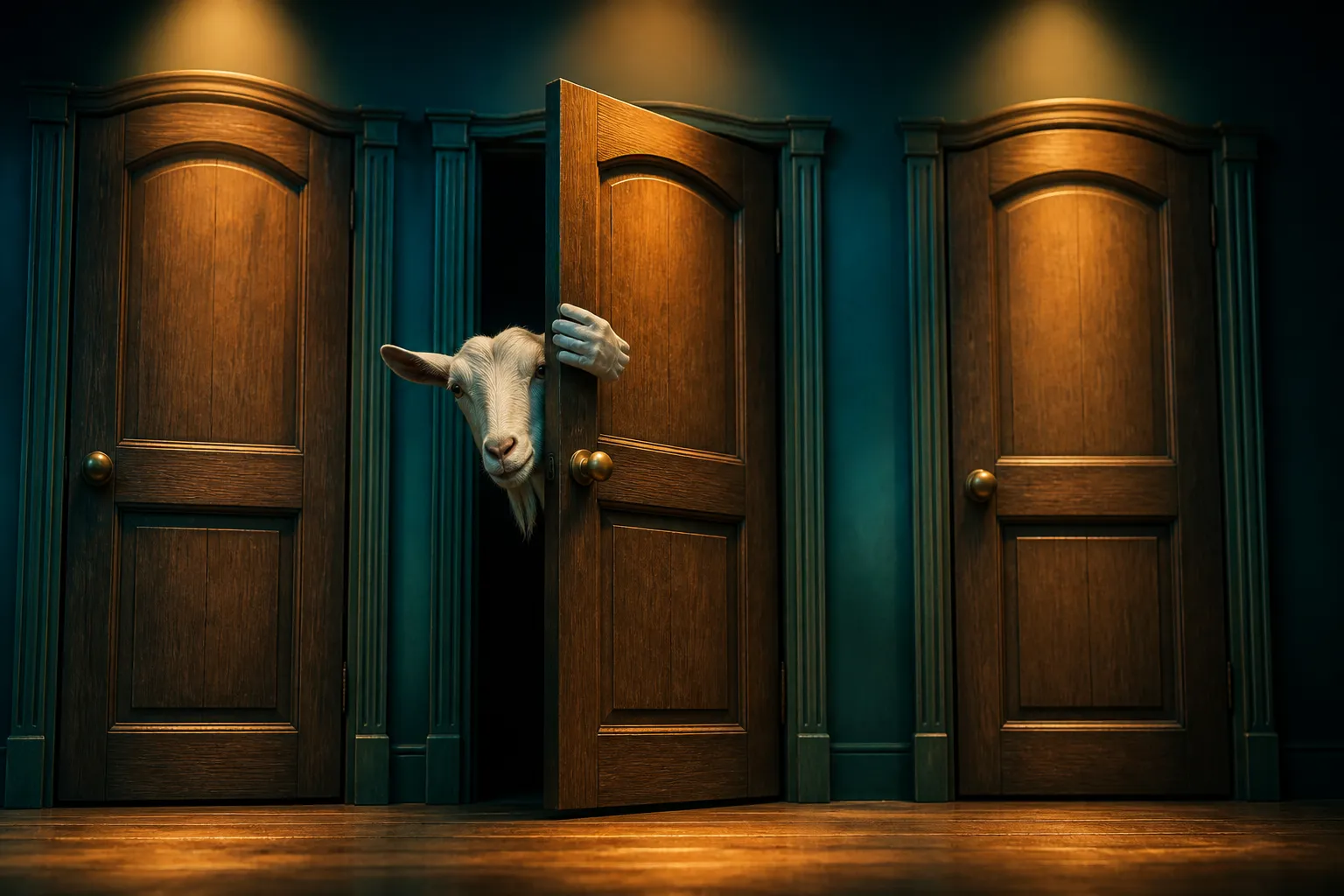
Return to the two closed doors and the host’s hand hovering over one handle. In one version, the contestant has already made a choice, and the host’s knowledge steers the reveal. In the other, the reveal comes first, under a different rule, and the contestant chooses afterward. The visible goat is the same. The sequence is not. That is why the door the host opens matters.
Sources
- How the Monty Hall problem is similar to the false discovery rate in high-throughput data analysis - PMC
- https://vertexaisearch.cloud.google.com/grounding-api-redirect/AUZIYQHIGtnB7muT2N0itcYU0wPvnadz8z7JRjrYdpUIT_3qnhXlha0OKGmo3lFeQpEBJHlNhwBZwHxHHIGj333G55dN9r2uGwBumTghUTQ5Txu35UTZbg-AAA==
- What’s So Hard about the Monty Hall Problem?
An exceptional writer at Deeperpectives, she covers public memory, family archives, and the histories held in ordinary objects. Before joining the desk, she cataloged oral histories for a neighborhood museum, where she learned to treat a small detail as a door, not a conclusion.