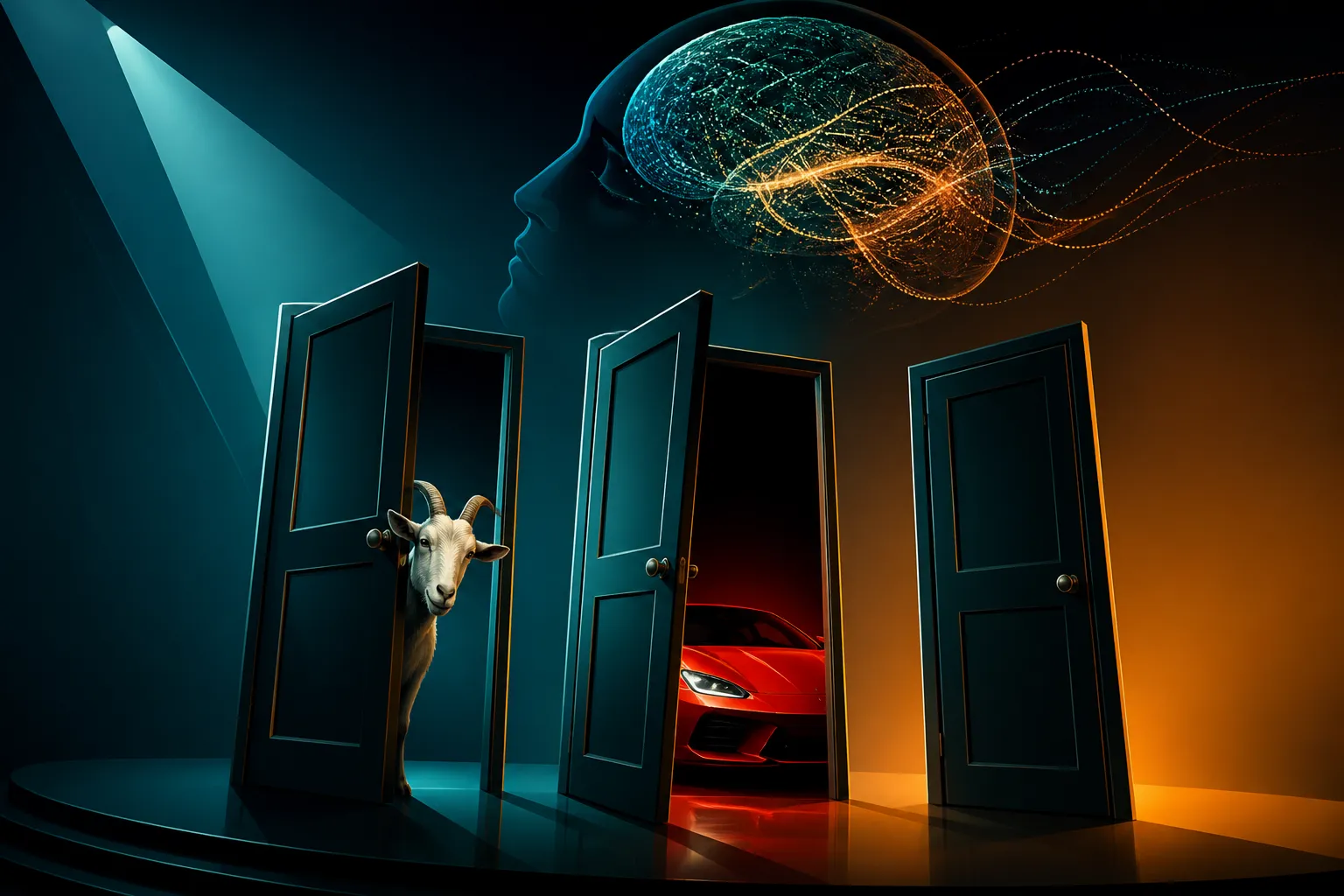
Three doors. One car. Two goats. This isn’t a riddle. It’s the setup for the Monty Hall problem, a probability puzzle that trips up minds and shatters assumptions. Most people get it wrong. Their gut instinct, a supposedly reliable internal compass, points them straight into a losing bet. It feels simple. It isn’t. This isn't just about a game show. It’s about how our brains process chance, and how easily that process can be corrupted.
Why a Simple Game Feels Unsolvable
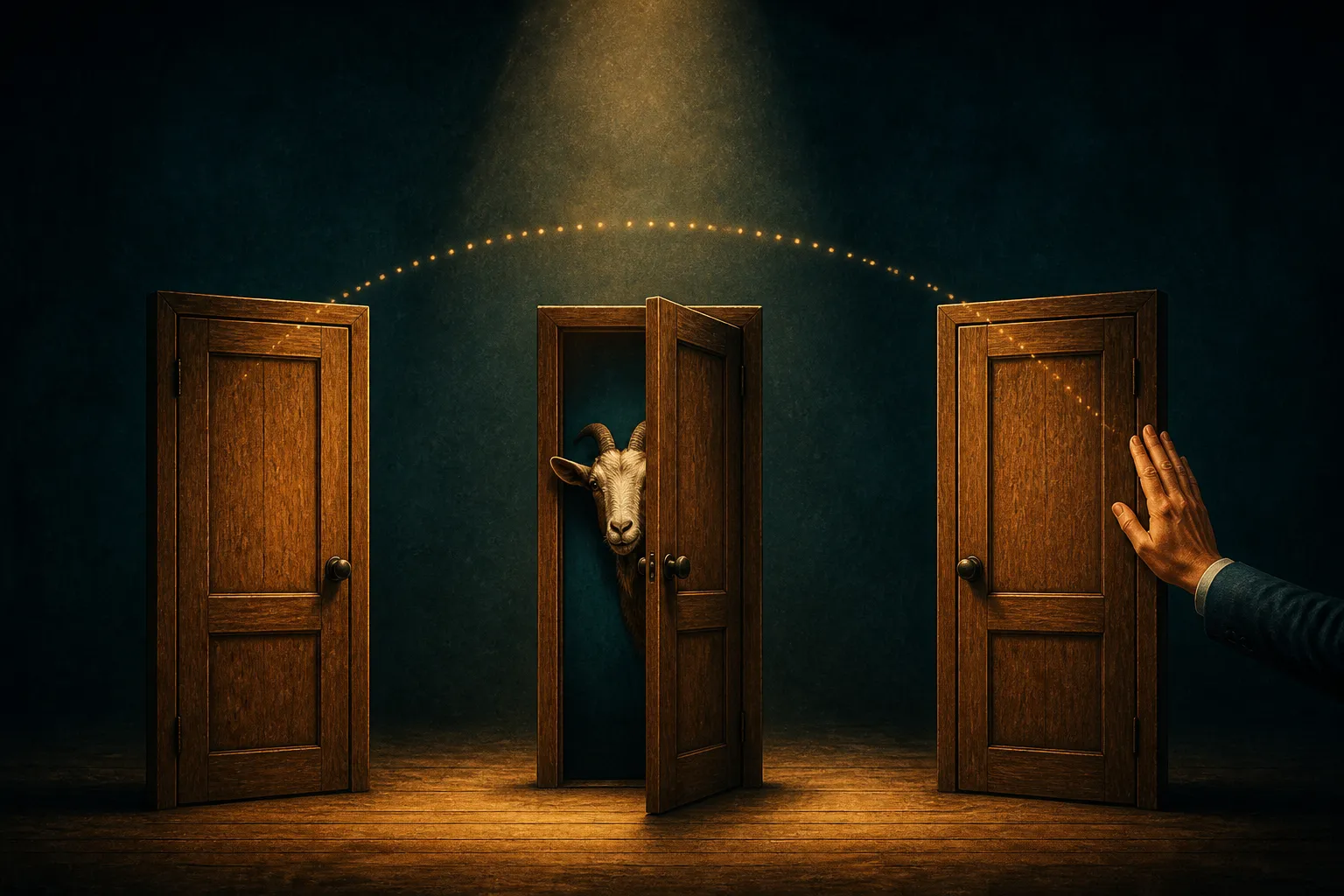
The rules seem clear. You pick a door. Monty, the host, then opens one of the other two doors, always revealing a goat. Never the car. Then he offers a choice: stick with your original door, or switch to the other unopened one. Which move wins? Most people freeze. They see two closed doors, one with a car, one with a goat. It looks like a coin flip, 50-50. Their first choice is now meaningless. Switching feels arbitrary. Staying feels safe. Both paths seem equally likely. This intuition is powerful. It’s also wrong.
This feeling of symmetry, of an even chance, is where the trap lies. Our brains prune away the past. They focus on the present moment: two doors, one prize. What they ignore is the crucial information embedded in Monty's actions. He didn't open a door at random. He opened a door he knew held a goat. This act, seemingly helpful, completely alters the underlying probabilities. It's not a fresh start. It’s a continuation where new information reshapes everything.
The Standard Answer and Its Reasoning
The accepted answer is brutal: switch. Switching doors wins the car approximately two-thirds of the time. Sticking with your initial choice wins only about one-third of the time. This isn’t conjecture. This is the math. It’s the resolution that baffles and infuriates, because it defies that strong 50-50 instinct.
Here’s why it works. When you make your first pick, you have a one-in-three chance of selecting the car. That means there's a two-in-three chance the car is behind one of the other two doors. Monty then steps in. He knows where the car is. He will always open a door that reveals a goat from the two you didn't pick. By doing this, he consolidates the two-thirds probability onto the single remaining unopened door. He doesn't change your original door's 1/3 chance. He shifts the remaining 2/3 chance. It becomes concentrated behind the other closed door. The host's knowledge, his deliberate action, isn't just a courtesy. It's the engine of the probability shift. Your initial pick holds its 1/3. The other option, the switch, now carries the concentrated 2/3. It’s a harsh lesson in conditional probability.
Is the Accepted Answer Always Correct?
The math seems settled. But is the answer always a guaranteed two-thirds switch? Plus.maths.org, in its "Myths of Maths" series, asks this very question, and it's a valid one. The stark two-thirds outcome depends on very specific, often unstated, assumptions. If these rules shift, so does the probability. The "correct" answer isn't universal. It's contextual.
The standard solution assumes:
- The car is placed behind a door at random.
- The host always knows where the car is.
- The host will always open a door revealing a goat from the two you didn't pick.
- The host will always offer you the option to switch.
Remove any of these conditions, and the game changes. Defenders argue that under the usual problem statement, the answer is fixed. The puzzle’s ambiguity dissolves once rules are cemented. Skeptics, however, point to the variability. What if Monty sometimes opens a door at random? What if he only offers a switch when you've picked the car? Then the odds warp. Your instinct, once merely wrong, might suddenly be less wrong, or even right. The answer, it turns out, is only as reliable as the rules you accept.
Related Puzzles That Test the Same Instincts
The Monty Hall problem isn’t an isolated anomaly. It's part of a family of probability puzzles designed to humble intuition. Significance magazine, published by Oxford University Press for statistical societies, regularly features such brain-benders. Their listing, with posts between August 2021 and June 2022, includes challenges like non-transitive dice, a puncture problem, balls in a bag, classroom bingo, a certain bet, and a higher-or-lower game. All test the same human tendency to misjudge chance.
Consider the non-transitive dice. This puzzle uses six dice, each with six numbers, drawing from 1 to 36. It illustrates how comparisons can loop in ways that defy simple transitive logic. You pick a die, your opponent picks one, and the higher roll wins. Intuition suggests if A beats B, and B beats C, then A should beat C. But non-transitive dice create loops where A beats B, B beats C, but C beats A. It's a closed circle of probabilistic dominance, a direct affront to how we usually perceive "better than." It’s another example of how an apparently straightforward comparison can hide a deep, counter-intuitive truth. Significance also points to an article by Stephanie Kovalchik from January 8, 2013, which links Ian McEwan's novel Sweet Tooth to the Monty Hall problem, suggesting the real-world impact of these concepts.
What Gut Instinct Gets Wrong and What to Do About It
Why do these puzzles short-circuit our intuition? The full reasons are complex, not entirely settled. A compelling hypothesis suggests we filter out crucial data. We focus on the doors that remain, the dice left to roll. We ignore the process, the sequence of events, that led to those current options. We treat a situation as independent when it's deeply conditional. We discard the ghost in the machine: Monty's knowledge, the dice's specific numbers, the context that shapes the probabilities.
Fighting this isn’t about becoming a statistical genius overnight. It’s about building better habits. First, write down the rules explicitly. Every single one. Second, always ask how the information you have was generated. Who acted? What did they know? Third, simulate the outcomes. Enumerate the possibilities if you can. Run the game in your head, or on paper, hundreds of times. Finally, be willing to distrust your first, confident answer. That gut feeling? It often lies. The raw data, the cold logic of probability, is the only honest broker in this game of hidden chances.
Sources
- puzzle Archives - Significance magazine
- Monty Hall problem | plus.maths.org
- Frontiers | Reasoning and choice in the Monty Hall Dilemma (MHD): implications for improving Bayesian reasoning
- Why a Twist to the Monty Hall Problem Stumped So Many | Psychology Today
- Why You Should Always Switch: The Monty Hall Problem (Finally) Explained - By Steven Pinker - Behavioral Scientist
- Steven Pinker, Columnist at Behavioral Scientist
- The Volunteer’s Dilemma - by Steven Pinker - Behavioral Scientist
Siobhan O'Reilly investigates the friction between urban decay and digital expansion for Deeperpectives. She spent a decade reporting from transit hubs and temporary settlements across the rust belt. Her work prioritizes the raw data of lived experience over polished corporate narratives.