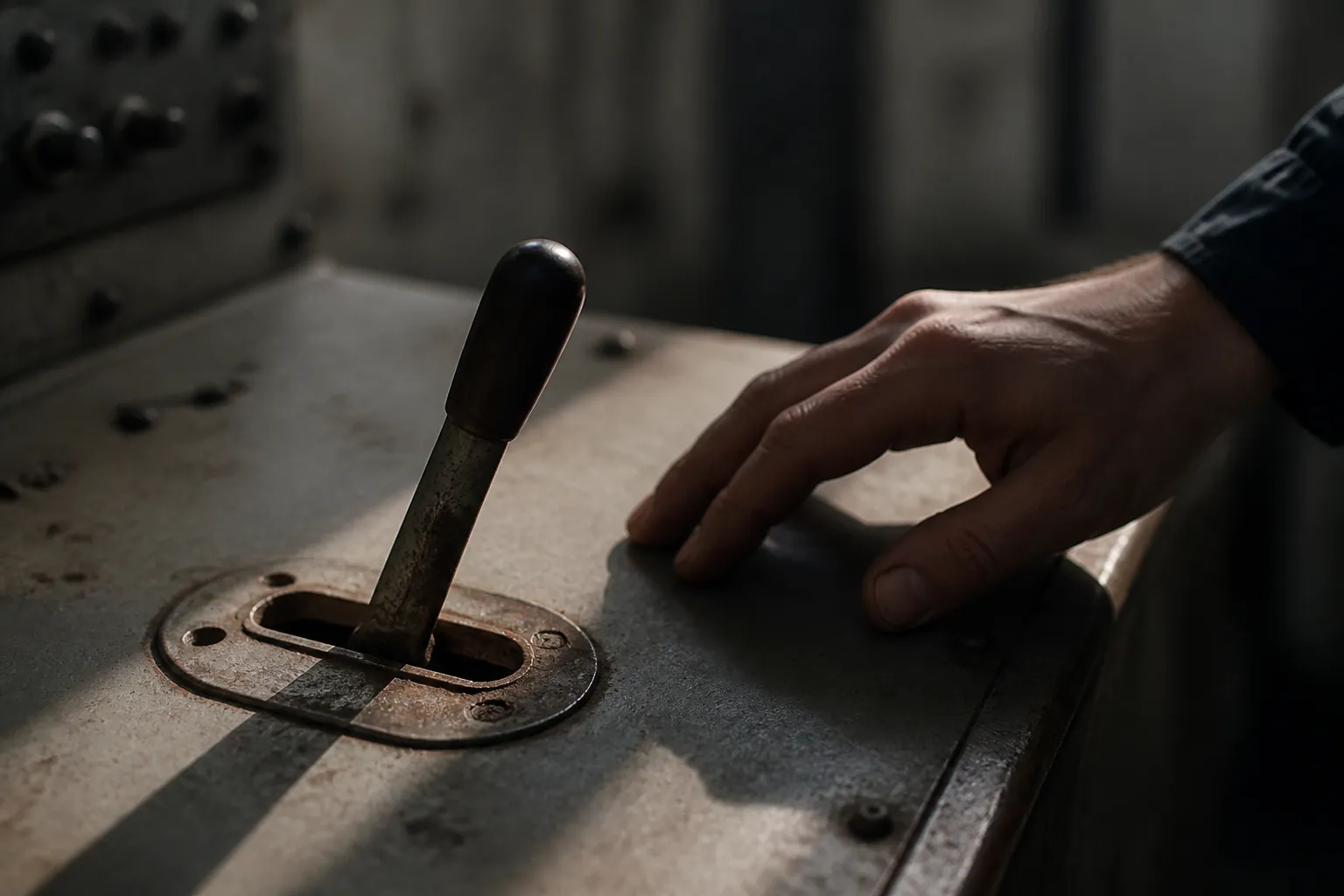
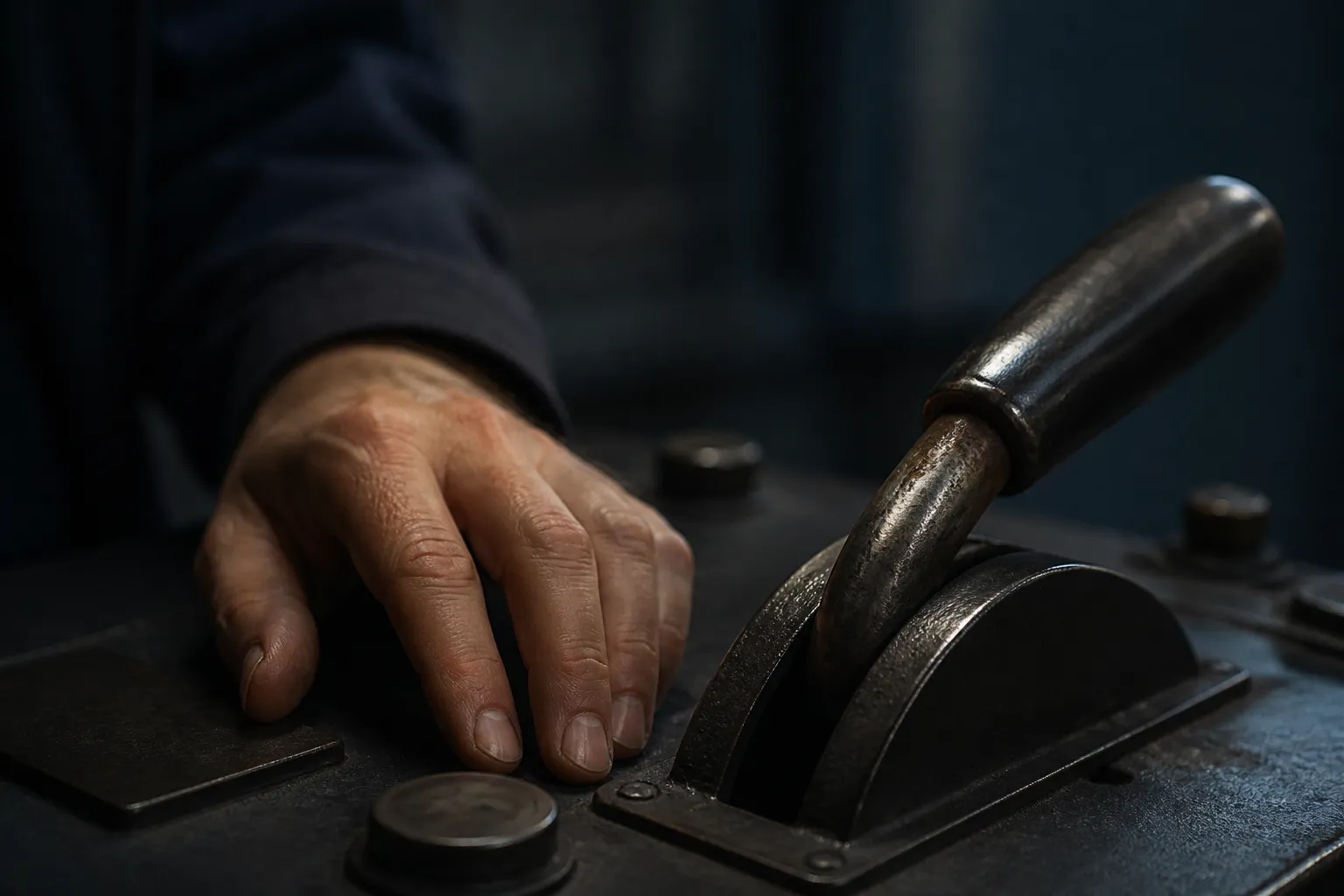
A hand rests beside a lever. In one version of the familiar trolley problem, pulling it redirects a runaway trolley and kills one person; leaving it alone allows the trolley to kill several. The details are spare, almost diagrammatic. Yet the hand changes the question. People may judge a death differently when it follows an action than when it follows a decision not to act.
That difference is called omission bias: a tendency to favor inaction over action, and to judge harm caused by doing something more harshly than the same harm caused by failing to do it. The term sounds like a verdict. It is better treated as a question about how people assign responsibility: when the outcome is held still, does the route to it change our judgment?
The question reaches beyond a thought experiment. A decision to intervene can make a person feel like the cause of what follows. A decision to wait can feel like refusing to interfere, even when waiting also shapes the outcome. That feeling may track a meaningful difference, or it may give the status quo an undeserved moral shelter.
The evidence summarized in the available account is suggestive, not complete. It reports early findings but not sample sizes, exact wording, or detailed procedures. Those limits matter. They leave room to describe the pattern without pretending that a short summary settles how often it occurs, why it happens, or what a particular real-world decision requires.
What changes when the outcome stays the same
Omission bias names more than a general preference for doing nothing. One form appears when an action and an omission lead to the same bad result, but people judge the omission more leniently. The harm is held constant; its perceived moral weight shifts with the path that produced it.
A second form compares choices within the same decision set. People may judge a harmful action as morally worse than an inaction that is factually worse. In that case, the action does not merely look more blameworthy. The outcome itself can be worse under inaction, yet the active choice still attracts greater disapproval.
A third form concerns choices with mixed consequences. An omission may seem more acceptable than an action that brings an equally favorable result but also carries a negative trade-off. Together, these forms make the idea more precise. The issue is not simply that people dislike risk. It is that the moral reading of a choice can shift depending on whether harm arrives through commission or omission.
The early experiments and the cost of intervening
Baron and Ritov’s 1990 vaccination scenario offered a stark measure of reluctance. Participants were hesitant to vaccinate even when the disease posed the greater danger. According to the reported finding, the disease death rate had to reach about ten times the death rate attributed to the vaccine before participants would vaccinate. The ratio captures an asymmetry: a death linked to the intervention weighed heavily against taking it.
That result does not, by itself, explain what participants thought or how they arrived at their choices. The available summary does not give the exact scenario wording or the study’s sample size and procedures. It supports a narrower point: in this scenario, the stated risk from acting appeared to require a substantially higher disease risk before participants favored vaccination.
Spranca and colleagues’ 1991 work used scenarios that included tennis strategies and the trolley problem. The reported pattern was that omissions received less negative ratings than corresponding commissions, even when the negative outcomes were identical. They also found that condemnation of harmful actions did not translate into equally strong approval of helpful ones. That imbalance suggests the response is not simply a neat preference for whichever option produces more good.
Why the unchosen path can feel cleaner
Several explanations have been proposed. Inaction may feel psychologically easier because it leaves the current arrangement in place. Acting may seem to carry transaction costs: effort, uncertainty, and the burden of selecting among options. And people may see a commission as more causally connected to what happens than an omission. These are proposed explanations, not conclusions established by the short research summary.
The trolley problem compresses those possibilities into a single visible gesture. Pull the lever, and the person acts; leave it alone, and the person does not. But the apparent cleanliness of the untouched hand can mislead. If the choice is between two available paths, not choosing is still part of the decision. The hard question is whether the difference between acting and allowing is morally relevant in that case, or whether it merely feels relevant.
Omission bias has also been described as a possible explanation for the endowment effect and status quo bias, patterns in which people favor what they already have or the state of affairs already in place. The connection is suggestive: changing a current arrangement can feel like taking responsibility for losses, while leaving it intact can make those losses seem less authored. The available evidence does not establish that omission bias explains these broader effects on its own.
Bias, or a reasonable caution?
The dispute is not settled by naming the pattern. One view treats omission bias as a cognitive bias because judgments may track whether a person caused an outcome more strongly than the outcome itself. If people condemn an action while overlooking a worse consequence of inaction, that asymmetry could lead to harmful choices.
Another possibility is that caution about acting can be rational. Interventions can bring uncertainty, responsibility, and risks that are not captured by a simple comparison of final outcomes. A person may have good reason to ask what they know, what they can control, and what unintended effects an action might produce. The available account does not provide the arguments made by those who regard omission bias as rational, so it cannot adjudicate between these positions.
A useful way to keep the question open is to compare like with like. Would the same outcome be judged differently if it followed an action rather than an omission? If so, does the difference reflect a real feature of the decision, such as distinct risks or responsibilities, or only the discomfort of being seen as someone who acted? The answer may depend on details the thought experiment leaves out.
What the evidence leaves in the archive
The early studies make the asymmetry visible, but the record available here is partial. It does not provide enough methodological detail to assess how the scenarios were presented or how broadly the findings should be applied. Nor does it establish a method for reducing the bias or deciding what to do in a specific situation. Those claims need evidence beyond the account of the early experiments.
The full study summaries and wider debate would matter, especially for separating an irrational preference for the status quo from prudent caution in the face of uncertain consequences. For now, the lever remains useful not because it supplies an answer, but because it makes the question difficult to hide: when the hand stays still, what responsibility has actually disappeared? The early research is summarized in the omission bias reference, though its gaps should remain part of the reading.
An exceptional writer at Deeperpectives, she covers public memory, family archives, and the histories held in ordinary objects. Before joining the desk, she cataloged oral histories for a neighborhood museum, where she learned to treat a small detail as a door, not a conclusion.