
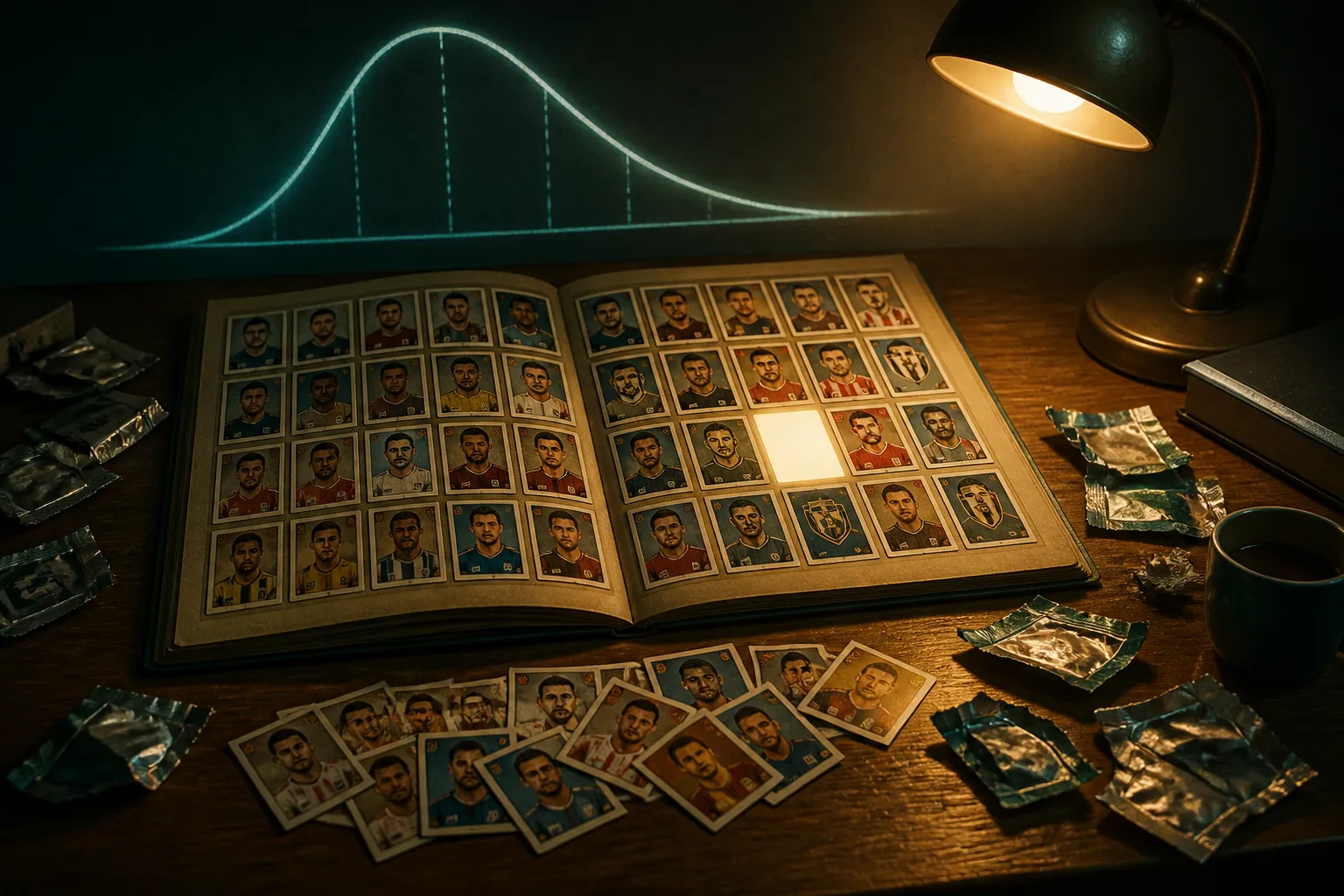
Near the front of a sticker album, a packet can feel generous. Peel back the foil, sort the little faces and crests, and several empty squares disappear at once. Later, the same packet lands differently. The album is thick with completed pages, but the new squares arrive one at a time, between familiar images. The last missing card seems to have learned how to hide.
This familiar frustration has a mathematical name: the coupon collector’s problem. It asks how long it takes to collect a complete set when each new item arrives at random. The question sounds simple until the album is nearly full. Then the odds begin to work against the collector in a way that is easy to mistake for bad luck, or for a shortage.
The Shape of the Problem
Imagine an album with a fixed number of possible stickers. Each draw has a chance of producing any one of them. The collector’s task is not to find a particular sticker, but to reach the first moment when every sticker has appeared at least once. The math follows the whole sequence, from the first lucky packet to the final stubborn space.
The 2026 World Cup album offers a large-scale example: 48 teams and 980 stickers. A packet contains seven stickers, but opening a packet does not mean gaining seven new pieces of the set. Early on, many possibilities remain uncollected. Later, most have already appeared. The album’s blank spaces become a map of what chance has not yet delivered.
The coupon collector’s problem gives a formal name to this kind of waiting. The phrase reaches beyond stickers, but the album makes the pattern visible: a collection can be close to finished and still be far from finished in effort.
Why the Last Stickers Are the Hardest
Suppose there are N possible stickers and a collector already has k distinct ones. If every sticker is equally likely, the chance that the next draw is a duplicate is k/N. The chance of finding something new is the shrinking remainder, (N - k)/N. Each addition changes the odds of the next one.
At half-completion, roughly half of random draws will be duplicates. At 90 percent completion, roughly nine in ten will be. That does not mean a particular collector will get a new sticker on a neat schedule. It means that, over repeated draws, the expected wait grows as the missing pool narrows. The final few spaces ask for repeated attempts against increasingly long odds.
This is why the last card can feel more elusive than the first hundreds put together. A first packet has many ways to surprise. A nearly full album has only a few useful outcomes, scattered among the same number of possible draws. The apparent rarity can arise even when all stickers are printed in equal numbers. The pattern alone does not prove that a manufacturer is holding anything back.
The Numbers Behind a Full Album
For the 980-sticker album, the reported average for completing the set through random buying is about 7,300 stickers. At seven stickers per packet, that is a little over 1,000 packets. If each packet costs $1, the expected spend is roughly $1,000. The buyer has handled more than seven albums’ worth of stickers to fill the spaces in one.
Those figures describe an average, not a promise about any one album. One collector may finish earlier, another later. But the scale of the average gives the duplicate pile its proper place in the story. It is not an odd heap left over after the real work. Under random sampling, it is part of the work.
A compact way to see the late-stage slowdown is to call the fraction of the album already complete f. The expected number of stickers to open before the next new one is 1/(1 - f). At 90 percent complete, that expression is 10. At 99 percent, it is 100. Each extra nine in the completion percentage makes the next new sticker harder to reach.
When Random Buying Stops Helping
Random packets make the most sense near the beginning, when a large share of their contents can fill blank spaces. Their value falls as the album fills. The same purchase that once produced several new stickers may later deliver mostly duplicates, leaving the collector with a narrower problem and the same broad lottery.
So the practical question is not simply whether to buy another packet. It is when to stop buying at random and turn toward a more targeted way of finding what is missing. The available account does not supply a universal switching point. The decision depends on what the collector cares about: the cost of more packets, the pleasure of opening them, the time spent, and how much completion matters.
Trading is an obvious possibility to consider, because another collector’s duplicates might match your blank spaces. But the evidence here does not establish how easy swaps are to arrange, what they cost, or how reliably they work. A careful answer should leave those questions open rather than turn a plausible option into a guaranteed solution.
What the Album Cannot Tell Us
The simple model assumes that each sticker is equally likely to appear. The material behind these figures does not examine in detail what happens if some stickers are less common than others, or explain the album’s printing and distribution process. If the odds differ, the waiting pattern may differ too. The equal-chance model explains one source of delay, not every possible cause of a difficult final page.
That limit matters because a collector sees only the packets opened and the spaces still empty. The mathematics can describe why duplicates rise as an album fills, but it cannot identify the history of a particular missing sticker. It cannot tell us whether a swap will be available, or how much a collector should spend before stopping. For more on the basic setup, the sticker collector’s problem connects the album to the broader puzzle.
Return to the last blank square. It seems to ask for one object, one final piece of paper. In a random collection, it is also the narrow end of a long sequence: every earlier success has reduced the number of new outcomes still available. The square stays empty not because it is the whole puzzle, but because it is where the puzzle’s accumulated odds become easiest to see.
Sources
- The Sticker Collector's Problem | Adam Butterworth
- Coupon Collector's Problem -- from Wolfram MathWorld
- The Coupon Collector Problem | Probabilistic Systems Analysis and Applied Probability | Electrical Engineering and Computer Science | MIT OpenCourseWare
- Coupon Collector Problem | Brilliant Math & Science Wiki
- 12.7: The Coupon Collector Problem - Statistics LibreTexts
- 12.1: Introduction to Finite Sampling Models - Statistics LibreTexts
- Cost to fill Panini World Cup sticker book is £773, says maths prof | World Cup 2018 | The Guardian
- Client Challenge
An exceptional writer at Deeperpectives, she covers public memory, family archives, and the histories held in ordinary objects. Before joining the desk, she cataloged oral histories for a neighborhood museum, where she learned to treat a small detail as a door, not a conclusion.