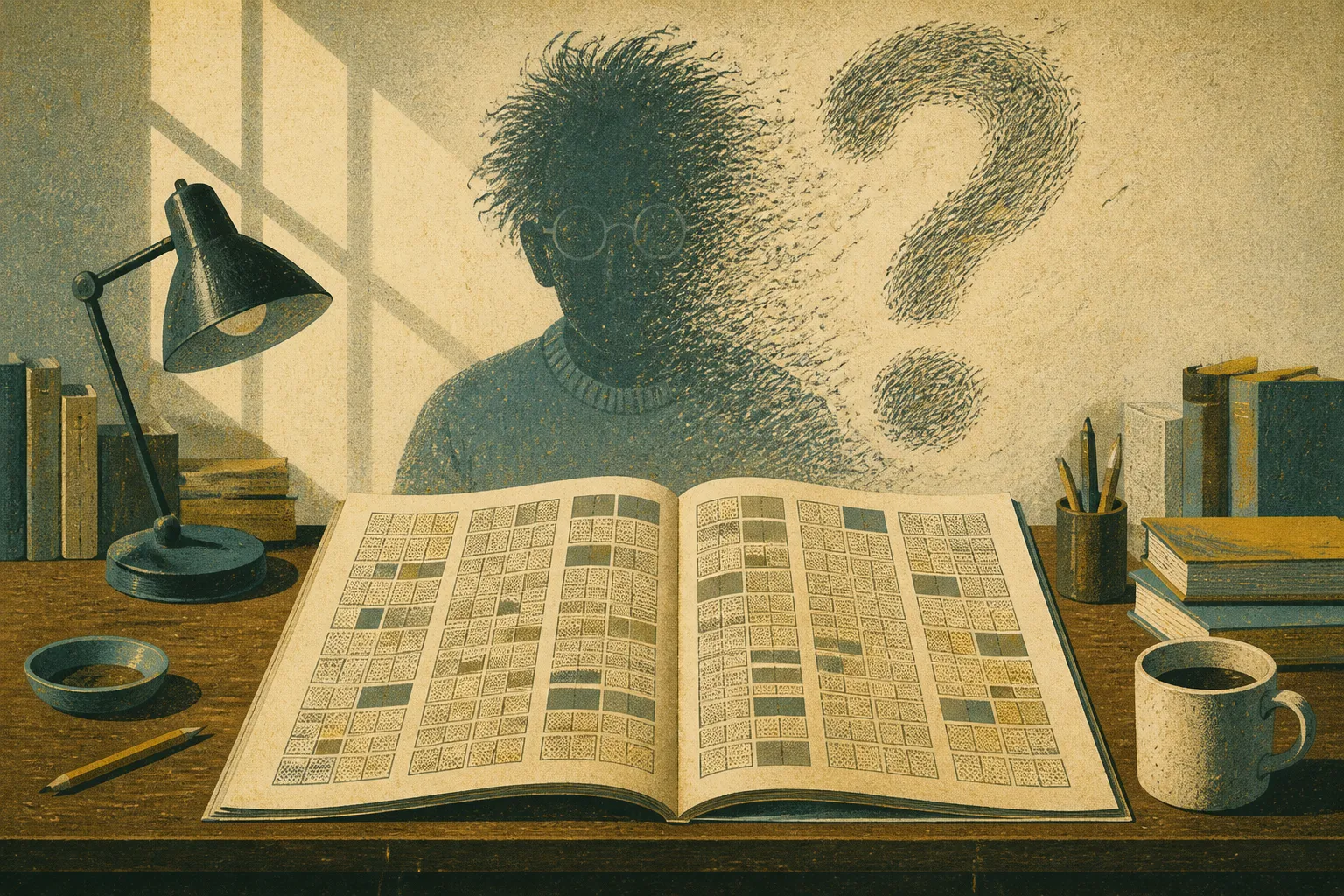

The sand clogs the sensors. It stays under your nails. It hides in the cracks of the sidewalk. One grain means nothing. Add another. Still nothing. You do this a thousand times. Now you have a pile. Or do you? When did the collection stop being a scattered mess and start being a heap? There is no whistle. No bell rings. The logic breaks before the sand does. We live in the gaps between what we say and what we see.

Eubulides of Miletus formulated this problem in the fourth century BCE. He was a thinker who saw the traps in the way we talk. He used the Greek word soros. It means heap. This is where the name comes from. He was showing us that our language is a fragile thing. He wanted to know the exact moment of change. He wanted the number that separates a collection from a singular object.
The logic is a simple induction. If you have a million grains of sand, you have a heap. If you take one grain away, you still have a heap. A single grain is a rounding error. It has no causal power. It cannot change the category of an object. You repeat this logic. You subtract one grain again and again. Eventually, you are left with one grain. By the rules of the logic, that single grain is now a heap. This is an absurdity. It is a logical collapse.
This is the Sorites Paradox. It is a trap that feeds on the tolerance of our definitions. We want our words to be flexible. We want them to breathe. But classical logic demands a sharp edge. It wants a border where the world only offers a gradient. The paradox shows that our most basic tools for thinking fail when they hit the dirt of the real world. No amount of polish can hide the friction between the ideal and the actual.
What the Paradox Actually Says
The paradox begins with a pile. Eubulides of Miletus looked at a heap of grain and asked a simple question. If you remove one grain, is it still a heap? The answer is always yes. One grain cannot make or break a category. It is too small to carry that weight. This is the logic of the soros. We start with a million grains. We know this is a heap. We subtract one. The logic says it is still a heap. We subtract another. The logic holds. We keep going until we have nothing left. The logic still says it is a heap. This is the collision between induction and reality. It shows that a series of small, reasonable steps can lead you straight into a wall. The argument weaponizes a tolerance principle. It assumes that the application of a predicate must be insensitive to tiny differences. But small differences add up. They accumulate until the category is hollowed out.
Why Vagueness Is the Real Problem
Most words are messy. They are not like a light switch. They are like a dimmer. Philosophers call this vagueness. It is different from ambiguity. An ambiguous word has two clear paths. A bank is where you put your money or where you sit by the river. You choose a path and the fog clears. Vagueness is different. A vague word like tall or rich or heap has no clear path. It has a center where everything is certain. It has an edge where everything dissolves. In the middle, you find borderline cases. These are the places where a person is neither tall nor short. They are both and neither at the same time. You can look at the data until your eyes bleed. You will not find the answer in the numbers. The problem is semantic rather than epistemic. It is in the word itself. The indeterminacy is built into the tool we use to measure the world.
The Major Philosophical Responses
Some people want to save the logic. Timothy Williamson is one of them. He argues for epistemicism. He says the line is real. There is a precise grain of sand that defines the heap. We are just ignorant. The mechanisms that fix word meanings are too complex for us to access. It is a cold, mechanical view of language. Others prefer supervaluationism. They say there are many ways to draw the line. Every way is valid. A sentence is true only if it is true for every possible sharpening of the word. This creates a world of supertruth. It keeps the logic clean, but it feels like a legal loophole. It ignores the grit under our boots. Then there is fuzzy logic. This turns truth into a percentage. A pile is 60 percent a heap. This sounds good until you try to find where 60 percent becomes 61 percent. You have just moved the paradox to a different neighborhood. Contextualists like Scott Soames say the line moves with the conversation. The meaning drifts. It follows the eye of the speaker. It is a living thing that refuses to be pinned down.
Why the Paradox Refuses to Go Away
The paradox lives in the streets. It lives in the courtrooms where judges struggle with reasonable force. There is no meter for reasonableness. There is no gauge for significant harm. These are vague predicates that determine whether a man goes to jail or goes home. The law demands a binary outcome for a non-binary world. Cognitive science shows that our brains do not work in ones and zeros. We categorize by prototypes and similarity. We do not use strict boundaries. This means that classical logic is a tool that does not fit the job. It is a scalpel being used to clear a forest. The paradox persists because it exposes the gap between the clean world of the mind and the dirty world of the earth. It reveals that our language was never meant for this level of scrutiny. We will keep fighting it as long as we keep trying to describe the grit of reality with the precision of a ghost. The sand continues to fall. The heap remains a mystery.
Sources
Siobhan O'Reilly investigates the friction between urban decay and digital expansion for Deeperpectives. She spent a decade reporting from transit hubs and temporary settlements across the rust belt. Her work prioritizes the raw data of lived experience over polished corporate narratives.