Walk down any old high street and the buildings seem to agree with each other. The cornices line up, the windows keep their proportions, and nothing looks like it was done in a hurry. It is easy to conclude that people used to know something we have forgotten. It is also easy to forget who is missing from the picture.
The Filter Behind the Admired Facade
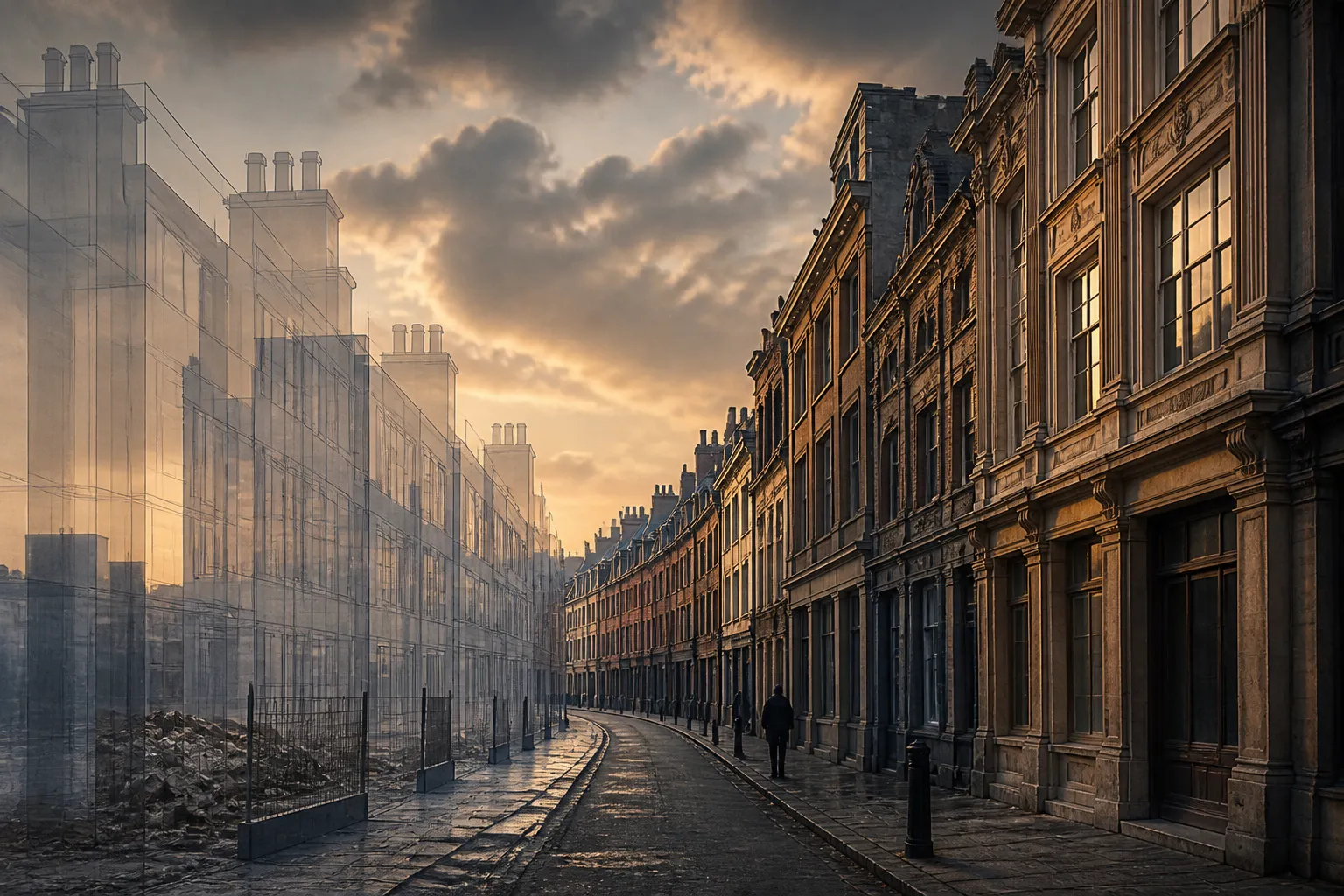
Survivorship bias is a filtering problem. Buildings that were not preserved, or did not last, drop out of view. What remains is the set that was good enough, loved enough or lucky enough to be kept. That set will look better than the full run of what was once built, and it will do so even if the builders of the past were no more gifted than we are.
A Hacker News thread on the subject offers this as one reason old buildings seem generally better than new ones. Commenters treat it as a partial explanation, not a verdict, and that seems the right weight to give it. The mechanism is sound. How much it explains is another matter.
The filter also runs for a very long time. A building from 1500 that we can admire today had to get through centuries of demolition, fire, war and shifting fashion. Most of its contemporaries did not. We are not looking at a sample of 1500. We are looking at what five hundred years of attrition left behind.
What the Evidence Actually Shows
Samuel Hughes, writing in Works in Progress, puts the perception sharply. Many people, he says, struggle to name an ugly building put up before about 1930, and find it harder still before about 1830. Those cutoffs are his own. They describe how people react, not a measured ranking of quality, and they should be read that way.
He is also candid about the footing. The claim that the public feels this way rests on anecdotal evidence from his work on a British government commission that interviewed hundreds of people. That is real experience, and it counts for something. It is not a systematic survey, and it should not be dressed up as one.
Then there is the gap that matters most for our topic. Neither source counts how many old buildings were demolished or how many survived. Without that, nobody can say how large the survivorship effect is. The scale of the bias is an open question, and an honest account leaves it open.
Competing Explanations, Fairly Weighed
There are at least three rival stories. Survivorship says we have torn down the ugly old buildings and kept the pretty ones. Decline says we simply build worse today. Changing taste says that what people find attractive moves over time, so judgments shift with the calendar. Hughes treats the “we build uglier now” idea as the obvious one to test. Several of the three may be true at once.
The thread gives the opposing side its best form. One commenter argues that modern architecture turned toward being original and conceptual, and that the results were mediocre. Another replies that many brutalist buildings are beautiful, and that older styles were once innovations too. Nobody wins that exchange, which is rather the point.
Durability and money complicate things further. One commenter says modern buildings are designed for a limited life while old ones were meant to last generations. Another says budgets matter: major modern landmarks were well funded and built to last, while many ordinary street-frontage buildings were not. Both points ask whether we are comparing like with like.
Testing the Admiration Without Fooling Ourselves
The practical fix is plain. Set landmarks against landmarks and ordinary buildings against ordinary buildings. The Pantheon in Rome, about 2000 years old, is a magnificent survivor, and it tells us almost nothing about the average building of its day. Pitting it against a typical modern office block is not a fair contest.
A careful reader can then ask a few questions the sources do not answer. Were the demolished older buildings also less attractive than the survivors? Are the famous modern examples typical, or exceptions with unusual budgets? Does the price premium that older homes command, even after controlling for location, reflect beauty, scarcity or something else? Hughes calls that premium distinctive, since most goods lose value over time. He does not settle its cause, and neither do the other sources.
The red flags are familiar. Be wary of arguments that judge whole periods from a few famous examples. Be wary of claims that rest on anecdote alone. Hughes admits his own case does, so the caution applies to his conclusions as well as to everyone else’s.
That leaves a modest position. Survivorship is a plausible explanation and a testable one. It is not proven, and it is probably not the whole story. The old high street may still be lovely. We just cannot yet say how much of that is the street and how much is the sorting.
Sources
Marcus Adeyemi-Holt is a house writer for Deeperpectives, where he examines how ordinary routines reveal larger patterns in work, memory, and place. He draws on years of reporting on municipal records and oral histories to trace the quiet forces that shape everyday life.