

Tuesday goes badly. The printer jams, a client cancels, and the bus leaves as you reach the corner. By Friday you have decided the week is cursed. The following week is merely fine, and you credit the new planner you bought on Wednesday. It is a pleasant story. It is also probably wrong, or at least incomplete.
What regression to the mean is
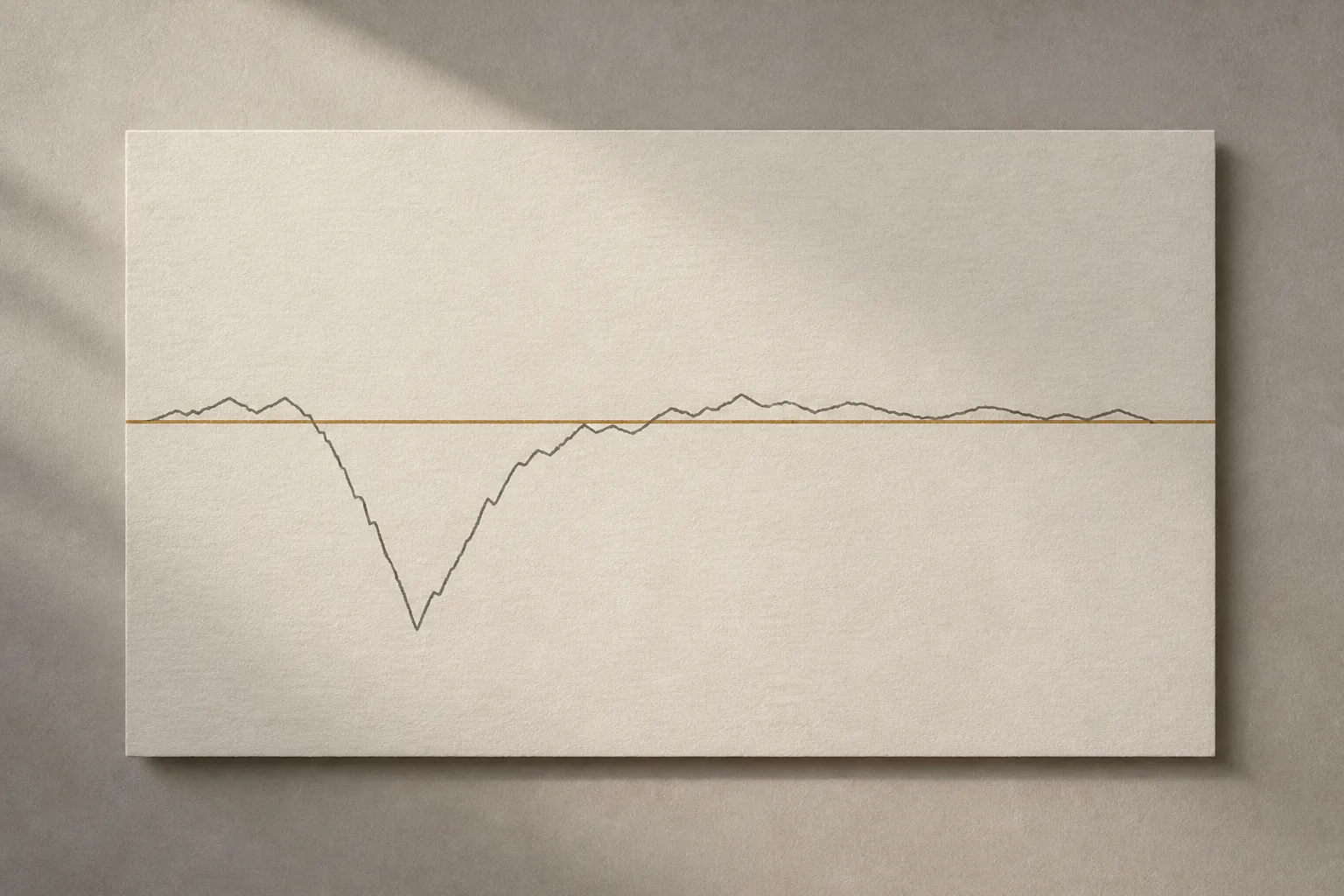
Regression to the mean describes a plain tendency: extreme results are usually followed by more average ones. According to ThinkingKit, this happens because extreme results are statistically unusual, not because some corrective force tugs things back toward the middle.
The logic is modest. A very bad week needs many factors to line up badly at once. That alignment is unlikely to repeat exactly, so the next week tends to land closer to your long-run average. Nothing has to be fixed for this to occur.
It also does not depend on effort or talent. A person who has a terrible week and then a better one has not necessarily changed. The bad week was partly bad luck, and luck of that size rarely returns on schedule.
Three familiar illustrations
The Sports Illustrated cover jinx is the classic case. Athletes tend to reach the cover after a career high or a record streak, which are outliers by definition. Their next performance is likelier to sit nearer their usual level. The decline would have arrived without the cover, a point Kahneman used this example to make.
The sophomore slump runs on the same engine. An exceptional debut album gives way to a good but less spectacular second one. The debut was the outlier, so a more ordinary follow-up is what the numbers predict, however hard the band worked.
Medicine offers the quietest version. People go looking for a remedy when their symptoms are at their worst. From that peak, symptoms would tend to ease somewhat on their own. The improvement alone does not show that the remedy worked.
The main reasoning error
The central mistake is treating regression as a causal effect of whatever happened to coincide with the change. A coach's new drills, a new remedy, a magazine cover: each can be credited with an improvement that statistics would have delivered anyway.
The error is tempting because timing feels meaningful. When something improves right after a dramatic low, people look for a cause, and the intervention is the most visible candidate. Regression offers a quieter explanation, one that needs no cause at all, and quiet explanations lose arguments to vivid ones.
The fix is to treat regression as a baseline to rule out before crediting anything. The question is not whether things improved. It is whether they would have improved without the intervention, given that the earlier result was extreme.
Questions to ask before crediting a change
Start with the earlier result. Was it extreme relative to the long-run average? If it was ordinary, regression is unlikely to explain much, and other explanations deserve a look.
Then ask whether the change would have happened anyway simply because the prior result was unusual. If the answer is plausibly yes, the intervention has not yet earned its credit.
Last, remember that regression does not rule out real effects. A genuine cause can exist alongside it, so the task is to estimate what remains once the baseline is accounted for. A comparison group that did not receive the intervention is one way to separate the two. The sources reviewed here gesture at that idea without explaining the mechanics.
Limits of what the sources establish
The material explains the concept and its traps clearly, but it offers no formulas, effect sizes, or worked numbers. Anyone hoping to measure regression in a real dataset will need to look further.
The J-PAL page on randomized impact evaluations is, in the excerpt reviewed, mostly organizational description. It does not say how regression bears on those evaluations, so that link stays an open question here.
The history is thin too. Galton and Kahneman are named, and little more. A fuller account would say where the idea came from, and would include a case where the intervention really was the cause. Until then, the modest advice stands: after a bad week, be a little slow to thank the planner.
Sources
- Regression to the mean: What it is and why it matters for impact evaluations | The Abdul Latif Jameel Poverty Action Lab
- Regression to the Mean | ThinkingKit
- Regression to the Mean: Causes & How to Avoid It - ResearchProspect
- Regression to the Mean — Mental Models — Barnaby Robson
- Supplemental Material for Regression to the Mean: Experimental Evidence and a Proposed Heuristic
- The man who discovered people hate losing more than they like winning - Andrew Leigh MP
Marcus Adeyemi-Holt is a house writer for Deeperpectives, where he examines how ordinary routines reveal larger patterns in work, memory, and place. He draws on years of reporting on municipal records and oral histories to trace the quiet forces that shape everyday life.