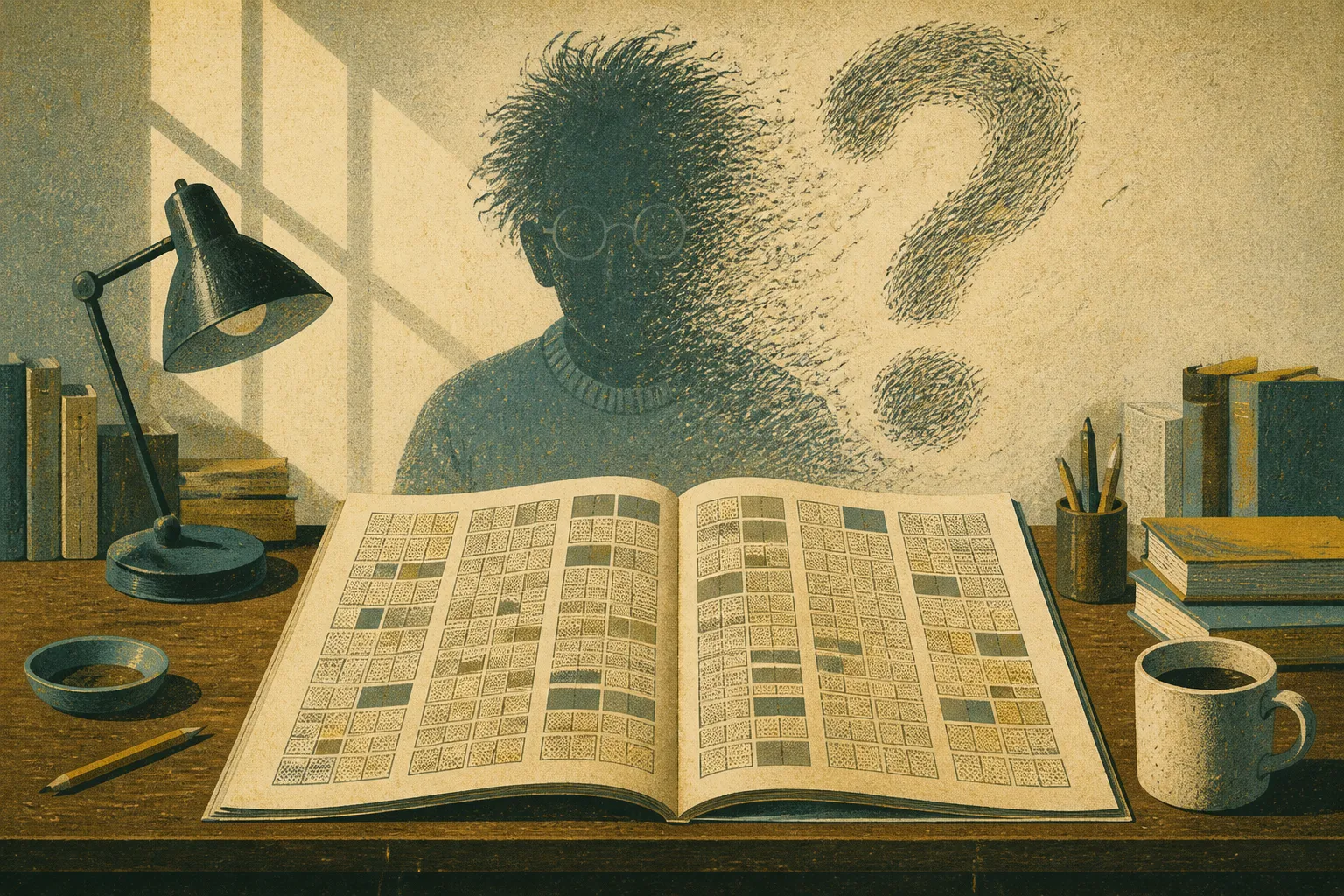

Ask a mechanic why your car makes that noise and you may get a sentence with six steps missing. He is not hiding anything. The steps have dropped out of his view, worn smooth by years of use. The problem has a name, and it is worth looking at slowly.

What the curse of knowledge is
The curse of knowledge, also called the curse of expertise or the expert's curse, is a cognitive bias. A person with specialized knowledge assumes that others share it. The trouble is not a shortage of information. It is a lost sense that one's own information is not universal.
The term was coined in a 1989 article in the Journal of Political Economy by the economists Colin Camerer, George Loewenstein, and Martin Weber. The overview on Wikipedia is a fair place to start. Its excerpt does not cover the 1989 paper's findings, so this article does not either.
A cousin: hindsight bias
The concept draws on Baruch Fischhoff's 1975 work on hindsight bias. Once you know how something turned out, it seems to have been more predictable than it was. In Fischhoff's research, participants could not accurately reconstruct their earlier, less-knowledgeable states of mind. They also could not ignore the bias even when they knew about it.
The two ideas are related, but they are not the same. Hindsight bias concerns your own past: you misjudge what you used to know. The curse of knowledge concerns other people: you misjudge what they know now. A teacher who cannot remember being confused is showing the first. A teacher who skips a step because the class must surely have it is showing the second. Often they arrive together.
What the experiments show
Tullis and Feder ran four experiments in which participants studied trivia questions. They then estimated the percentage of novice participants who would know each answer, across several rounds of study and estimation. Own knowledge consistently contaminated the estimates. When participants had to answer a question before estimating novices' knowledge, studying the facts impaired both the calibration and the resolution of their estimates. The more they studied, the less they drew on their own earlier experience of not knowing.
That last point is the odd one. Learning more made people worse at guessing what a beginner would know.
Steven Pinker calls the curse of knowledge the chief contributor to opaque writing. Writers often fail to see that readers have not learned their jargon or the intermediate steps. He points to the candy-box task, based on a 1983 study by Wimmer and Perner. Children who learned the box held pencils later said they had known all along. Many studies show adults keep a version of this limit.
A 2022 Psychological Science study adds a caution. It suggests the decline in older adults' theory of mind may have been exaggerated by unrelated demands of some experimental designs. Our own knowledge of reality is one of three sources of conflict that theory of mind has to overcome, and the curse is one of them.
Warning signs in the wild
Experts often struggle to talk with nonexperts. They dive into the weeds, ignore context, and talk over heads. The signs are easy to list.
- Jargon that goes unexplained.
- Intermediate steps skipped because they feel obvious.
- A plan for how students will learn, built on faculty judgment and never checked with students.
- Calling an outcome obvious after the fact.
- Explaining in the format the speaker finds most comfortable, such as data-heavy detail for a data-minded speaker.
Stanford's Graduate School of Business describes two habits behind these. Communicators assume what the audience knows and take shortcuts. And they explain things in the way that suits them, not the audience.
What you can actually do
The sources are thin on proven fixes. The Wikipedia excerpt stops before its section on correcting the bias, and the Tullis and Feder abstract is cut off before its results on reducing it. What follows is practical suggestion, not tested remedy.
Start with the questions Stanford poses. What does my audience already know, and how do they come to know things? What do they need to hear, rather than what do I want to say? Pinker's version is blunter: does my reader share the skills and obscure facts I treat as common knowledge?
Then check the answer against a real person. Explain the idea to a novice and ask them to say it back. Mark where they stall. Those stalls are the missing steps. This is the author's suggestion, not a method from the sources. It follows from the Wikipedia point that explanations should be checked with the audience, not judged by what seems best to the expert.
Stanford also lists six tools: diagram, deconstruct, compare, picture, backward map, and chunk. Diagramming forces the steps onto a page. Chunking breaks a long explanation into pieces. Backward mapping starts from what the listener needs to do and works back to what they must know first. The sources list these tools but show no evidence that they improve understanding, so treat them as aids to try.
The mechanic could simply ask, after his six-step sentence, whether any of it made sense.
Sources
- Curse of knowledge - Wikipedia
- https://vertexaisearch.cloud.google.com/grounding-api-redirect/AUZIYQGpR14cYNbRLZZKC0PMLd1lIc_ZkSHCKmMVUWkO7aJ0oDNcu35hwuNqLhn575gRryNlpZF60IUjmz7PhNj8lFdcaZ72sYYYOIasHbSI5aQIRYG0CZchzt2wwfaTHzSPscZFukGiCQGbKA_aCq1u6gQdZnGzacJjiINS62FAWLiU
- The “curse of knowledge” when predicting others’ knowledge - PMC
- The Curse of Knowledge: Pinker Describes a Key Cause of Bad Writing – Association for Psychological Science – APS
- Hit the Mark: Make Complex Ideas Understandable | Stanford Graduate School of Business
- Breaking the “Curse of Knowledge”: Older Adults’ Supposedly Reduced Theory of Mind Might Reflect Experimental Demands – Association for Psychological Science – APS
- The curse of knowledge: Why experts struggle to explain their work | MIT Sloan
- The Power of Data | MIT Sloan
Marcus Adeyemi-Holt is a house writer for Deeperpectives, where he examines how ordinary routines reveal larger patterns in work, memory, and place. He draws on years of reporting on municipal records and oral histories to trace the quiet forces that shape everyday life.