
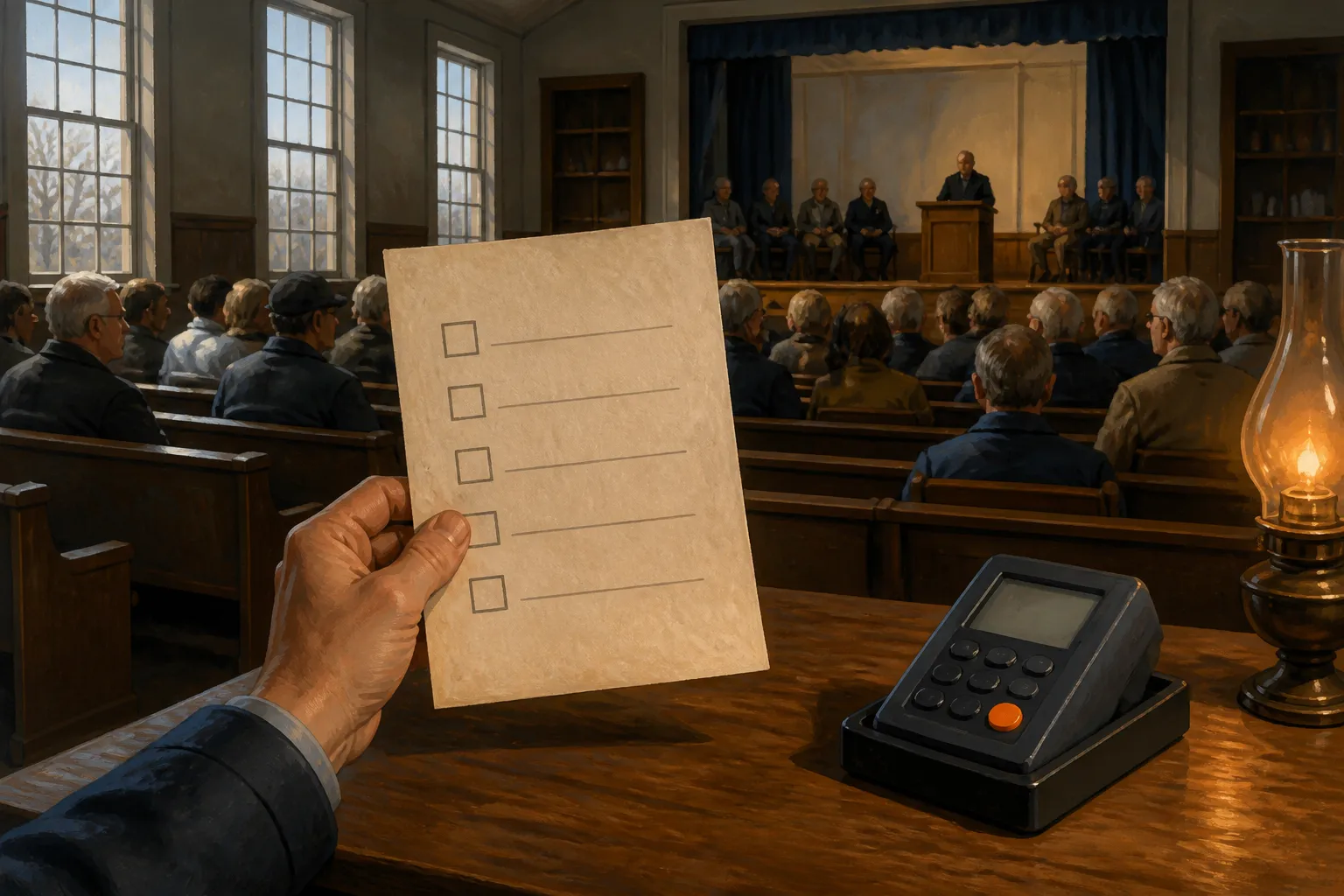
Somewhere in every town hall there is a person who will say it, usually kindly: we have always done it this way. The sentence can be a warning or a shrug. In Concord, Massachusetts, where the 2025 Town Meeting arrived with electronic clickers, a shorter evening and a 130-page briefing book, it was both, sometimes within the same minute.
Reiss said she wanted to address concerns "without stifling debate."
What the appeal to tradition claims
The appeal to tradition says a practice is right, or should stay, because it has long been done. The logic has a sensible root. Long use suggests a practice works, and institutions pick up lessons that no single member can see all at once. Changing it carries risk.
The reasoning turns into a fallacy when age is treated as proof of merit. A procedure can be old and still be slow, unclear or unfair. The better question is what the practice was built to do, and whether it still does that job.
New England town meeting makes a good test. Supporters point to nearly 400 years of self-governance and use in more than 1,000 communities. That record has weight. It also means every proposed change is measured against a history that defenders and critics read differently.
The case for keeping the old way
Defenders argue that open, in-person debate has value that is hard to count. Residents hear neighbors, face questions and watch a proposal change under amendment. A tool that reduces the evening to a tally can make the talking feel optional.
Tradition also gives people shared expectations. They know how motions move, what a raised placard means and when debate ends. Those norms can shield quieter voices from fast procedural moves, and they give a community a common language for disagreeing.
Scholarship on the institution asks whether town meeting has been a bulwark for democracy or a threat to it at different moments. That question is useful because it refuses the easy answer. Some old habits protected participation. Others shut people out. The age of the habit tells you nothing about which kind it was.
The case for changing the old way
Reformers in Concord had a concrete complaint. Town Moderator Carmin Reiss said one of the "chief complaints" in the study committee's outreach was that the meeting takes too long. A long meeting quietly sorts people. Working parents and older residents may leave early, and the tradition then decides who gets a say.
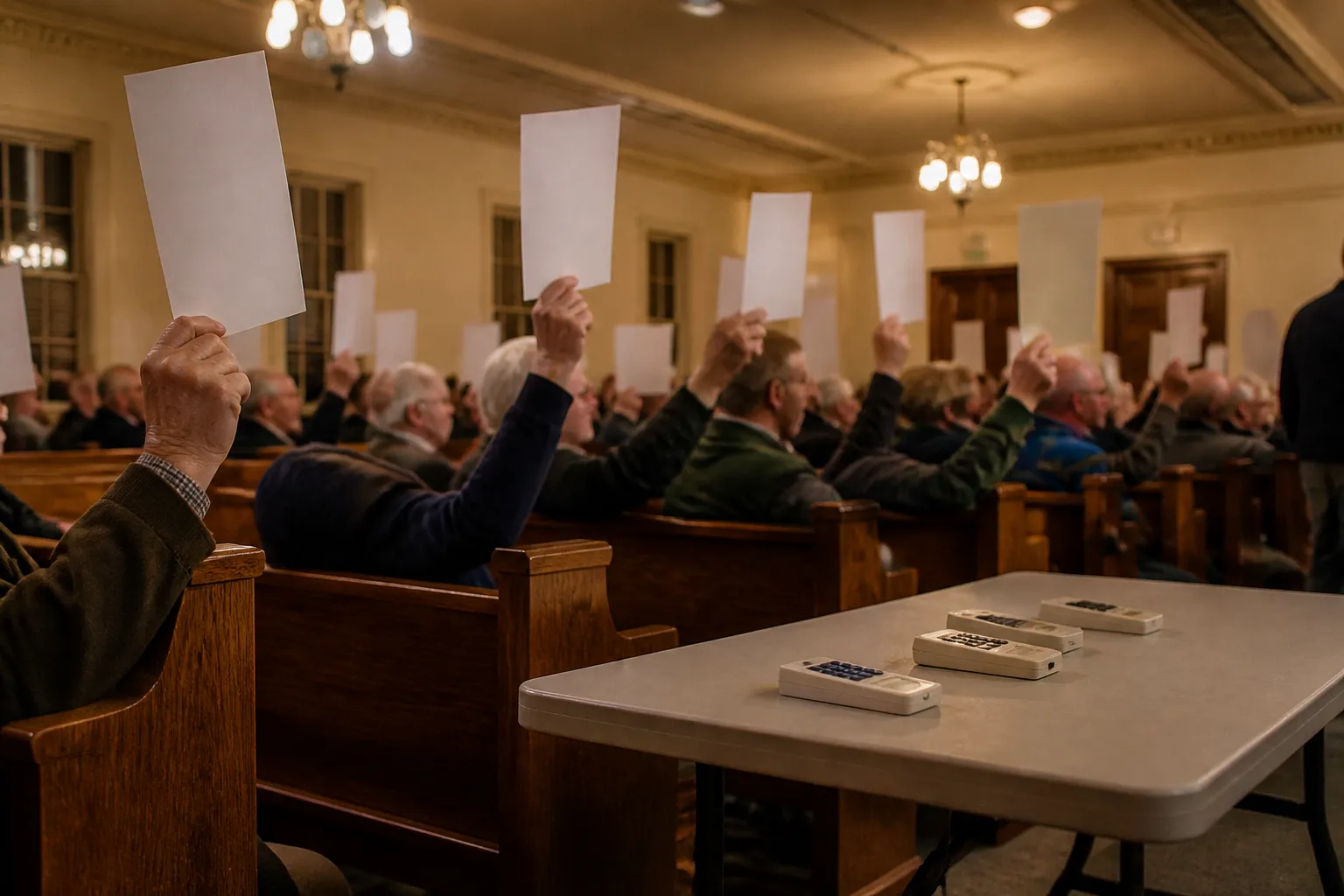
The town's answer did not tear out the old system. It rented clickers for all nights, following study committee recommendations, to give private and precise counts on certain articles. Placards stayed as a backup and remained the tool for procedural votes, such as calling the question or cutting off debate. The meeting also started at 6:30 p.m. to finish discussion earlier.
Reiss also proposed an informal check-in after about 30 minutes of discussion. It is not a formal vote. Residents raise placards so the room can show whether it is ready to move on, and the Select Board backed the idea. It is a small device, and a modest one: it asks the room before anyone cuts the room off.
How to judge a change without deciding by habit
The sources frame the choice as a trade-off between efficiency and preserving debate. Reiss put the test plainly. She wanted to address concerns without stifling debate. A reform earns its place if it shortens the evening and leaves the argument intact.
The organizers of a UMass symposium on change at town meeting suggested a method. Ask what has succeeded and failed in past attempts, and use that record. This turns a mood into a factual question. Instead of asking whether a practice is old, ask what it has produced and what other towns found when they tried something else.
A few questions travel well. Does the change speed up the meeting without cutting off debate? What have other communities tried, and what worked? Which lessons from town meeting apply to democracy elsewhere? Each can be answered either way, which is the point.
What remains unknown
The sources leave real gaps. They do not say whether voters approved the clicker proposal or the Article 27 petition for remote participation. They do not describe how the check-in worked in practice, so it is hard to say whether any of this succeeded on its own terms.
Nor do they explain the historical reasoning behind Concord's existing procedures. That is the missing piece for a fair test of the appeal to tradition. A rule adopted to solve an old problem may no longer fit, or may still be needed. The sources also give no price for the clickers and no evidence on whether tradition-based arguments have beaten reforms.
Timing matters too. Any change to remote participation would need state legislative approval, and the technology could take years to arrive even if lawmakers agree. A sound reform can still be slow. That delay belongs on the ledger beside the cost of change.
Sources
- New technology, new procedures for 2025 Town Meeting
- Deliberation & Division: Making Change at The New England Town Meeting
- Deliberation & Division: Making Change at The New England Town Meeting : UMass Amherst Events Calendar
- New England or 'Open' Town Meetings – Participedia
- https://delibdemjournal.org/article/606/galley/4465/view/
- New England's distinctive town meeting style of government Definition for AP US History | Fiveable
- Town Meeting 101 - Discourse
- The 400-Year Experiment: Can the New England Town Meeting Survive the 21st Century?
Marcus Adeyemi-Holt is a house writer for Deeperpectives, where he examines how ordinary routines reveal larger patterns in work, memory, and place. He draws on years of reporting on municipal records and oral histories to trace the quiet forces that shape everyday life.