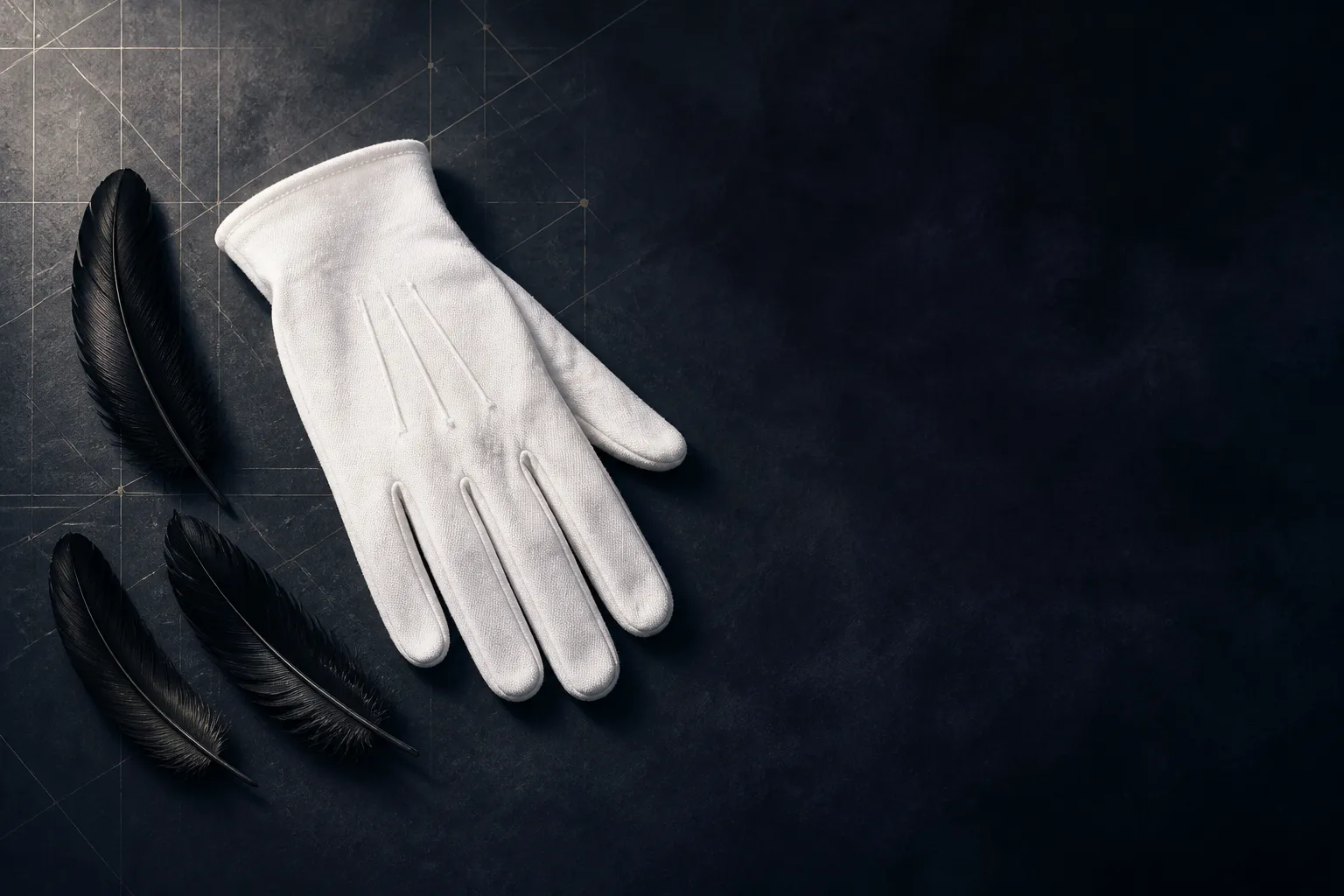
Imagine a white glove laid out as evidence. It has no bird inside it, and its color seems to belong to a different question altogether. Yet in a famous puzzle about evidence, the glove can count in favor of the claim that every raven is black. The oddity is not a trick of language. It presses on a harder question: what does it mean for an observation to support a claim?
Where the puzzle comes from: confirmation and its limits
Confirmation theory studies how evidence supports or undermines a hypothesis when the evidence does not guarantee that the hypothesis is true. In ordinary reasoning, evidence rarely closes every door. A record can fit several accounts; an observation can be compatible with more than one explanation. The task is to say when one piece of evidence favors a claim over its alternatives, not simply to note that the evidence and claim can coexist. The Stanford Encyclopedia of Philosophy’s account of confirmation describes the field as an effort to develop plausible models of this non-deductive reasoning.
That uncertainty is old. David Hume is usually credited with exposing the problem at its roots: many hypotheses can remain logically compatible with all the evidence we have. Evidence-based reasoning therefore remains fallible in ordinary circumstances. We may have good reason to believe something without having a demonstration that rules out every rival. A theory of confirmation must explain what makes evidence count for one account rather than merely fail to contradict it.
Carl Hempel made these questions central to the theory of science. His work on confirmation, induction, explanation, and scientific rationality shaped a generation of philosophers of science. In his section on scientific reasoning, the headings “The Paradox of Confirmation” and “The Equivalence Condition” point directly to the puzzle’s structure. Hempel’s broader method was to clarify vague concepts by asking what criteria an adequate account should meet. The raven case is one such test: a principle that sounds reasonable in the abstract produces a result that feels wrong in the hand.
The hypothesis and the intuitive test
Start with the sentence, “All ravens are black.” A black raven seems to support it. That bird is one of the things the sentence talks about, and its color matches the claim. The support is not proof: there may be another raven somewhere that is not black. Still, the observation appears to move in the right direction.
Now restate the claim. If every raven is black, then every non-black thing is a non-raven. The two sentences say the same thing in logical form. A white glove is not black, and it is not a raven. So it fits the second sentence: it is a non-black thing that is not a raven. By the equivalence condition, if logically equivalent hypotheses receive support from the same evidence, the glove appears to support the original claim too.
This is where intuition objects. The glove tells us nothing about the color of ravens, most people will say. It seems to be evidence about gloves, or perhaps about the contents of a drawer, but not birds. The tension matters because the argument has not shown that the glove proves anything. It asks whether the glove provides even some evidential support, however slight, and what standards we use to judge that support.
Why the glove might count, and why it might not
One response accepts the logical result and challenges the feeling of irrelevance. The glove is a non-black non-raven, so it is an instance of the equivalent formulation. It rules out one possible counterexample to “all non-black things are non-ravens,” and therefore, under this approach, gives a little support to the raven claim as well. The amount would be tiny: the observation concerns one object among the many things in the world, while the hypothesis is specifically about ravens.
The opposing response asks whether logical fit is enough. An observation can satisfy the wording of a claim without changing what we should expect about the subject. Before seeing the glove, we have no particular expectation about raven colors; after seeing it, our expectations about ravens may be exactly the same. On this view, the glove’s formal relation to the hypothesis does not make it useful evidence about birds. The question is not only whether the sentences are equivalent, but whether the observation should alter our confidence in the claim.
Neither reply makes the discomfort disappear. The first protects a tidy rule about equivalent hypotheses, while the second protects the sense that evidence should bear on what we are trying to learn. The disagreement is about what confirmation is meant to capture: logical relations, changes in expectation, or some account that can respect both. The discussion of Hempel offers a starting point for the paradox and the equivalence condition, though no single quick example settles what a full theory of evidence should say.
Lessons for everyday reasoning
The glove is useful because it makes a familiar mistake visible. We often collect observations that are compatible with a belief and treat compatibility as support. But a stronger question is whether the observation would look different if the belief were false. If it would not, then the observation may be a poor guide, even when it fits the claim’s wording.
For a general claim about ravens, the direct test is to look at ravens, especially for a raven that is not black. More black ravens may add to the record, but a single counterexample would defeat the universal claim. That asymmetry is a practical reason to ask what could show a belief to be wrong, rather than simply gathering more instances that agree with it.
The white glove does not settle confirmation theory. It gives the problem a small, graspable shape: an object that seems unrelated, a sentence that can be turned around without changing its meaning, and a feeling that the resulting evidence cannot matter. In an archive, a detail can open a question without answering it. Here, the glove is not a conclusion about ravens. It is a prompt to inspect the rules by which we decide what counts as evidence.
Sources
An exceptional writer at Deeperpectives, she covers public memory, family archives, and the histories held in ordinary objects. Before joining the desk, she cataloged oral histories for a neighborhood museum, where she learned to treat a small detail as a door, not a conclusion.