

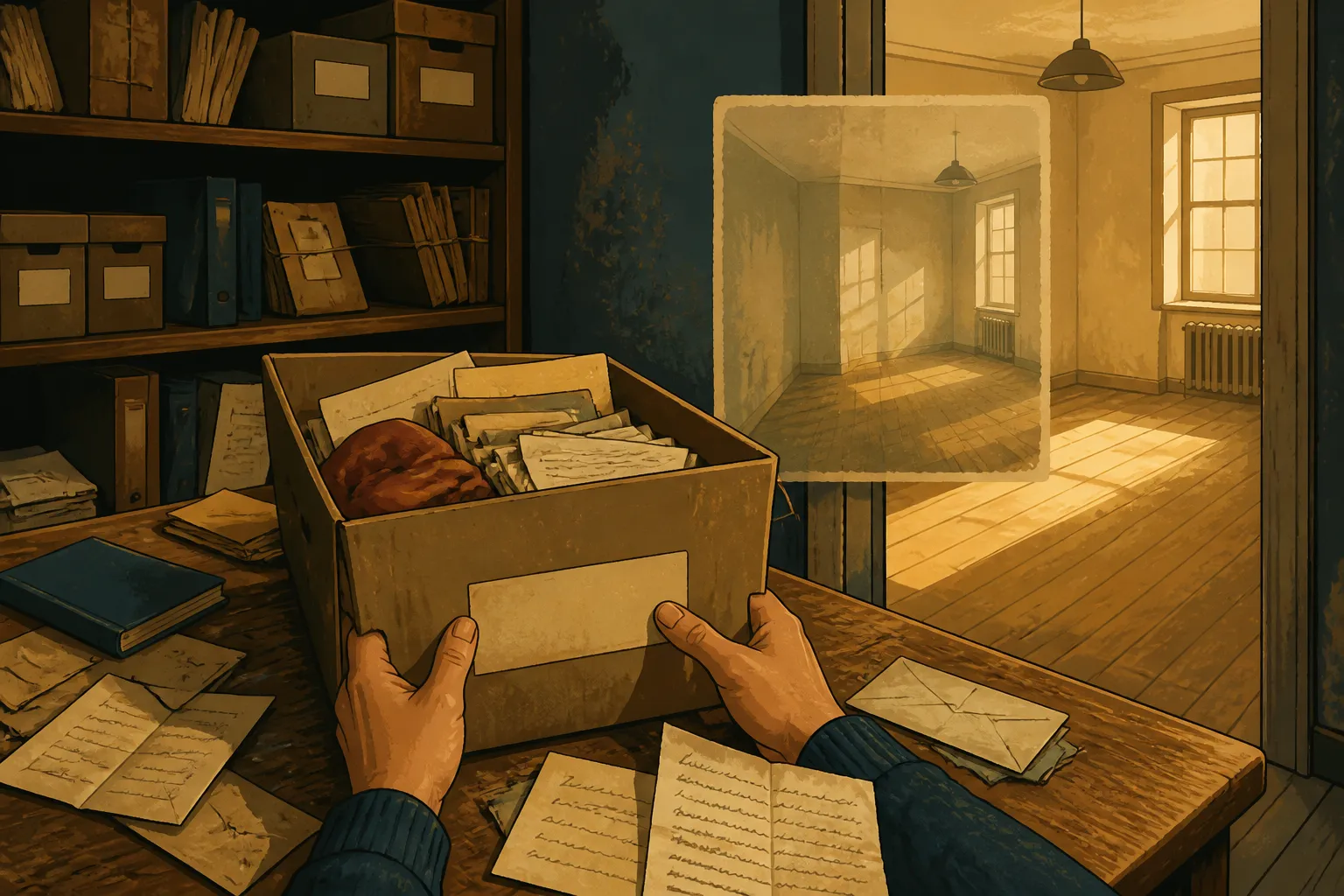
In an old archive, a box label can look like a promise: home. Inside are letters about a rented room, a family’s departure, and a place described years later as home. The word stays put on the page. What it points to may not. In a story, that small shift can change what a reader thinks the evidence has established.
When one word carries two jobs
The familiar name for one version of this problem is equivocation. In a simple argument, a term appears in a premise with one meaning and returns in the conclusion with another. The switch can make the conclusion seem supported when it is not. A story can stretch the same mechanism across pages: a word is introduced in one sense, then reused later as if it had kept its original meaning. Because the change is separated in time, the reader may not notice the hinge.
It helps to ask what kind of change has occurred. A shift in reference means the word points to a different person or thing. “The house” might first mean a particular building, then refer to the family living in it. A shift in sense changes the concept itself: “home” might move from a physical dwelling to a feeling of belonging. A shift in connotation keeps a core meaning but changes its emotional charge. “Order,” for example, might begin as a neutral arrangement and later sound like a demand for obedience. These are related, but they are not interchangeable explanations for a reader’s confusion.
Nor can a reader always tell whether the shift was planned. A writer may be using a word’s double life to reveal a character’s changing loyalties. Or the same effect may come from loose phrasing. From the reader’s seat, intention is not immediately visible. The first task is to notice that the word no longer fits the same frame.
A nearby research trail, not a direct answer
The closest research in the supplied sources concerns garden-path sentences. These sentences allow a reader to form one structural interpretation before later words point toward another. A reader may settle on the more frequent reading, then have to revise it when the sentence supplies disambiguating information. That is a useful parallel: early cues can shape an interpretation that takes effort to undo. But a shift in sentence structure is not the same as a word changing meaning across a story.
A study of garden-path sentences examined whether interpretations changed at the point of disambiguation or by the sentence’s end. It used reading-time measures and comprehension questions, and tested four language models: GPT-2, LLaMA-2, Flan-T5, and RoBERTa. The reported work included three experiments on question answering, implicit parse shifts, and attention to disambiguating information. The study also reports that some misinterpretations can linger after a sentence has clarified its structure. Read the study on incremental comprehension of garden-path sentences for its account of that work.
The parallel has limits worth keeping in view. The study looks at temporary syntactic ambiguity, not a word introduced with one meaning and reused with another much later. Its reported alignment between people and language models, especially when an extra cue such as a comma is present, is preliminary. The available text is truncated, so its examples and full discussion cannot be checked here. This evidence can suggest that early interpretations sometimes persist; it cannot demonstrate how readers handle meaning shifts across a narrative.
The small hinge in a long reading
Readers often commit to an early interpretation because it is efficient. Most sentences do not ask us to reopen every earlier choice. When new information arrives, revising a settled reading takes attention. That general pattern makes it plausible that a familiar word can carry its first meaning forward even after its role has changed. Plausible is not the same as tested: the sources here do not establish this process for mid-story shifts.
A reader can still make a careful check. When a repeated word seems to fit too smoothly, pause and ask what it named the first time. Is the later instance about the same object, the same concept, or the same emotional charge? Look nearby for a clarifying phrase, a boundary marker, or a change in who is speaking. Those are reasonable reading habits, not a method validated by the cited research.
Consider a fictional family account in which “home” first means a rented apartment. Later, a narrator says the family “went home” after returning to a country they had left. The phrase might point to a dwelling, a country, or a claim of belonging. The word alone cannot settle which. The surrounding details matter: a street address, a border crossing, a remembered voice. Each detail offers a different kind of evidence, and the reader should not let one familiar label do all the work.
What the record leaves open
The available sources do not directly define or illustrate a word changing meaning partway through a story. A San José State University Writing Center handout is listed as a source on garden-path sentences, but the supplied document text was unreadable, so its examples and advice cannot be reported. The research source concerns syntax. The central question here therefore rests on reasoning from a related field, not direct findings about narrative meaning drift.
That gap leaves practical questions unanswered. How often do readers notice a shift in reference, sense, or connotation? Which textual cues help them revise? When does a writer use the ambiguity deliberately, and when does it simply blur the claim? The sources do not answer these questions, and they offer no tested recovery strategy. Naming the limits matters because a nearby result can be tempting to stretch into a broader conclusion.
For now, the most reliable habit may be modest: return to the word’s first appearance, then compare it with the later one. Keep the two passages open together, as if laying paired letters on a table. If the word has changed jobs, the difference may show in what it points to, what it means, or how it asks the reader to feel.
A two-part check

Return to the first occurrence
In an archive, the label on a box is only a beginning. The letters inside can complicate it, and a later account can give the same word a wider reach. Reading with care means keeping those uses distinct long enough to see what the story actually supports. A word may remain unchanged in ink while the meaning around it moves.
Sources
- https://vertexaisearch.cloud.google.com/grounding-api-redirect/AUZIYQEHpscUcmX6BOcerObUOlBUSIgOD64m--BeE4s3DAGIRCZURgE0DUORqBtzKmuRcXa57h1odXFGM_5g-7hXq98UfTYPhbLt5mwcjn96q3EmdzmZGxo7_Hg0N3fd1u_ZjOByYau1YW_y3C8HEfUBd_y7tbxDEsLXRokLkwBP_976YpwVL0s=
- Incremental Comprehension of Garden-Path Sentences by Large Language Models: Semantic Interpretation, Syntactic Re-Analysis, and Attention
- Associated Press Stylebook
- New AP Stylebook features expanded artificial intelligence chapter | The Associated Press
- AP Style - Purdue OWL® - Purdue University
- What is a Zeugma? || Oregon State Guide to Literary Terms | Oregon State University
- What is a Trope? || Definition and Examples | College of Liberal Arts | Oregon State University
- https://vertexaisearch.cloud.google.com/grounding-api-redirect/AUZIYQHozxBQWE3ButFq4OQk7-7682EMn7vC3bHinjp-s4sFjO3NIlSh0vcOC9dniamXBmwVUvyzwkQD2I0w5ucBiln2G8rCPkHU2kZh7diskr8NEqisfJfbxg==
An exceptional writer at Deeperpectives, she covers public memory, family archives, and the histories held in ordinary objects. Before joining the desk, she cataloged oral histories for a neighborhood museum, where she learned to treat a small detail as a door, not a conclusion.