

Put twelve identical-looking coins beside a two-pan balance. One is counterfeit, and it may be heavier or lighter than the rest. The scale gives no number. It shows a tilt or a balance. Three weighings have to settle which coin it is and which way it differs.
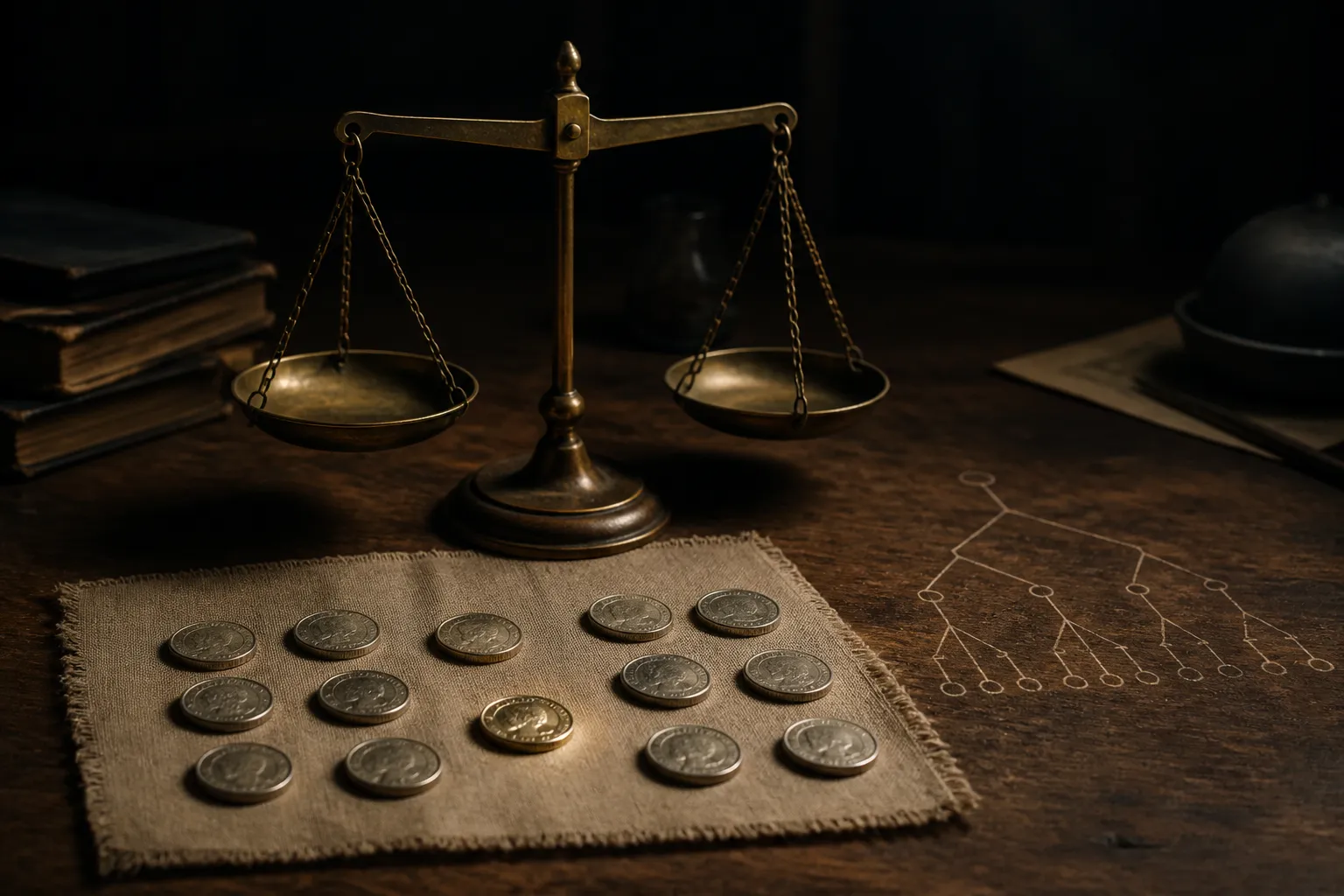
The puzzle as posed
The counterfeit has two possible identities. Coin seven might be the odd one and heavy, or the odd one and light. A solution that names the coin but not the direction is unfinished. Each weighing reports one of three things: left side down, right side down, or level.
The rules matter. There is exactly one counterfeit. The other eleven coins match. There are no reference weights, and you get at most three weighings. The puzzle appears as a practice-interview question that states these conditions. Change any of them and a working procedure can stop working.
Why the count comes first
Twelve coins, each heavy or light, give 24 situations. The final record of outcomes must separate all 24, because each one needs its own conclusion.
Three weighings with three outcomes each give 27 possible records. Twenty-seven is more than 24, so the puzzle is not ruled out by arithmetic. Two weighings give only nine records. Nine cannot label 24 situations, so two weighings cannot work. Three is the minimum.
Freeman Dyson showed in 1946 that twelve is also the ceiling. Thirteen coins cannot be resolved in three weighings under these conditions. Dyson also noted that thirteen can be done if you have one extra coin known to be genuine.
Two ways to build a procedure
The usual approach is a decision tree. The first weighing sits at the top. Each of its three results leads to a second weighing chosen for that result, and so on. The coins on the pans depend on what has already happened.
The NRICH-style opening shows the idea. Split the coins into three groups of four and weigh group A against group B. If they balance, the odd coin is in group C. Later weighings then compare coins from C against coins now known to be genuine. The NRICH write-up starts this way, but the sources here do not give the full tree in a checkable form.
The other approach is oblivious. All three weighings are fixed in advance, and you read the results together at the end. Dyson's 1946 solution is of this kind. It needs no branching at the scale, only careful bookkeeping of where each coin sat.
The labelling that makes the oblivious version work
The Dyson-Lyness scheme, described in the cut-the-knot treatments, uses base three. Give each coin a three-letter label built from A, B and C. Letter i says what happens to that coin in weighing i.
- A in position i: the coin goes on pan A.
- B in position i: the coin goes on pan B.
- C in position i: the coin stays off the scale.
Read the three results as a three-letter word too. C means the pans balanced. A means pan A rose. B means pan B rose.
Now decode. If the result word matches a coin's label, that coin is the fake and it is lighter. If the result matches the label with A and B swapped, called the conjugate, that coin is the fake and it is heavier. A lighter coin lifts its own pan, so its label reads out directly. A heavier coin does the opposite, so its swapped label appears instead.
This is where 24 of the 27 outcomes get used. The scheme leaves out AAA, BBB and CCC. The twelve coins take one label from each conjugate pair, so heavy and light results never collide. In practice the labels must also put four coins on each pan in every weighing. The sources give only an outline of this scheme and no full correctness proof, so I will not list a specific set of twelve labels here.
Checking any proposed answer
Whatever method someone offers, put four questions to it.
- Does it name both the coin and its direction in every case?
- Does each of the 24 situations end in a distinct conclusion?
- Does it quietly use a known-good coin? That is only allowed if the puzzle's conditions permit it.
- Does it stay within three weighings? Some puzzle sites present solutions that use four, and those fail the brief.
The check itself is plain. Write down every weighing and every outcome. Trace each of the 24 cases through the page. If every case lands on its own correct answer, the solution holds.
One caution on claims about thirteen coins. A blog post suspects that thirteen might work if direction need not be identified. Its author offers no proof, so treat it as a guess. Sources also differ on some attribution details of the puzzle's history. Marilyn vos Savant's 1993 algorithm for twelve balls in three weighings, listed by MathWorld, is one cited solution, though that entry does not lay out its steps here.
So yes, three weighings can find the counterfeit and say whether it is heavy or light. The count shows why three is the least that could work. The labelling shows how one fixed plan can carry all 24 cases.
Sources
An exceptional writer at Deeperpectives, she covers public memory, family archives, and the histories held in ordinary objects. Before joining the desk, she cataloged oral histories for a neighborhood museum, where she learned to treat a small detail as a door, not a conclusion.