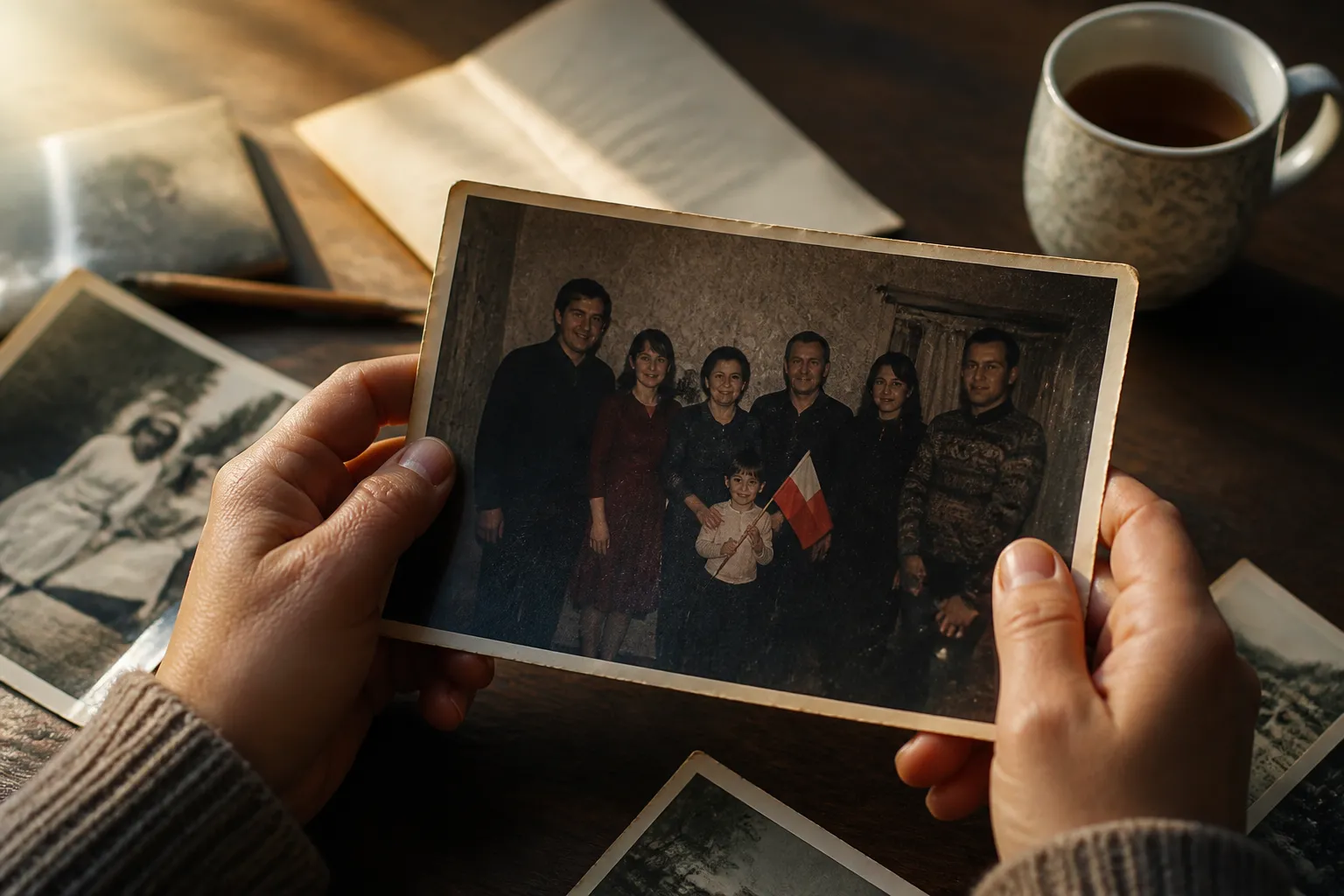
In a family photograph, the light can look unusually certain. A row of relatives faces the camera; a child grips a paper flag; the room behind them seems to hold its breath. Someone turns the print over and writes, “We always celebrated this way.” The picture makes the sentence feel settled. But it records one framed moment, not every day that came before or after it. Its vividness is real. So is the gap between what it shows and what we ask it to prove.
Why one photograph feels like enough
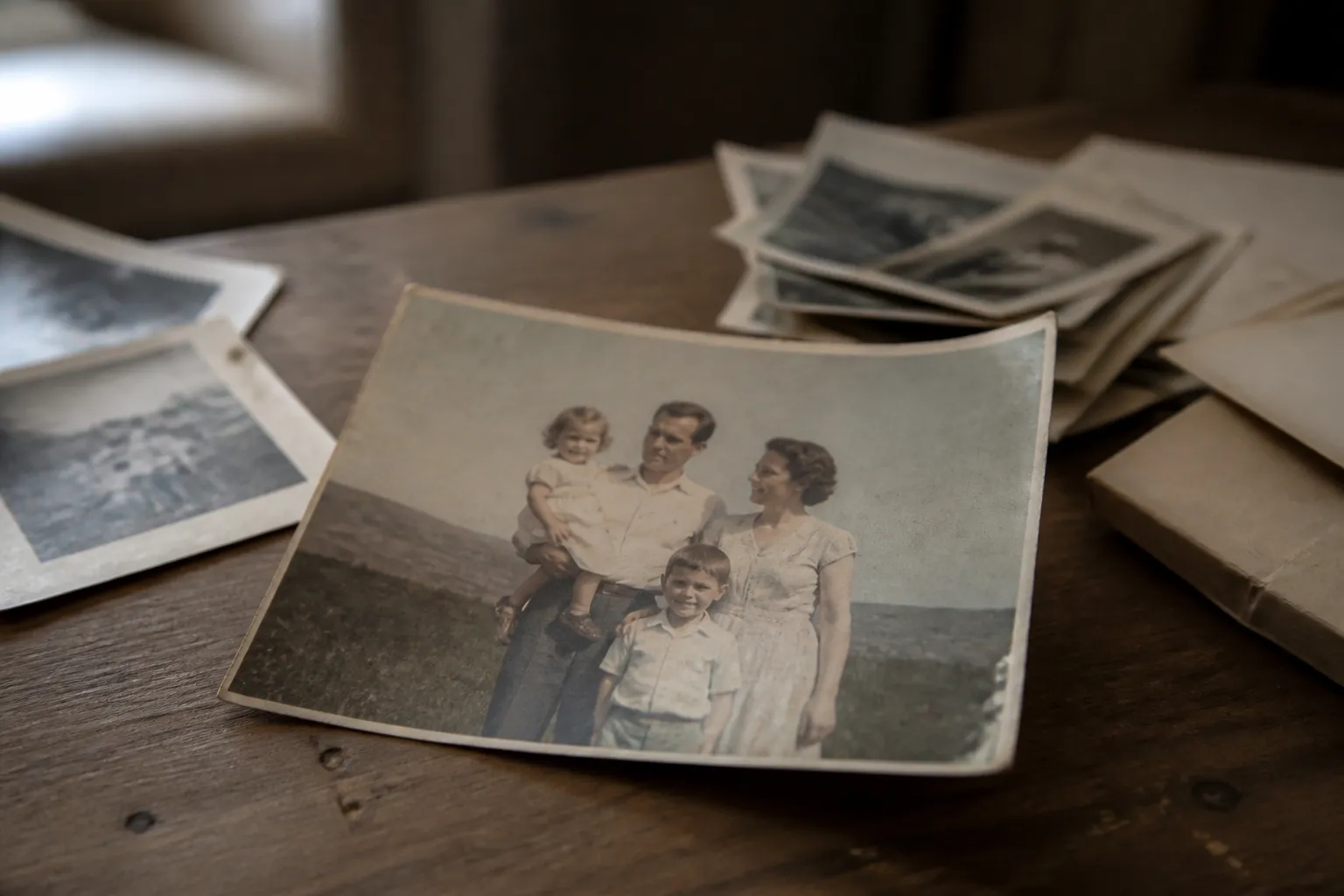
A photograph offers details that a general statement does not: faces, clothes, furniture, a particular gesture caught in time. The viewer can return to them, point them out, and feel close to the people in the frame. That intimacy can make an image seem more complete than it is. We see a table set for a holiday and begin to picture a whole family’s customs, or notice work clothes and infer what a neighborhood was like.
The inference may be worth exploring. The trouble begins when one case is made to carry a claim about many cases. That is the shape of a hasty generalization: moving from a limited example to a conclusion broader than the evidence can support. The photograph can be accurate about the people and objects it shows while remaining insufficient evidence for what “everyone” did, or what an entire era was like.
The guidance from the National Archives used here is written to teach people how to analyze primary sources. It offers a method for observing, contextualizing, and using evidence, not a ready-made rule for deciding when a family photograph represents a wider pattern. That distinction matters. Careful looking gives us better questions; it does not make the limits disappear.
Start with what the photo actually shows
The National Archives’ photograph worksheet begins with a quick scan: note what stands out, identify what kind of photograph you are looking at, and check whether it has a caption. Then list the people, objects, and activities visible. This small inventory slows the jump from detail to story. “Three adults sit beside a decorated table” stays closer to the image than “This family always gathered for celebrations.” The second may be true, but it asks the photograph to answer a question it cannot settle on its own.
Type matters, too. A posed portrait and a candid snapshot have different relations to the moment they preserve. A portrait may show people arranged for the camera; a candid may catch an unplanned gesture, though even an apparently spontaneous image has a frame and a photographer behind it. Neither kind is automatically more truthful. Each gives evidence of something different, and the caption, if there is one, may clarify or complicate what we think we see.
Try writing two short lists: what is visible, and what you are inferring. The first might include a uniform, a crowded doorway, or a hand resting on a shoulder. The second might include a claim about work, wealth, affection, or custom. Keeping those lists apart does not drain the image of meaning. It makes the path from observation to interpretation visible enough to examine.
Ask who made the picture and why
Next come questions of origin: who took the photograph, where and when it was made, what was happening at that time, and why the picture was taken. The Archives’ method asks readers to make sense of a source using evidence from the object and knowledge about its maker. A handwritten date, a studio mark, or a family note may help. So may a record that places the people or place in a particular historical setting. Each clue adds context; none should be treated as a magic key.
A camera records only what enters its frame, and a person decides when to raise it. A relative choosing to photograph a holiday meal is making a selection, even if the choice is affectionate and ordinary. The image may preserve a joyful gathering while omitting the argument in the kitchen, the empty chair, or the years when no one could afford a camera. Those absences do not prove a contrary story. They remind us that the photograph was made for a reason, by someone with a particular point of view.
The National Archives notes that perspective is shaped by a source-maker’s background, beliefs, and experiences. Applied to a family photograph, that means asking what the photographer could see, what they cared to record, and what they might not have thought to include. A family member’s picture is evidence of a family moment and of a choice about which moment to preserve. Those are related facts, but not identical ones.
Test the photo against other evidence
When the question reaches beyond the people in the frame, bring in other evidence. The photograph worksheet asks what the image shows that might not be learned elsewhere, and what other documents or historical evidence would help explain the event or topic. Letters, diaries, records, other photographs, and accounts from people who were there might each answer different questions. No one item automatically completes the picture, and a stack of sources is useful only when their dates, origins, and purposes are considered.
Suppose a picture seems to show that a family had a particular holiday tradition. Another photograph from a different year might suggest repetition. A letter could describe how the gathering was organized. A record might establish who was present. These materials would not all prove the same thing, and they might disagree. That disagreement is not a nuisance to smooth away. It can show that a practice changed, that one person remembered it differently, or that the family story was simplified in the telling.
There is no fixed number of photographs that turns a particular case into a representative sample. The teaching materials do not set a threshold, nor do they explain how to judge representativeness. So the claim itself needs calibration. One well-documented image can show that a moment happened, illustrate a possible pattern, or make visible a detail that totals and averages conceal. It cannot, by itself, establish how common that pattern was. Personal evidence deserves attention without being asked to stand in for everyone.
Make the questions a habit
Document analysis is a beginning, not an endpoint. The National Archives describes it as a foundation for using sources as historical evidence, and encourages readers to practice the same kind of careful analysis with every primary source they encounter. That repetition is useful beyond the archive. Each time an image feels conclusive, ask what part of the conclusion comes from the photograph and what part comes from the story around it.
A few questions can travel with the print: What do I notice first? What kind of photograph is this, and is there a caption? Who made it, when, where, and why? What evidence supports my reading of the photographer’s perspective? What does this image reveal that I might not learn elsewhere, and what else should I check? Finally, does one case support the size of the claim I am making?
These questions do not ask us to distrust family photographs. They ask us to give them the kind of attention they merit. A small detail can open a door into a larger history, but the door is not the whole house. The image keeps its force when we let it be specific: one family, one frame, one moment that may lead us toward a broader account, provided we keep looking.
For a practical starting point, see the National Archives’ photograph analysis worksheet and its broader document analysis guidance.
Sources
- Document Analysis | National Archives
- Analyze a Photograph | National Archives
- https://vertexaisearch.cloud.google.com/grounding-api-redirect/AUZIYQHW7skR6rTmY_RyrGQO_r06HG2d5YSWafPozXo0Imx2kU2HwNoC91_ob3wHW0zGwOCib2moNyb7cvFQWhCkQ94285e08416XizzbzqHlKKsqGwTKrySa6BnGkC9IL9Gzqk1m9vtcyG26N_TOJ2qjtQBM6sUYygjvPG4D74FoxpwRivScmH80ZV6IZSiZbNkHsrwwhs2MM8AqjbI6n7ofgcbZGEHWj6JCq3iRzHlwysvf-ZtSsZBUE4=
An exceptional writer at Deeperpectives, she covers public memory, family archives, and the histories held in ordinary objects. Before joining the desk, she cataloged oral histories for a neighborhood museum, where she learned to treat a small detail as a door, not a conclusion.